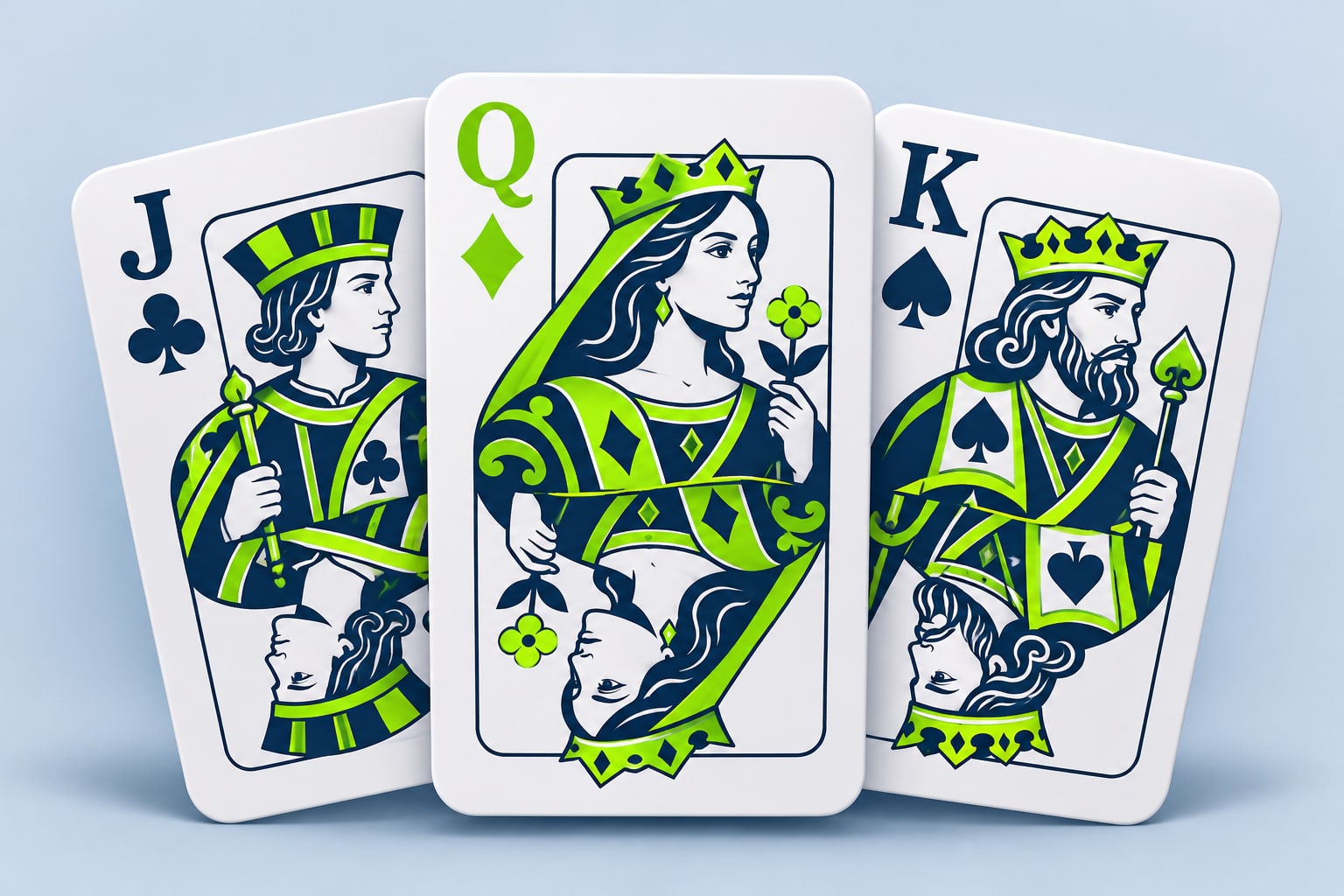
Face cards are the jacks, queens and kings in a standard deck. There are twelve in a fifty-two-card deck, and their game value depends on the rules; a ten is a ten-value card in blackjack but is not a face card.
Visual explainer
Twelve face cards, sixteen ten-value cards
One standard 52-card deck, with no jokers.
Face cards
12 of 52
Jacks, queens and kings.
Blackjack ten-value cards
16 of 52
12 face cards + 4 tens.
Poker keeps jack, queen and king as distinct ranks. Related: Rank · Blackjack.
The three pictured ranks
Face cards are the jack, queen and king of each suit in a standard playing-card deck. They are also called court cards because their traditional artwork depicts court figures. With four suits and three such ranks per suit, a standard fifty-two-card deck contains twelve face cards. The ace is not included in that category, even when a game's ranking puts it above the king. The ten is also excluded despite sharing the same point value as face cards in some games. Distinguish the category based on rank and artwork from the numerical value assigned by a particular set of rules.
Counting them in a standard deck
An ordinary deck has four jacks, four queens and four kings. If one card is selected uniformly from a complete standard deck, the probability of a face card is twelve out of fifty-two, or three out of thirteen. That is approximately 23.08 percent. This calculation assumes the complete deck and does not include jokers or nonstandard ranks. After known cards have been removed, the relevant counts can change. For example, removing a known king leaves eleven face cards among fifty-one remaining cards. The calculation depends on the actual available cards, not on whether a previous selection happened to feel lucky.
Blackjack groups them with tens
In standard blackjack scoring, jacks, queens and kings each count as ten points, as do the four ordinary tens. A complete standard deck therefore contains sixteen ten-value cards but only twelve face cards. This distinction matters when a rule, explanation or probability refers to any ten-value card. An ace with a qualifying ten-value card can form a natural blackjack under the game's rules, including an ace with an ordinary ten. Replacing ten-value with face card would wrongly exclude that possibility. Always check special rules about splitting, blackjack payments and particular card combinations rather than assuming equal point value makes every treatment identical.
Poker keeps the ranks distinct
In standard high-poker ranking, a king outranks a queen, which outranks a jack. Their shared face-card label does not make them interchangeable. A pair of kings and a pair of jacks are different pairs, and a jack cannot simply substitute for a queen to complete a straight. Suits and the full five-card hand must also be considered when identifying the category. A royal flush uses ten, jack, queen, king and ace of one suit, so it includes three face cards along with two cards outside the face-card category. The name of the category is therefore more specific than a collection of pictured cards.
Paying hands depend on the particular game
In Jacks or Better video poker, the minimum paying pair is normally a pair of jacks, with higher pairs also qualifying under the paytable. Two different face cards, such as a jack and a queen, are not a pair merely because both belong to the same broad category. Other video poker variants have different minimum awards or wild-card rules. A face-card symbol on a slot is different again: it is a symbol whose payment depends on that slot's own rules rather than a physical card drawn from a standard deck. Identify the game before applying a familiar card-game value.
Use the exact rank when explaining a hand
For clear instructions or hand histories, record the rank and suit when they matter. Saying that a player drew a face card leaves three possible ranks and four possible suits unresolved, which may be insufficient to determine a poker hand or special payout. In blackjack, ten-value card may be the right broader description if the distinction among ten, jack, queen and king does not affect the situation. Neither description alone tells a player the best decision without the rest of the rules and visible cards. Precise terminology prevents a simple category label from becoming an incorrect assumption about value, probability or strategy.