Escape is informal poker language for getting out of a difficult situation with limited damage. A helpful card or split pot may provide an escape, but the term is broader than a guaranteed chop; “escape cards” can also mean outs.
Informal language for avoiding a worse result
Escape is informal poker language for getting away from a difficult situation without suffering the loss that seemed possible. The exact meaning depends on the sentence. A player may escape cheaply by folding a strong-looking hand when it is beaten, or a later card may turn an apparent loss into a tie or a win. Specialist poker dictionaries also record usage about getting back to even after being behind. None of these meanings creates a formal game rule. It is more accurate to describe what happened than to assume escape always means receiving one particular kind of card or automatically splitting a pot.
When a shared board produces a tie
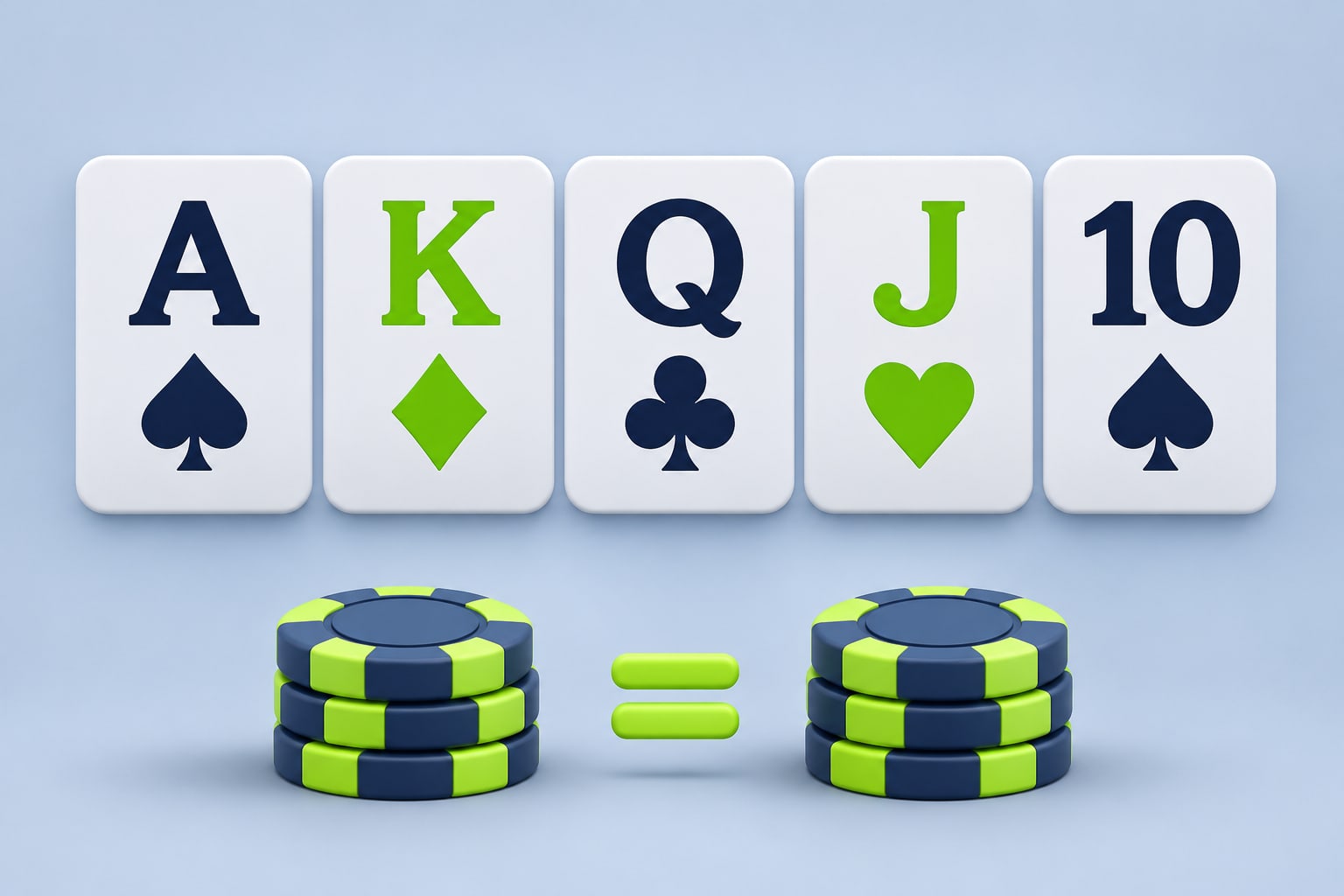
A split pot can be one form of escape. Consider a hold'em showdown where the final board is ace, king, queen, jack and ten, with no more than two cards of any suit on the board. Every remaining player can use the board's ace-high straight, and no player can form a flush from only two private cards under that suit arrangement. The best available high hands are therefore tied. Someone who appeared behind earlier may describe the river as an escape. The conclusion comes from comparing the legal five-card hands, however, not from the emotional description of the final card.
A helpful card may still leave a loser
A card that improves a hand does not necessarily make it best. Completing a straight can still lose to a flush, and making a flush can still lose to a higher flush or another stronger hand. A board card may help several players at once. This is why an apparent escape should be checked against the full board, the possible opposing holdings and the game's construction rules. A nickname for a useful card does not settle those comparisons. At showdown, identify the actual five-card hand and compare it correctly rather than treating improvement from the previous street as equivalent to winning the pot.
Escape cards and outs
The phrase escape cards can also be used for outs: unseen cards that could improve a hand enough to change its prospects. A clean out must do the required job under the circumstances being considered. Some apparent outs are compromised because they also improve an opponent, create only a tie or fail under a particular card-construction rule. Count cards rather than merely counting ranks, and state what result the calculation is intended to achieve. The chance of winning outright is different from the chance of avoiding a complete loss through a chop. Combining those outcomes without distinction can overstate the value of continuing.
A split is not always a profit
Receiving part of a pot does not automatically mean the hand produced a net gain. Compare the amount received with everything contributed, including any applicable charges. A player who receives half of a pot after contributing half may simply recover the contribution before costs. Side pots and more than two tied players can make the division more complicated. In high-low games, winning a share of one half is another distinct situation. Use the actual pot eligibility and settlement rules. Calling the result an escape may express relief, but it should not replace accurate accounting of how much was risked and how much came back.
Avoid treating relief as a strategy
Stories about dramatic escape cards can make unlikely recoveries especially memorable. They do not establish that a similar card is due in the next hand or that continuing from a weak position is automatically justified. The cost of calling, the available information and the possible outcomes need to be evaluated separately. Folding can also limit damage, and past money committed does not force a player to add more. Keep any spending limit independent of the desire to recover a particular pot or return a session to even. Escape is useful language for describing a result; it is not a promise that persistence will eventually produce one.