The board is the set of exposed cards relevant to a poker hand. In Hold’em it usually means the shared community cards; in stud it can mean an individual player’s visible cards.
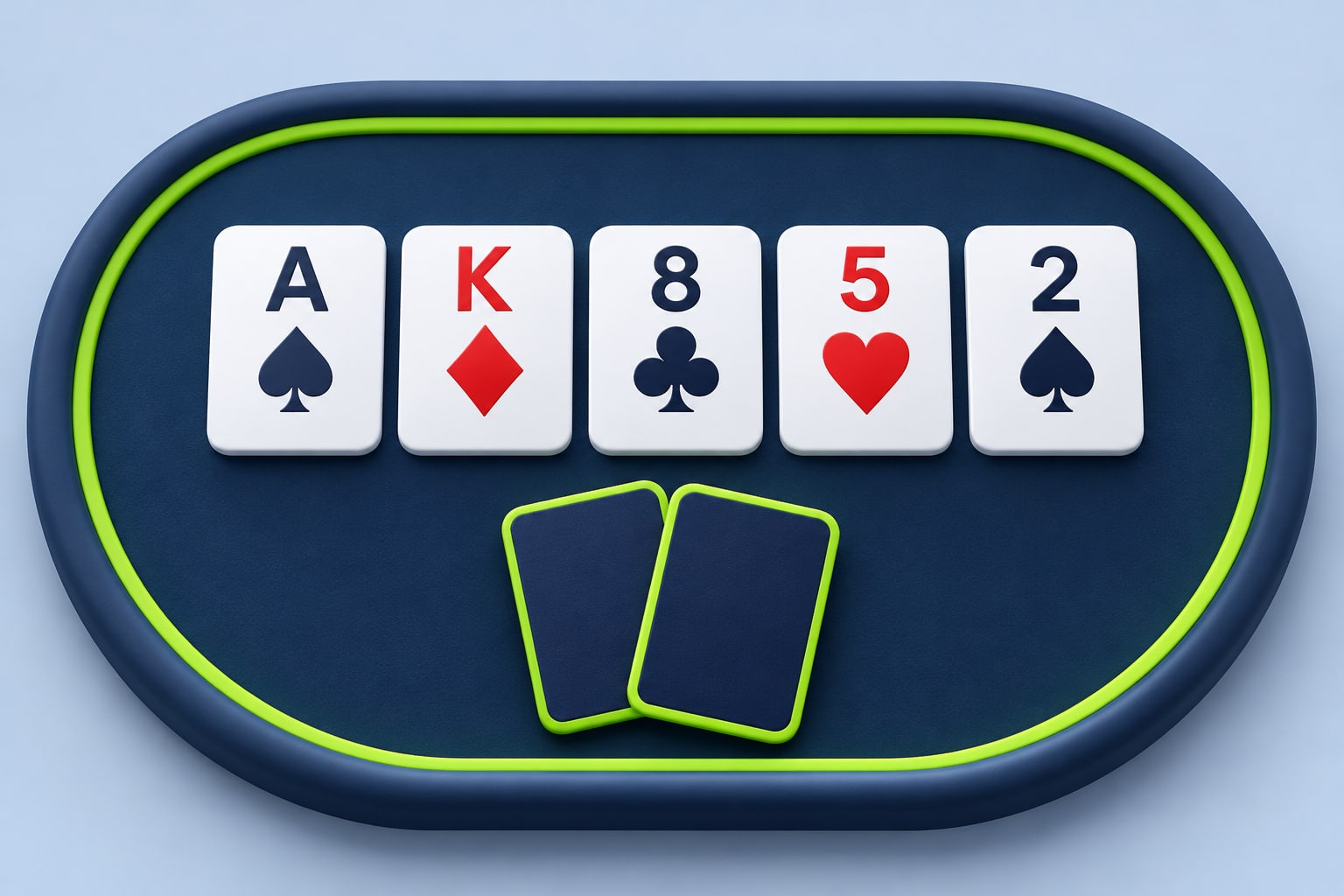
Community cards in Hold’em
In Texas Hold'em, the board normally means the community cards placed face up in the centre of the table. Every player still in the hand can use those cards together with their own two private cards to make the best permitted five-card poker hand. The board eventually contains five cards if the hand reaches the river, but it is not dealt all at once in ordinary play. The flop contains three cards, the turn adds a fourth and the river adds a fifth. A hand that ends earlier may have fewer board cards because all but one player have folded.
Reading a partial or complete board
The board is public information, but it does not reveal the private cards held by opponents. A pair on the board can help several players at once. Three cards of the same suit may create flush possibilities without proving that anyone has completed a flush. Connected ranks can suggest possible straights, but the exact cards and the game rules still matter. Describe what is visible before drawing conclusions. For example, saying the board contains two kings is an observation; saying a particular opponent has a full house is an inference requiring additional information. Keeping those two levels separate prevents overconfident readings.
Playing the board in Hold’em
In Hold'em, the best five-card hand can use both private cards, one private card or neither. When neither is needed, a player is sometimes said to play the board. If the board itself is the best possible five-card hand available to each remaining player, their main hand values can tie and the relevant pot is split under the rules. However, a strong board does not always force a split. A private card may improve a straight, complete a higher flush or supply a better kicker. Compare complete five-card hands rather than assuming that matching the board's headline category guarantees equal strength.
Omaha uses a different card-selection rule
The shared cards in Omaha are also commonly called the board, but the player must use exactly two private cards and exactly three community cards to make a hand under standard Omaha rules. This is different from Hold'em. A player cannot simply use all five board cards, and holding one card of a suit alongside four matching board cards is not enough for a flush without another matching private card. The familiar word board therefore does not establish the card-selection rule. Identify the variant before evaluating the hand. This distinction is especially important when switching between games in a mixed-game format.
A player’s visible cards in stud
In stud poker, board can refer to the exposed cards in front of one player rather than a shared set of community cards. Standard seven-card stud gives players a mixture of face-down and face-up cards, and each player's visible cards provide information about that player's possible hand. Those exposed cards do not ordinarily become available for every opponent to use. References to a strong board or the highest hand showing are therefore describing visible information in a different structure from Hold'em. Always ask whose board is being discussed and whether the cards are shared or belong to an individual hand.
Use the board without treating it as certainty
A useful reading of the board includes ranks, suits, possible completed combinations and plausible draws. It also recognises what remains unknown. Betting history and player decisions may add context, but they do not make hidden cards visible. On an online table, make sure the highlighted cards represent your actual best hand rather than merely an animation or example. If reviewing a disputed result, record the full board, the private cards shown and the game variant. The correct comparison follows from those facts and the hand-selection rules, not from which player appeared more confident during the betting. Visible cards are evidence, while an opponent’s hidden holding remains uncertain.