Dice is the plural of die. Casino craps uses two six-sided dice marked from one to six, but the word itself does not require exactly two dice or describe one particular game.
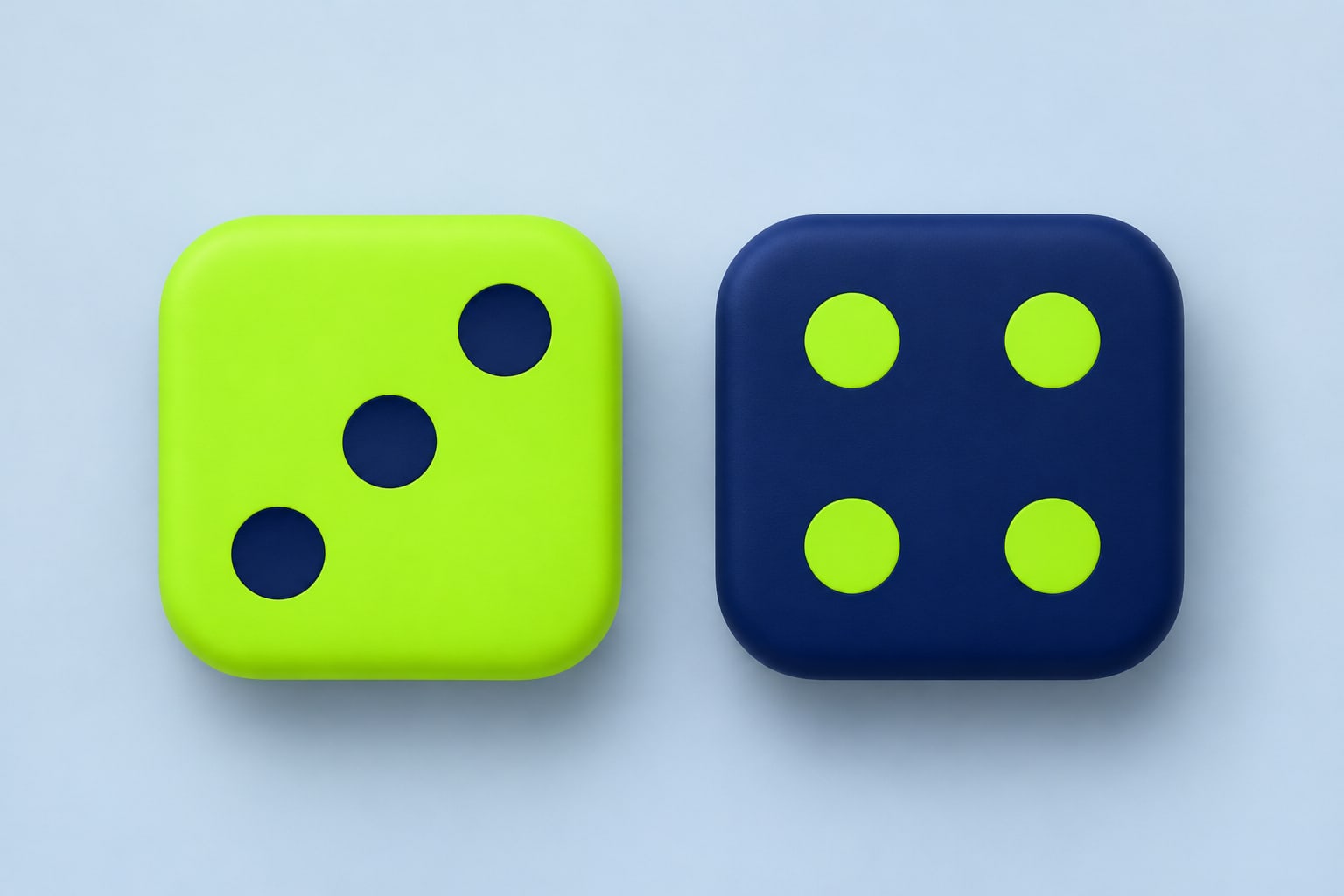
One die and several dice
A die is a single object used to produce a random result; dice is the plural. In ordinary casino craps, the equipment consists of two six-sided cubes marked with one through six spots, called pips. Other games can use a different number of dice or a different design, so the word dice alone does not specify a pair or a set of rules. A result can refer to the faces individually or their combined total. In craps, a six and a one total seven, but some proposition wagers distinguish a particular combination rather than covering every way to make that total.
Visual explanation
Seven has more combinations than two
Two independent fair six-sided dice produce 36 equally likely ordered pairs.
Total 21 of 36
1 ordered pair
Total 32 of 36
2 ordered pairs
Total 43 of 36
3 ordered pairs
Total 54 of 36
4 ordered pairs
Total 65 of 36
5 ordered pairs
Total 76 of 36
6 ordered pairs
Total 85 of 36
5 ordered pairs
Total 94 of 36
4 ordered pairs
Total 103 of 36
3 ordered pairs
Total 112 of 36
2 ordered pairs
Total 121 of 36
1 ordered pair
For example, 1+6 and 6+1 are different ordered pairs. These probabilities describe fair dice, not a prediction for the next roll. See craps.
Why totals have different probabilities
Two fair six-sided dice produce 36 equally likely ordered outcomes. The first die can show any of six faces, and each of those can be paired with any of six faces on the second die. Seven has six combinations: one and six, two and five, three and four, and the reverse of each. Two has only one combination, one and one. Consequently, a total of seven occurs with probability six in 36, while two occurs with probability one in 36. The possible totals from two through twelve are not equally likely, even though each individual face on a fair die is equally likely.
Ordered results and doubles
Order matters when counting equally likely outcomes even if a wager treats the two dice as interchangeable. A four and a two can occur in two orders, while three and three occurs in only one. Both totals equal six, but their probabilities differ when considered as individual combinations. In craps, a hard six specifically means three and three; an easy six uses four and two or five and one. This distinction affects wagers that depend on doubles or specific combinations. Count the actual qualifying ordered outcomes rather than assuming that every visual arrangement with the same total has the same probability.
The same total can settle bets differently
Craps rules give meaning to dice results according to the wager and stage of play. Seven wins a standard Pass Line bet on a come-out roll but loses it after a point has been established. A Field wager, an established Come bet and a Don't Pass wager have their own conditions. Therefore, seeing the dice total is only the beginning of interpreting the result. Identify the active bet, whether a point exists, and whether the bet is working. A dealer's announcement provides a useful cue, but the published rules determine settlement rather than the excitement or disappointment of other players around the table.
Physical dice and simulated results
A live game may use physical dice thrown under the table's procedures, while an electronic game can generate a result and animate dice on a screen. The animation is a presentation of the result, not necessarily a physical process that can be influenced by timing a click. Check whether the game uses a live feed, a random number generator or another disclosed mechanism. Rules may also explain invalid physical throws, dice leaving the table and how a valid result is called. Do not assume that a decorative image proves fairness or that a particular throwing gesture guarantees control over regulated game outcomes.
Independence and responsible interpretation
For independent fair throws, previous totals do not alter the probability distribution of the next throw. Several sevens in a short period can occur without making another total due, and a long gap without seven does not force one to arrive immediately. A sequence can look unusual while remaining possible under the rules of probability. Assess a game through its rules, oversight and available evidence rather than a short personal streak. Understanding dice combinations helps explain payouts and house edges, but it does not remove uncertainty. Set spending limits before play and avoid increasing stakes to recover losses based on a belief that the dice must soon compensate.