An RNG supplies random values used by digital games. Rules map those values to outcomes; randomness alone does not establish payout or operator reliability.
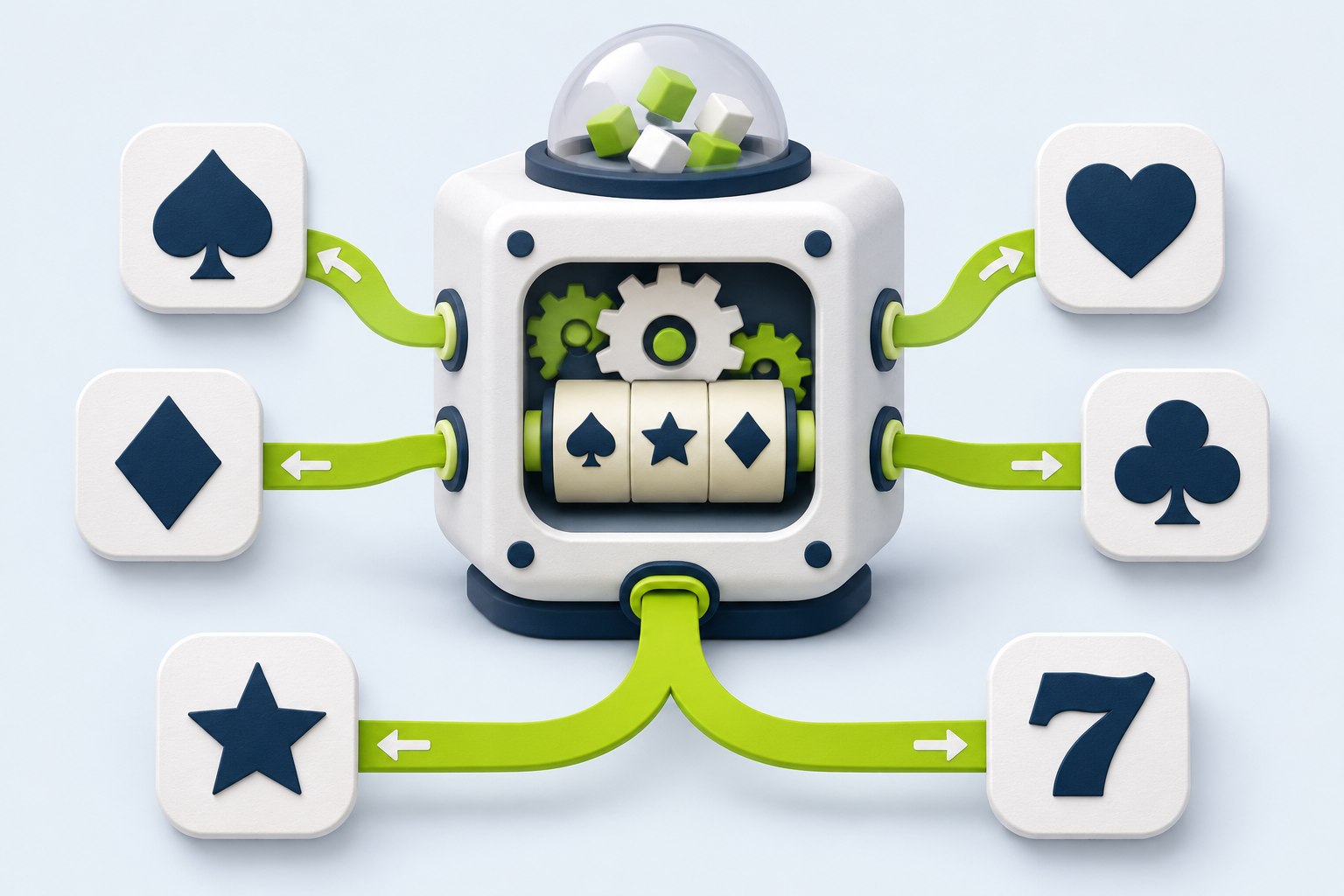
At a glance
Random values still need game rules
Randomness and the payout schedule perform different jobs.
1 · Generate
Random value
The RNG provides an input.
2 · Map
Game outcome
The game maps that input to a defined outcome.
3 · Settle
Applicable award
The rules determine the return for that outcome.
Random does not mean every prize is equally likely. The paytable describes awards; RTP concerns the expected return across the outcome distribution.
What a random number generator does
An RNG, or random number generator, produces values used by a game to select outcomes according to its design. In online casino games, those values can determine cards, reel positions, dice results or other events. The visible animation then presents the selected result. The RNG is an important part of fairness, but it is not the entire game: mapping, payout rules and implementation also matter.
Many systems use a pseudorandom algorithm that expands an initial state into a sequence designed to meet specified statistical and unpredictability requirements. Other designs can incorporate physical entropy sources. Calling a process random does not mean its software has no structure. The relevant question is whether the complete implementation meets the applicable requirements and produces outcomes with the intended probabilities.
Random does not mean equally likely
A fair mapping can assign different probabilities to different outcomes. With two ordinary dice, for example, seven is more likely than two because more combinations produce it. A slot can likewise use a distribution in which some symbols or awards are rarer than others. Random selection therefore should not be confused with every displayed symbol or prize having an equal chance.
The paytable and outcome probabilities together determine theoretical return. An RNG can operate correctly while the game retains a house edge. Conversely, a claimed high RTP does not by itself prove that the random process has been implemented or tested properly. Fairness of selection and generosity of payouts are related parts of the overall game assessment, but they answer different questions.
Testing and regulatory standards
Regulated markets can require testing against technical standards covering matters such as randomness, unpredictability and correct implementation. An independent laboratory may assess a defined game version or system against specified requirements. The scope, date and identity of the tested product matter. A generic testing badge should not be taken as evidence that every game on a website has been examined under the same standard. [1]
Testing is also distinct from licensing the casino operator. A software certificate does not authorize a business to accept customers everywhere, and an operator's license does not mean every customer outcome is individually approved by the regulator. Check the responsible entity and the relevant product evidence separately. Misleading or unverifiable references to testing should be treated as unresolved claims rather than automatically accepted assurances.
Sequences and personal experience
Random outcomes can contain streaks, repetitions and clusters. A run of losses or several identical results is not, by itself, proof of manipulation. For independent rounds under unchanged conditions, earlier outcomes do not create an obligation for the next one to compensate. A game can have a stable theoretical distribution while producing a short session that looks very different from its long-run average.
At the same time, saying randomness can look unusual does not dismiss every technical concern. A suspected error should be investigated using round records, rules and relevant system evidence. Personal observation can identify a question worth asking, but a small sample rarely establishes the complete probability model. Claims of fairness or unfairness should be matched to the quality and scope of the evidence available.
RNG games and live games
A streamed physical table may use cards or a wheel rather than an RNG for its principal result, while still relying on software for other functions or features. Some game shows combine physical and digital processes. The word live does not remove the need to understand which mechanism determines each award. Likewise, a realistic animation does not prove that a physical event occurred behind it.
When evaluating a game, identify the supplier, version, rules and relevant testing information. Keep the operator's payment reliability and licensing separate from the technical question of outcome generation. An RNG is a component that selects values; its role has clear limits. Randomness does not guarantee a win, a fair withdrawal process or a particular return on the next session. Those questions require different evidence.