True odds express the mathematical likelihood of an outcome or the fair payout corresponding to it. A payout at true odds has zero expected advantage before fees under the stated assumptions, but the wager can still lose.
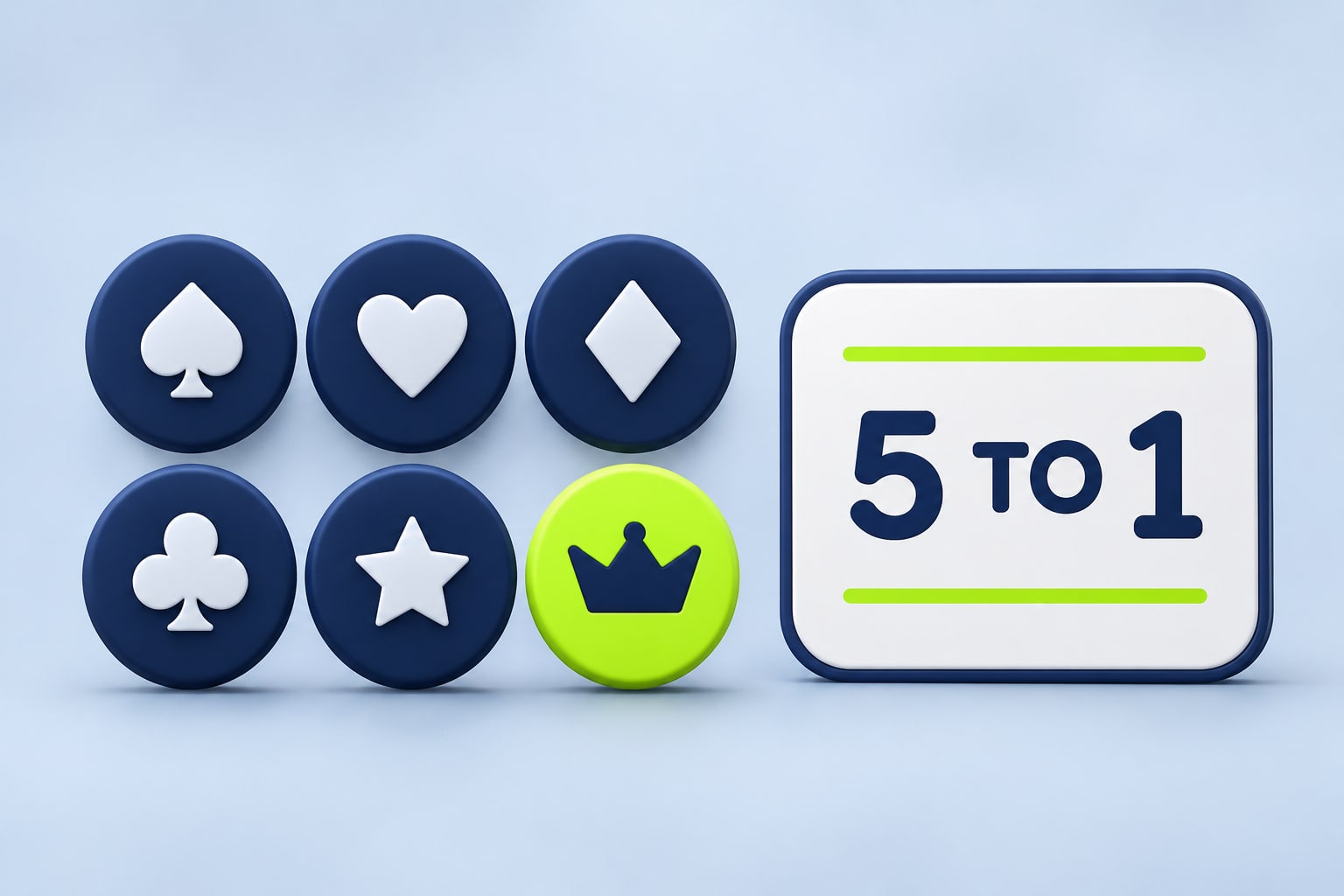
KeyToCasinos • Visual explainer
True odds balance probability and payout
Illustration: one chosen face of a fair six-sided die wins; the other five faces lose.
Win probability
1 in 6
Approximately 16.67%.
Fair profit payout
5:1
A $1 win earns $5 profit; a loss costs $1.
Expected net result
$0
(1/6 × $5) − (5/6 × $1) = $0 before fees.
Zero expected advantage does not prevent losing streaks or loss of the stake. This example assumes equally likely faces. Related: Odds · Expected value.
Probability and odds describe the same uncertainty differently
True odds refer to the mathematical relationship between an event and its alternatives under a stated model. If one of six equally likely outcomes wins, the probability of winning is one sixth and the odds against winning are five to one. The five represents losing possibilities and the one represents the winning possibility. Those expressions are related but not interchangeable without conversion. A phrase such as one in six describes probability, while five to one can also be used to describe a profit payout. Clarify whether a page is discussing the chance of the event or the money paid when it occurs.
A fair payout balances the expected result
For that illustrative one-in-six event, a five-to-one profit payout produces zero expected gain or loss before fees. A one-unit wager wins five units of profit on one outcome and loses one unit on each of the other five outcomes. The probability-weighted net calculation is one sixth times five minus five sixths times one, which equals zero. The winning payment also returns the original stake, giving six units returned in total. A payout of only four units of profit would fall below the fair level. This example assumes equal outcomes and no ties, commissions or other conditions affecting settlement.
Craps odds wagers provide a familiar example
After a point is established in ordinary craps, an eligible odds wager behind a pass or come bet can pay the mathematical odds of that point occurring before seven. The standard profit ratios are two to one on four or ten, three to two on five or nine, and six to five on six or eight. These are conditional comparisons between the point and seven, not the probability of rolling the point on the very next throw. Other totals can occur without resolving that odds wager. Use the actual table's rules, allowed increments and odds limits when interpreting the amount paid.
The underlying wager remains separate
The zero expected house advantage on a correctly paid odds portion does not erase the disadvantage of a required underlying pass or come wager. Adding an odds stake can reduce the house-edge percentage measured against the combined amount, while increasing the amount exposed to a losing resolution. Those are different effects. A player who puts more money behind the same base wager has not obtained guaranteed protection from loss. Keep the base stake and odds stake separate in the explanation, and use a consistent denominator when quoting percentages. Otherwise a lower combined percentage can be mistaken for a lower possible monetary loss.
Fees and rounding can change the result
A wager described as paying true odds may also charge a commission or apply payment increments that matter to the final amount. A buy or lay bet with a fee is not automatically equivalent to a no-commission odds wager. Calculate the entire transaction, including when the fee is charged and whether a stated payment is rounded. Likewise, the claimed probability must match the actual event being bet. A one-roll dice proposition and a point-before-seven wager have different resolution rules. A familiar number in an odds table is not enough without the event, payout convention and relevant costs.
Fair does not mean safe or predictable
A zero-edge wager can still lose its entire stake, and repeated play can produce substantial swings around the average. True odds do not tell a player which outcome will occur next or imply that losses must be recovered within a fixed number of attempts. The term is useful for comparing a payment with its mathematical benchmark, not for promising a winning session. In a clear explanation, state the possible outcomes, their probabilities, the net payout and any additional cost. That makes the fairness of the payment understandable while keeping the actual amount at risk and uncertainty of the result visible.