Back-to-back means consecutive events with nothing relevant between them. In card-game language it can describe matching ranks or suits dealt consecutively; in wider gambling discussion it can describe successive wins or tournament results.
Consecutive is the central meaning
Back-to-back describes events occurring consecutively within the sequence being discussed. In card-game vocabulary it can refer to cards of the same rank or suit arriving one after the other. In wider poker reporting it can describe winning two tournaments in succession or obtaining the same result in consecutive hands. It is not a separate hand-ranking category or a wager with one universal payout. The sentence must identify what occurred, whose sequence is being counted and whether the events were genuinely consecutive. Without that context, the phrase provides less information than simply naming the two results and their order.
A card-dealing example
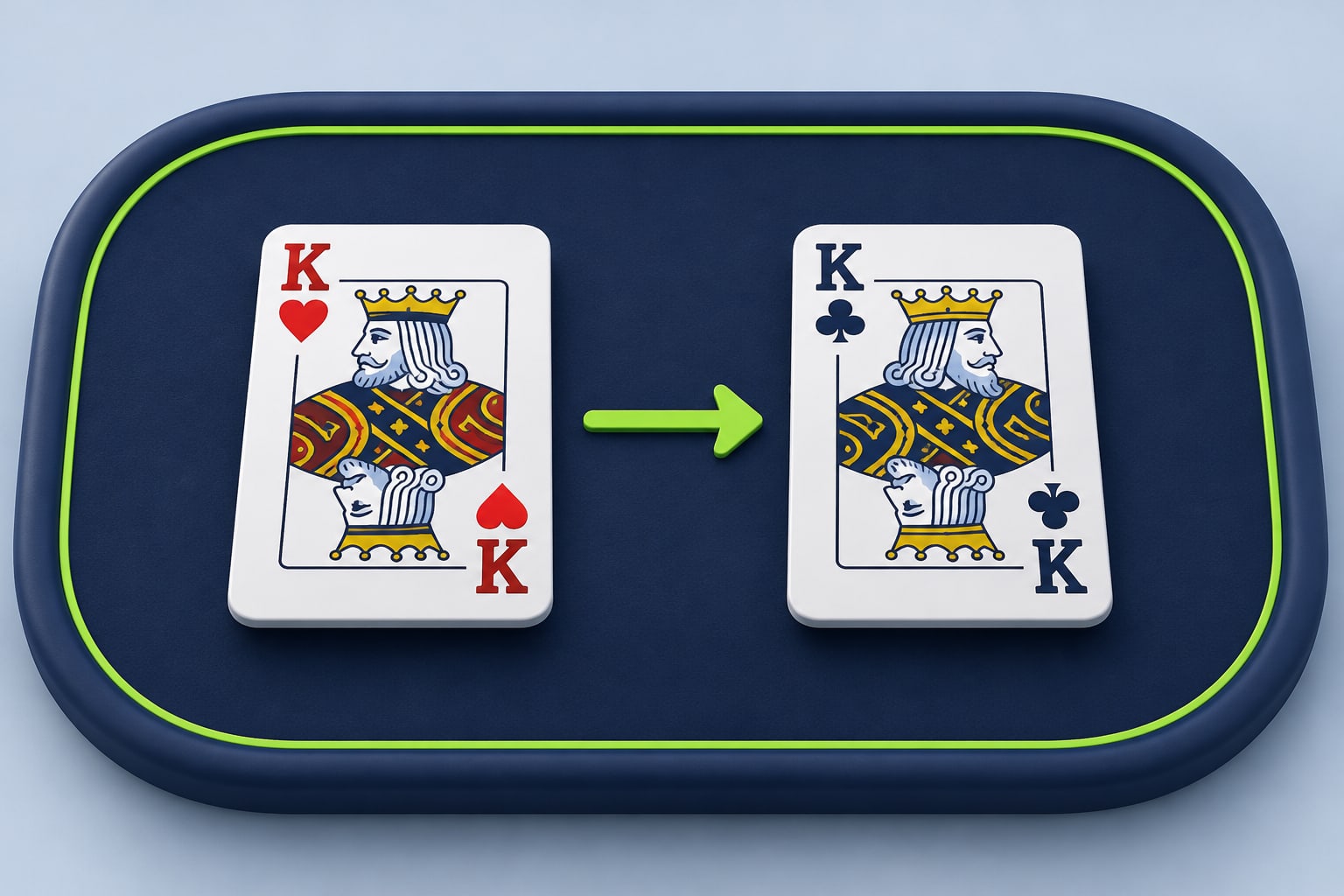
Suppose a player receives a king of hearts followed by a king of clubs as the relevant consecutive cards in a deal. They match in rank and can be described informally as back-to-back kings. Two consecutive hearts instead match in suit, even if their ranks differ. Those are different observations. Matching suits do not make a pair, and matching ranks do not make a flush. The game's normal rules determine the value of the resulting hand. The description of how the cards arrived does not create a bonus award unless the particular game explicitly offers one for that event. A normal pair is evaluated by its rank, not its arrival order.
Clarify which dealing sequence is meant
At a multi-player table, cards may be distributed around the seats, so a player's first and second cards are not necessarily consecutive cards out of the deck. A report may use back-to-back to mean consecutive cards received by that player rather than adjacent cards in the physical dealing order. Those interpretations can matter if someone is discussing probabilities or reconstructing a hand. Use precise wording when the distinction is relevant. State that the player received two kings, or that two kings left the deck consecutively, instead of assuming the casual phrase communicates the same sequence to every reader.
Consecutive results do not create a new rule
A player might win back-to-back hands, receive two consecutive blackjacks or win an event in successive years. Each statement describes a past sequence. It does not by itself establish a higher probability of the same outcome next time. Whether events are independent depends on the actual game process. Cards dealt from an unshuffled remaining deck are not the same model as fresh independent rounds, so neither a blanket streak claim nor a blanket independence claim should be applied without context. The phrase alone supplies no mathematical model and no evidence that a future wager is due to win or lose.
Different from a backdoor draw
Back-to-back should not be confused with backdoor, a poker term for a draw that requires suitable cards on both later streets, such as the turn and river. A backdoor flush can be completed by two successive cards of the required suit, but the terms describe different aspects of the situation. Backdoor identifies what the draw needs from its current state, while back-to-back describes the sequence in which events occurred. A player can receive consecutive matching cards without having started with a backdoor draw, and a report of back-to-back tournament wins has nothing to do with drawing cards at all.
Prefer the actual cards and outcomes in a record
For a hand history, record the ranks, suits, street and action rather than using back-to-back as a complete explanation. For tournament reporting, identify the events and dates so the consecutive claim is clear. For a casino session, separate each wager and return instead of treating a brief winning sequence as evidence of a reliable method. Repeated results can be memorable without being predictive. The practical value of the term is its concise description of order. It does not change a hand's rank, override the paytable or justify increasing the next stake beyond a spending limit chosen before the sequence began.