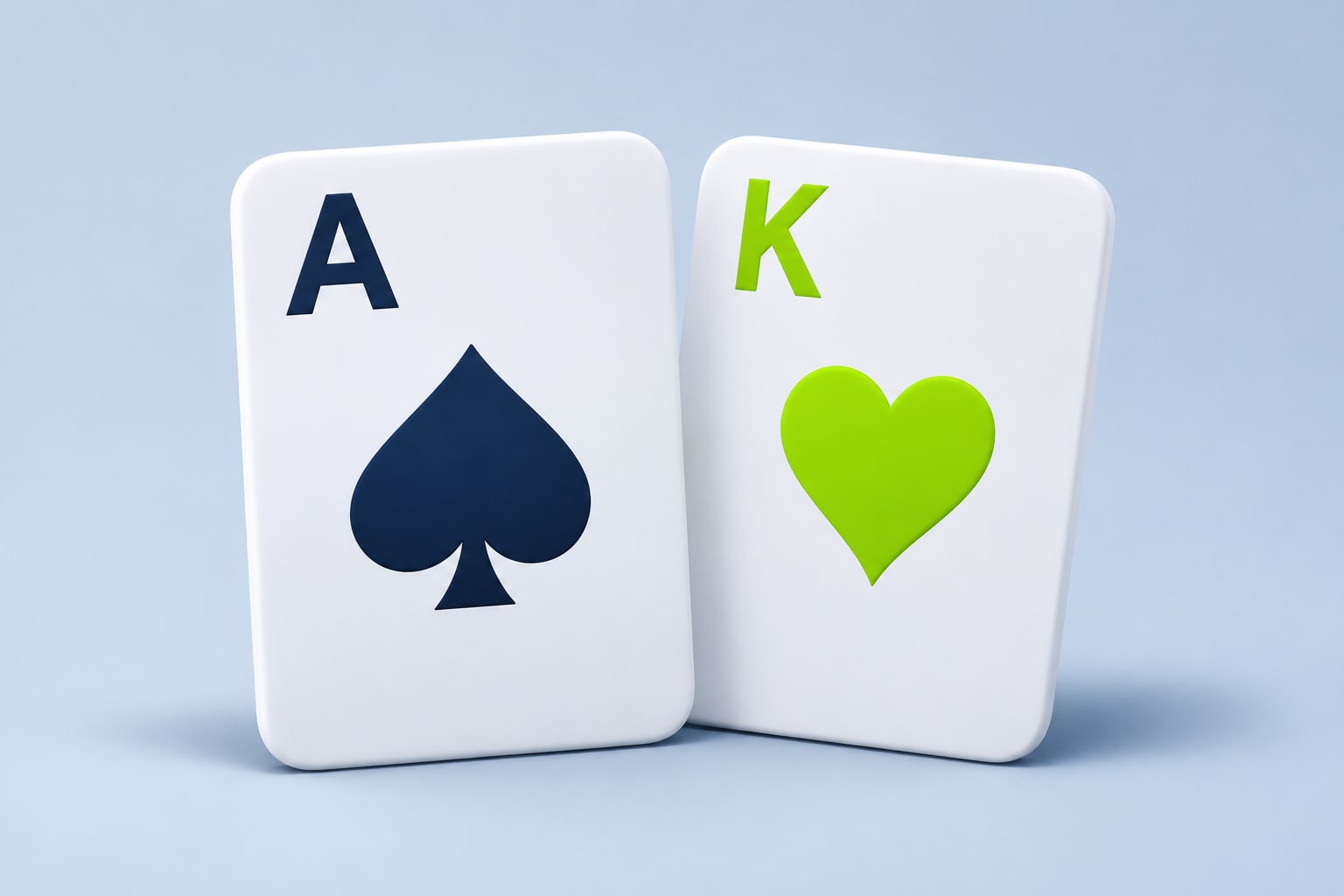
Off-suit describes cards from different suits. In Texas hold’em it commonly refers to two starting cards that do not share a suit, such as an ace of spades and a king of hearts.
What the description tells you
A standard deck has four suits: clubs, diamonds, hearts and spades. Two cards are off-suit when their suits differ. Their colors can still match: a club and a spade are both black but belong to different suits. Conversely, color is not an alternative fifth suit or an extra hand-ranking category. The term tells you one feature of the cards, not their complete strength. An ace and king of different suits can be a strong starting combination, while two low disconnected cards of different suits have quite different possibilities. Rank, position, opponents and betting conditions remain relevant. Identifying the suits correctly also prevents mistakes when reviewing a hand history or comparing a chart with the cards actually dealt.
Reading common starting-hand notation
Poker charts often use a lowercase o to mark an off-suit hand, as in AKo for ace-king off-suit. A lowercase s usually means suited, as in AKs. A pocket pair is commonly written as two matching ranks without either suffix, because two cards of the same rank cannot share a suit in an ordinary single deck. Notation is shorthand, so read any chart's legend before using it. A recommendation for a suited hand should not automatically be copied to its off-suit counterpart. Even when both hands are playable, their potential and the situations in which they are selected can differ.
How combinations affect frequency
For two different ranks in a standard deck there are sixteen possible two-card suit combinations before any cards are known. Four are suited and twelve are off-suit. Ace-king therefore has twelve off-suit combinations and four suited combinations in an untouched deck. This is a counting fact, not a statement that the off-suit hand wins three times as often. Once particular cards are known, some combinations are no longer available. Analysts use these counts when describing ranges because a category with more combinations can represent more actual hands, even if its label occupies the same space in a starting-hand chart.
Flush possibilities and the final hand
Off-suit hole cards cannot both belong to one five-card flush. A hold'em player can still make a flush using one hole card and four community cards of that suit, or use a five-card flush entirely on the board where the rules permit. The final hand is evaluated from the best legal five-card combination, not from the starting-hand label. Having suited cards creates additional flush possibilities but does not guarantee a flush, and a small flush can lose to a higher one. In other poker variants, the required number of hole cards can change which combinations are legal, so the game's rules matter.
An example with ace-king
Consider an ace of spades and a king of hearts. The hand is ace-king off-suit. If the board contains an ace, the player may have a pair of aces, with the remaining cards determining the best five-card hand. If the board produces a straight, flush or stronger combination, the final evaluation can be different. The original off-suit description remains accurate but does not settle the contest. An opponent can also hold a hand that improves differently on the same board. This is why a familiar starting-hand name should not replace reading the actual community cards and possible competing hands.
Using the term without overstating it
Off-suit is descriptive, not a direction to fold every such hand or to play every suited alternative. Starting decisions depend on the game format, action already taken, stack sizes and position. Charts are written for particular assumptions, and a cash-game chart may not fit a tournament situation. For beginners, the first useful skill is simply to distinguish ranks, suits and colors correctly and understand the notation being used. Keep the amount at risk within an affordable limit, and avoid treating a strong-looking starting hand as a promised payout. Different suits are one piece of information among several, not a complete strategy.