Bullets is a nickname for a pair of aces. Aces wired can describe an initial pair of aces, especially in stud; usage varies and does not always mean both cards are concealed.
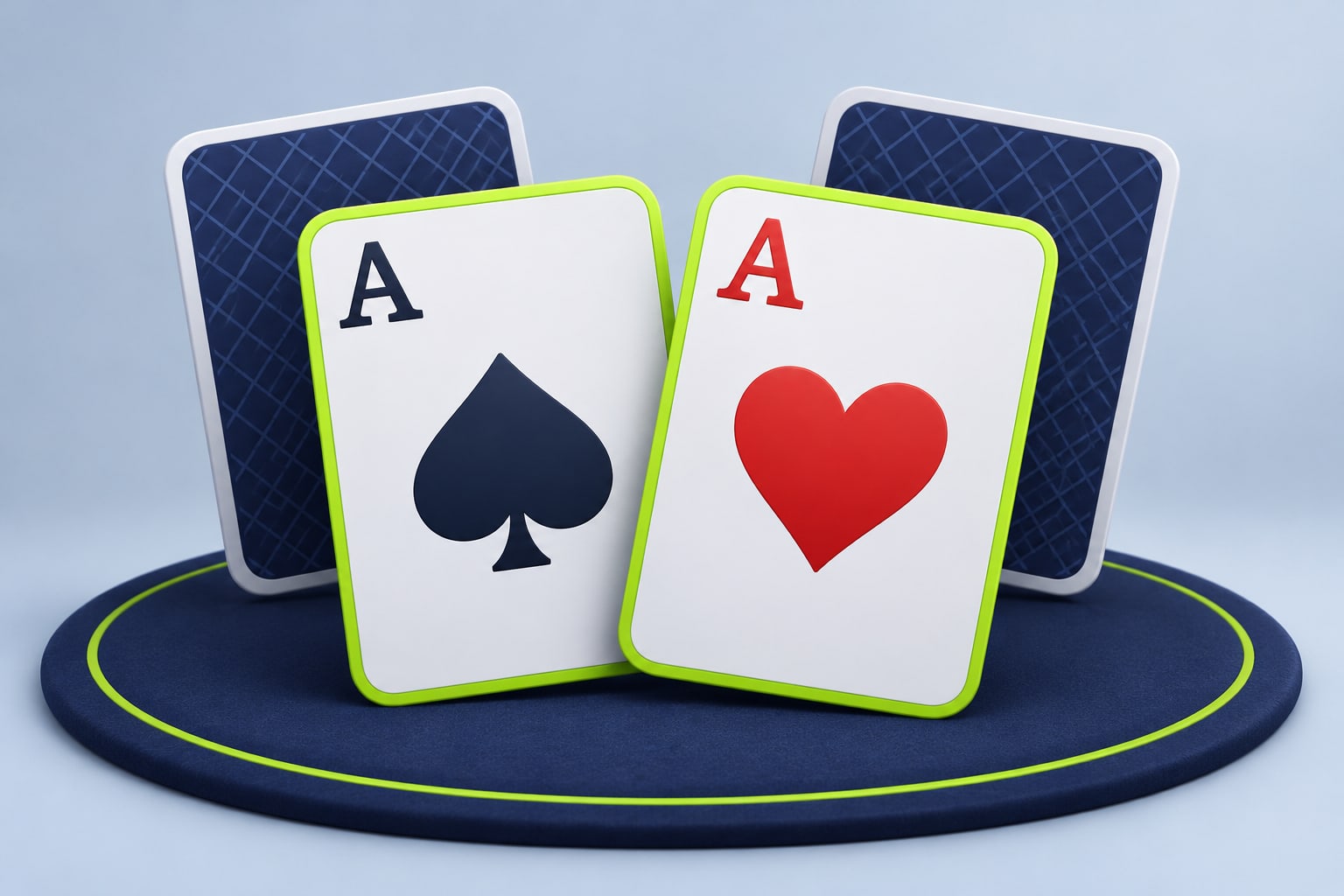
Two expressions for a powerful starting pair
Bullets is a common nickname for a pair of aces, especially the two private starting cards called pocket aces in Texas hold'em. Aces wired is an older expression whose use varies across poker settings. In stud terminology, wired can describe a pair among the initial cards, including one face down and one face up, or a pair in the first two concealed cards. It should therefore not be defined exclusively as hidden aces. Neither expression changes the official hand rankings. When reading an old report, identify the poker variant and the cards' positions before assuming that the phrase describes precisely the same arrangement as a modern hold'em deal.
Visibility depends on the poker variant
In seven-card stud, the initial deal includes two concealed cards and one exposed card. Two aces in the concealed portion reveal less to opponents than an ace face down with another ace showing. Both arrangements can fall within uses of wired aces, so the surrounding description is important. In hold'em, both private cards ordinarily remain hidden until the player chooses or is required to show them. Concealment affects what opponents know, but it does not protect the hand from being overtaken. A useful explanation should state whether the aces were both hidden, partly exposed or revealed at showdown rather than relying on the slang to communicate every detail.
Starting strength versus final hand rank
Pocket aces are the strongest two-card starting pair in standard high-hand Texas hold'em, but the final result uses the best five-card hand. A single pair loses to two pair, three of a kind, a straight and other higher-ranked combinations. Community cards can also create a shared result that makes the original pair less decisive than expected. Do not confuse the strength of the initial holding with certainty at showdown. Against multiple opponents, there are more competing hands that could improve. The exact winning probability depends on the opponents' cards, suits and remaining board, rather than being one fixed percentage attached to the nickname bullets.
A worked board example
Suppose you hold ace of spades and ace of hearts, and an opponent holds king of clubs and queen of clubs. On a flop of king, queen and seven, with no ace, your opponent has two pair while you still have one pair. A later ace can change the comparison again, while other cards can create further possibilities depending on the suits and final board. This example shows why the starting favourite does not remain ahead on every flop. At each stage, compare the actual five-card possibilities and available improvements rather than assuming that a prestigious starting-hand nickname settles the outcome.
Avoiding automatic strategic conclusions
A strong starting hand still requires decisions about bet size, position, stack depth, number of opponents and the board. The glossary expression does not prescribe one universal way to play every situation. A small pot with deep stacks presents different considerations from a short-stack tournament confrontation, and an increasingly coordinated board can alter what opponents plausibly hold. When studying an example, preserve those conditions instead of extracting a rule that aces must always be played identically. Also distinguish the quality of a decision from its eventual result. Losing with a strong hand is possible after a sensible decision, just as a poor decision can occasionally receive a favourable outcome.
Reading the slang without chasing the result
Reports may say a player picked up bullets, had aces wired or saw their aces cracked. The last phrase means that the aces were beaten; it does not necessarily imply improper dealing or unfair play. Use the actual cards and action to understand what happened. A disappointing loss with pocket aces is not a reason to increase later stakes or continue beyond a planned spending limit. The next hand is a separate decision with its own information. These nicknames make commentary more colourful, but the formal hand ranking, game rules and money at risk remain the useful basis for evaluating play and understanding settlement.