Taking the odds means adding an odds wager behind an established pass-line or come bet in craps. Standard odds pay at the true dice probabilities, but the original flat bet and the risk of loss remain.
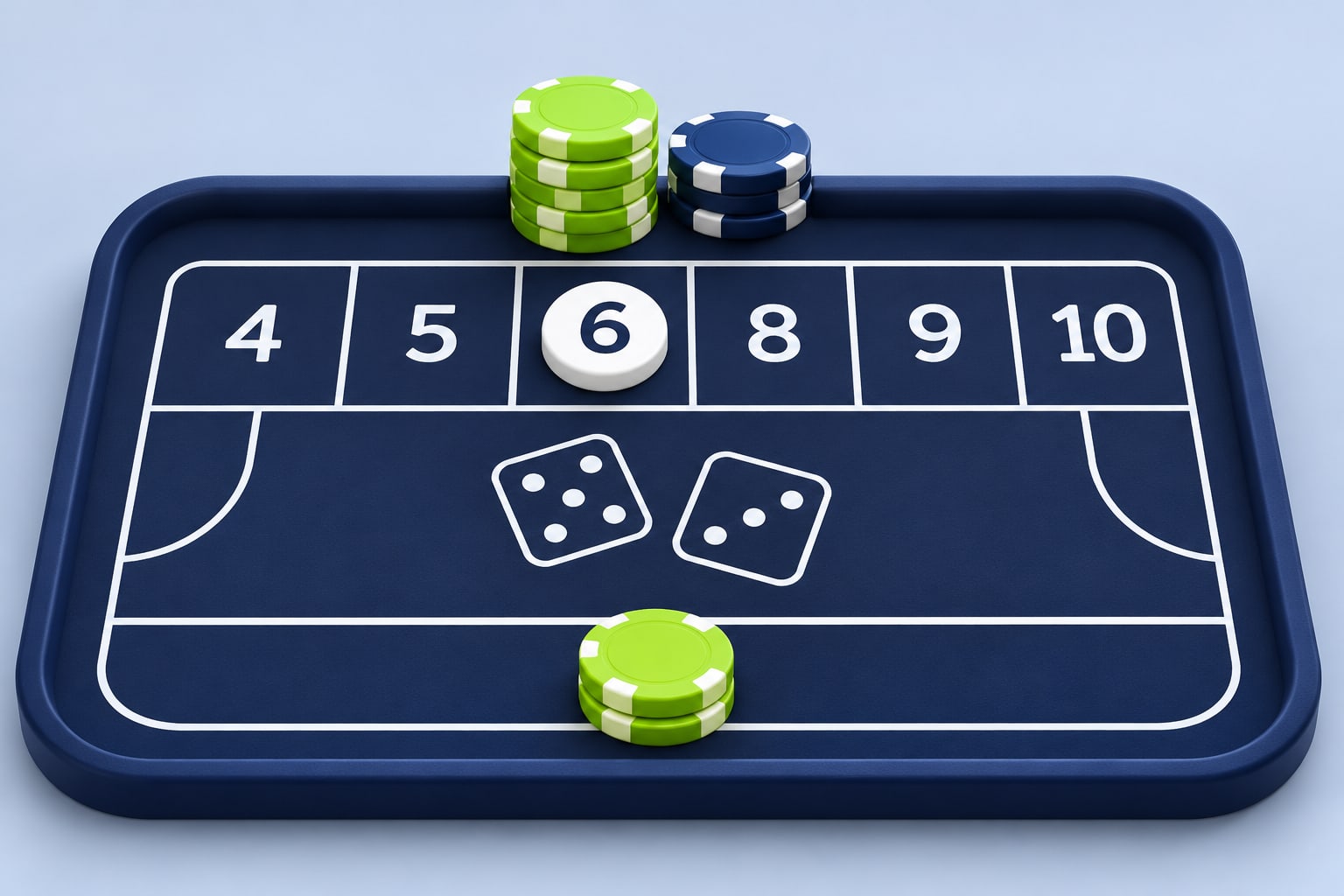
Visual explainer
Taking odds: stake and profit by point
Standard pass-line or come odds, shown separately from the original flat bet. Other totals leave this working odds wager unresolved.
Point 4 or 10
$10 wins $20
True-odds profit ratio 2:1. Winning return including stake: $30.
Point 5 or 9
$10 wins $15
Profit ratio 3:2. Winning return including stake: $25.
Point 6 or 8
$10 wins $12
Profit ratio 6:5. Winning return including stake: $22.
The point must appear before 7. If 7 comes first while these odds are working, the odds stake loses.
The base wager is settled separately. Odds limits and permissible chip amounts depend on the table. Related: Laying the Odds · Double Odds Bet.
An additional wager after a point
Taking the odds is the usual phrase for placing an additional odds wager behind a pass-line or come bet after that bet has established a point. The point is one of four, five, six, eight, nine or ten. The added wager backs that point appearing before seven, following the working conditions of the game. It is separate from the original flat bet even though both relate to the same point. You cannot assume that a chip placed anywhere near the line is recognised as odds. At a physical table, follow the dealer's placement instructions; online, use the labelled odds control for the intended bet.
Why the payouts depend on the point
The point numbers have different numbers of dice combinations. Four and ten each have three combinations, five and nine each have four, and six and eight each have five. Seven has six. Standard odds wagers compensate for those differences by paying two to one on four or ten, three to two on five or nine, and six to five on six or eight. These are profit odds, with the winning stake retained or returned separately. The probabilities explain the payout schedule; a number with fewer ways to appear receives a larger reward when it wins. Check the table rules for exact handling and permitted amounts.
A complete settlement example
Suppose a five-unit pass-line bet establishes six, and the player adds ten units in odds. If six arrives before seven while both bets are working, the flat bet earns five units and the odds earn 12 units at six to five. The total profit is 17 units, separate from the 15 units originally staked. If seven arrives first, both working stakes lose, for a loss of 15. This example shows why an odds bet is not free money. It can offer a fair mathematical payout and still increase the amount that can be lost on the next relevant outcome.
No house edge on odds is a limited statement
Under standard true-odds payouts, the added odds component has zero mathematical house edge. That does not remove the house edge already attached to the flat pass-line or come wager. Adding odds can reduce the combined expected loss expressed as a percentage of all money placed, because more of that money is in the zero-edge component. It does not erase the original wager's expected cost, and it increases the total money exposed to variation. Compare absolute expected loss as well as percentages. A lower percentage on a larger combined stake is not automatically a smaller potential session loss.
Limits, increments and working conditions
Tables limit the odds amount, often using a multiple of the flat bet. The permitted multiple can vary by point or house rules, and the stake may need to fit the payout ratio so that winnings are paid in available chip denominations. Come odds can also have different default working conditions on a come-out roll, so ask rather than assuming every chip remains active. Requests to take down or adjust odds should be made clearly before the dice are in action. The original contract wager may have different removal rules from its odds component. Treat those as separate instructions, not interchangeable permissions.
Taking versus laying the odds
Taking odds backs the established pass or come point to arrive before seven. Laying odds behind a don't-pass or don't-come bet backs seven to arrive before the point and uses the corresponding reverse payout ratios. A standalone lay bet with commission is another related but distinct wager. Keep the direction, base bet and fee structure clear when reading advice. None of these terms justifies betting beyond a predetermined budget. If adding odds would make the possible loss uncomfortable, the fair payout does not make the extra stake affordable. Understand the arithmetic first and keep the amount at risk within the limit chosen before the session.
Related glossary terms
Sources and further reading
- See also:
- Laying the Odds