A double odds bet in craps is an additional odds stake up to twice the underlying pass-line or come bet; the payout still depends on the established point.
Visual explainer
“Double” describes the added stake
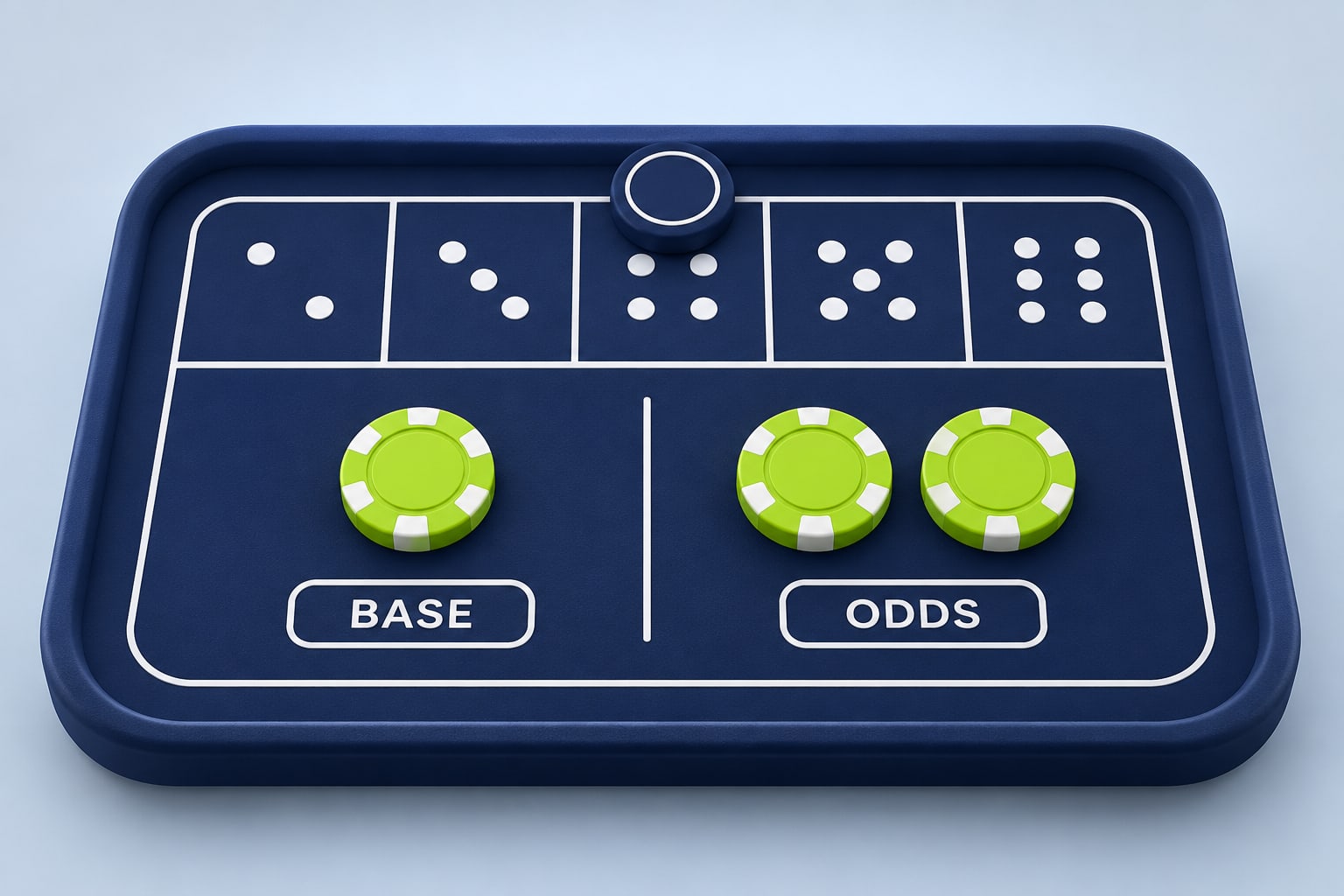
Illustration: $5 pass-line bet, point 6, with double odds taken. The odds payment is still determined by the point.
Base wager
$5
A winning pass-line bet earns $5 profit.
Double odds
$10
Twice the $5 base wager. At point 6, it earns $12 profit.
Point 6 wins
$32 returned
$15 in returned stakes + $17 combined profit.
If 7 appears before 6 while both bets are working, the combined $15 stake loses. Double odds does not mean double the chance of winning.
Standard pass-line settlement, no commission. Check the table’s permitted odds amount and point-specific payment. Related: Taking the Odds · Point (The Point).
The multiple refers to the added stake
Double odds usually means that the permitted odds stake is twice the amount of the qualifying pass-line or come wager. If the base wager is five units, taking double odds adds ten units, giving fifteen units exposed altogether. It does not mean the odds wager always pays two to one, and it does not double the chance of winning. The payout ratio is determined by the point number. Separating the base stake, additional stake and payout ratio avoids the most common ambiguity in the phrase. A table may allow a larger maximum while still allowing a player to choose only a double-sized odds stake.
When the odds wager becomes available
A pass-line wager can be backed with odds after a point has been established. A come wager similarly needs a number to be established before an associated odds wager can be added. The original wager and its odds portion remain distinct, even though they depend on the same point-versus-seven outcome. Read the table's placement and working rules, particularly for come-bet odds during a later come-out roll. Do not assume that every chip behind a line bet is active in every phase. At a live table, the dealer can clarify the permitted amount and location before the dice are released for the next roll.
A payout example at point six
Suppose a five-unit pass-line wager establishes six as the point and the player adds ten units in odds. If six appears before seven, the pass-line portion wins five units of profit, while the ten-unit odds portion pays twelve units of profit at six to five. The combined profit is seventeen units, with the original fifteen units also returned. If seven appears first, both stakes lose. Intervening totals ordinarily leave that point decision unresolved. At point four or ten, the same odds stake pays two to one instead; at five or nine, it pays three to two. The word double describes the stake multiple in all these cases.
Double odds and full double odds
Some tables use a convention called full double odds. Under that convention, the maximum can be two times the base bet on four, five, nine and ten, but two and a half times on six and eight. This accommodates the six-to-five payout relationship at those points. It is therefore worth asking whether a posted double-odds label means a strict two-times cap or the full-double convention. Other tables use limits such as three-four-five times, which vary by point in a different way. None of these names establishes what every casino currently offers. The actual displayed rules and the dealer's confirmed limits govern the available wager.
Why the combined percentage can fall
Standard odds payouts reflect the true point-versus-seven probabilities, so the odds portion has zero house edge under those rules. Adding it to a base wager with a house edge reduces the expected-loss percentage when that loss is expressed against the larger combined amount wagered. It does not erase the base wager's expected dollar loss or eliminate variation. For a fixed base bet, adding more odds increases the possible amount won or lost on the resolving event. A lower combined percentage is therefore not the same as lower exposure. Compare both the mathematical rate and the total stake rather than treating the percentage alone as a reason to increase betting.
Choosing an amount within the rules
Taking the maximum odds is optional, and a player need not increase a wager merely because the table permits it. Check the required increments, point-specific payout and whether the stake is being taken behind a right-side bet or laid against a point on the don't side. Those arrangements use different payout relationships and can express limits differently. Decide the total amount you are prepared to lose before adding chips. A long run without seven does not make a point safer, and an earlier loss does not make a double-odds recovery due. The term explains a permitted stake relationship, not a guarantee or an instruction to risk more.