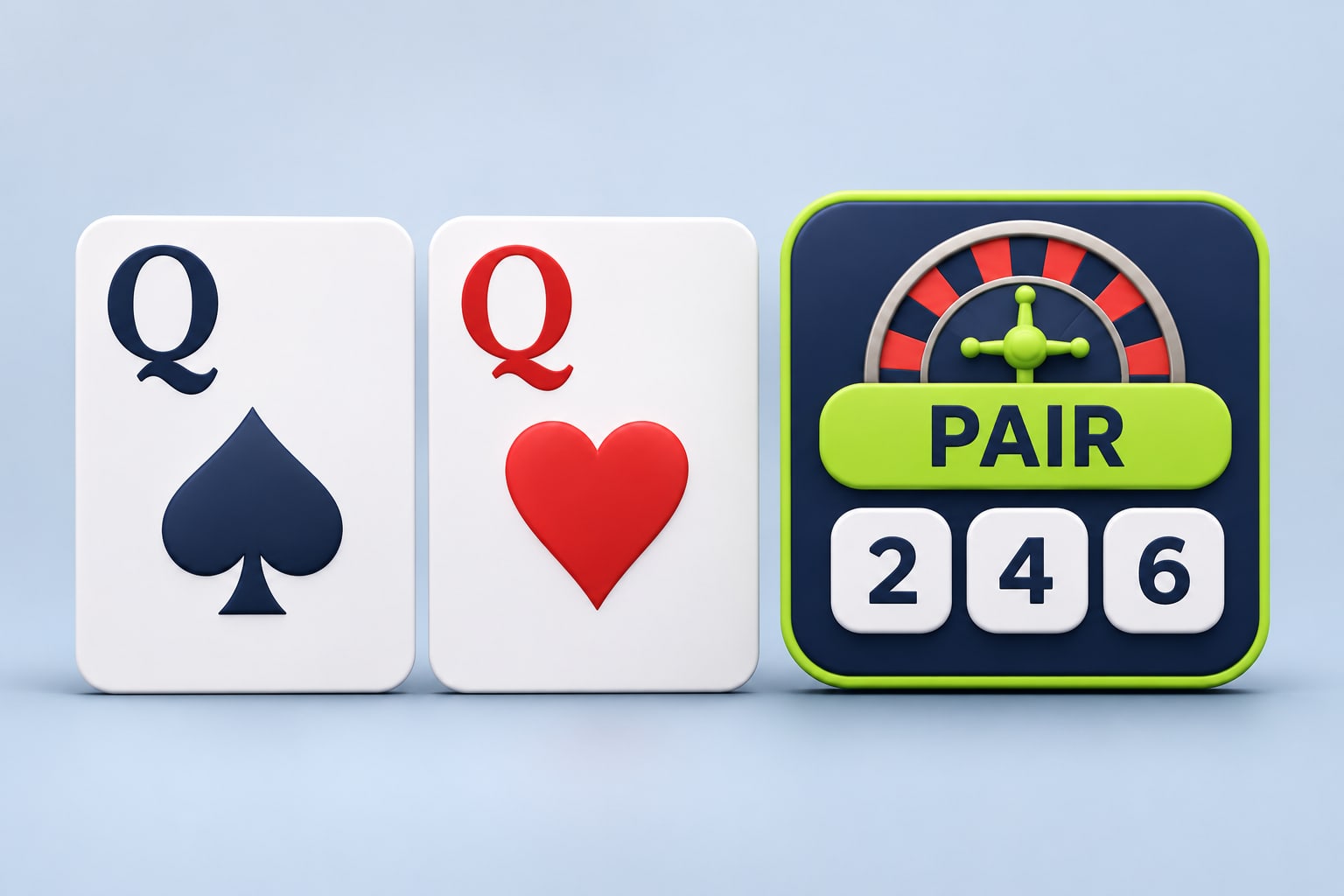
In poker, a pair is two cards of the same rank. On a French roulette layout, Pair means even numbers and is an entirely different betting term.
The ordinary poker meaning
A pair consists of two cards sharing the same rank, such as two queens or two sevens. Their suits need not match; in a standard single deck, two distinct cards of the same rank necessarily have different suits. A five-card hand classified as one pair contains that matching rank plus three other cards of different ranks. If another rank also occurs twice, the hand is two pair instead. Three matching cards produce three of a kind, and four matching cards produce four of a kind. The name describes the hand’s structure, rather than a promise that it will win the current pot against an opponent.
Visual explanation
Compare the pair, then the kickers
Two ordinary five-card poker hands with the same pair.
Hand A: pair of eights, ace-high kicker
Hand B: pair of eights, king-high kicker
Hand A wins: the pair ranks tie, so the highest remaining card decides. If that also ties, compare the next kicker, then the last. Suits do not break the tie. See video poker.
How two one-pair hands compare
Under ordinary high-poker rankings, a higher pair beats a lower pair. A pair of queens therefore beats a pair of jacks regardless of the other three cards. If both players have the same pair, compare their remaining cards, called kickers, from highest to lowest. For example, Q-Q-A-K-7 beats Q-Q-A-J-9: the pairs match, the ace kickers match, and the king then beats the jack. The nine never gets a chance to decide that comparison. If all five ranked cards are equal, the hands tie under the standard rules; suits do not normally break the tie for the pot. Special variants require their own ranking rules.
Pocket pairs and shared cards
In Texas Hold’em, a pocket pair means the player’s two private cards have the same rank. A pair can also be formed by matching one private card with a community card, or it can appear entirely on the shared board. These situations do not have identical strategic implications. A paired board gives every remaining player access to that rank, and another player may have a stronger combination. The final comparison uses each player’s best permitted five-card hand. Omaha has a different construction requirement: exactly two private cards and three community cards. Always apply the game’s card-use rules before deciding which pair or kicker counts.
Pairs in video poker
In video poker, a pair is evaluated against the displayed paytable rather than against another player’s concealed hand. In Jacks or Better, the qualifying minimum is normally a pair of jacks, queens, kings or aces. A lower pair does not earn that particular one-pair award, although keeping it during the draw can still have strategic value. Other games use different minimums, wild cards or pay schedules. Do not infer a return solely from the word pair. Check the game title, the qualifying ranks, the number of credits wagered and the complete table. A winning classification and the best decision before the draw are separate questions.
Pair on a French roulette layout
The French word Pair means even and appears opposite Impair, meaning odd, on traditional roulette layouts. It is unrelated to matching playing cards. The even bet covers eighteen numbers: 2, 4, 6 and so on through 36. A winning ordinary wager pays even money, or one unit of profit for each unit staked, with the original stake returned. Zero is not included in the even selection despite being an even integer in mathematics. Roulette uses the defined betting group, not an unrestricted mathematical category. This distinction matters when reading a French table or a translated rules page that retains the original layout labels.
Checking the context before acting
A guide discussing kickers, pocket cards or hand rankings almost certainly uses pair in the poker sense. A layout mentioning Rouge, Noir, Manque and Impair is using the French roulette vocabulary. In single-zero roulette, the even group covers eighteen of thirty-seven pockets; the one-to-one payout does not make the probability exactly one half. Specific rules such as la partage or en prison can change how certain zero outcomes are settled. In poker, meanwhile, a pair’s value depends on the other available cards and the applicable rankings. Reading the neighbouring terms prevents two familiar-looking words from being mistaken for the same game instruction.