Impair is the French roulette term for an odd-number bet, covering the 18 odd numbers from 1 through 35 and normally paying 1:1.
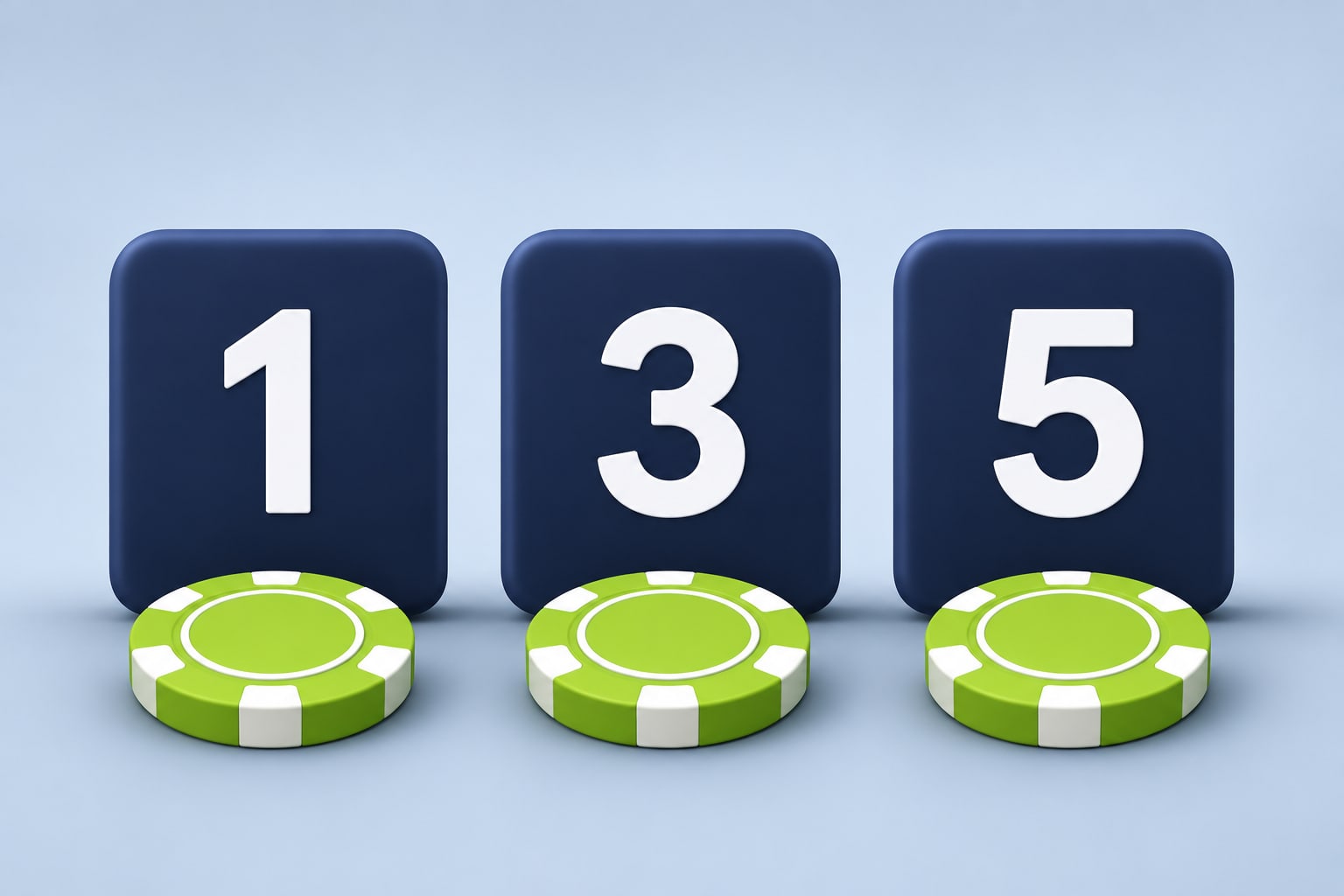
Visual explainer
Odd-number coverage still leaves zero
Illustrative standard single-zero roulette, with ordinary settlement and no la partage or en prison rule.
Odd numbers · Impair18 / 37
A 1-unit wager earns 1 unit profit when an odd number wins.
Even numbers plus zero19 / 37
The same wager loses 1 unit on these outcomes.
Expected player result: (18 × 1 − 19 × 1) / 37 = −1/37 unit, about −0.027 unit per unit wagered. House edge: about 2.70%.
The 1 to 1 payout does not mean a 50% winning chance. Zero treatment can differ under additional French roulette rules. Related: French Roulette (European Roulette) · House Advantage or House Edge.
What impair means on a roulette table
Impair identifies a group of numbers, rather than a particular wheel section. Its winning outcomes are 1, 3, 5, 7, 9, 11, 13, 15, 17, 19, 21, 23, 25, 27, 29, 31, 33 and 35. French layouts pair it with pair, meaning even. English layouts generally label the same betting areas ODD and EVEN. Changing the language does not change the covered numbers or the standard payout. The wager sits outside the main numbered grid, so it is an outside bet. That description concerns its position on the cloth, not the physical location of winning pockets. Odd numbers are distributed around the wheel and include both red and black outcomes. A wager on impair therefore differs from choosing a color or predicting which wheel sector will catch the ball.
Placement and settlement
A chip placed inside the impair box applies its full value to the odd-number group. It is not divided into 18 separate straight-up bets. Suppose you stake $6 and the result is 17. At the standard 1:1 payout you receive $6 profit and retain the original $6 stake, giving a total return of $12. If 18 lands, the $6 stake loses. The same loss ordinarily occurs on zero. A display showing $12 returned has not awarded $12 profit: half that amount was already yours. On a digital table, check the selected denomination and total wager before confirming. Repeated taps commonly add chips to the same position. The highlighted coverage, rather than a nearby chip graphic, is the best way to confirm that the interface registered the intended outside bet.
Why an even-money payout is not a fifty-fifty chance
A standard single-zero wheel has 37 pockets, but only 18 win an impair wager. The probability of winning is therefore 18/37, about 48.65%. The other 19 outcomes lose under ordinary settlement. On a double-zero wheel, 18 of 38 outcomes win, about 47.37%. The payout can remain 1:1 even though the chances differ. For a $1 wager on the single-zero game, the probability-weighted result is 18/37 dollars of winning profit minus 19/37 dollars of losing stakes, or a loss expectation of 1/37 dollar. That produces a 2.70% house edge. With two zeros the corresponding edge is 2/38, about 5.26%. These are long-run mathematical averages, not a deduction from each spin and not a prediction of your next session.
Zero rules and overlapping bets
Some single-zero tables offer la partage on eligible even-money bets. If zero lands, half the impair stake is returned instead of the full amount being lost. This changes the calculation: 18 outcomes win one unit, 18 lose one unit and zero loses half a unit. The resulting edge is 0.5/37, about 1.35%. En prison uses a different procedure, holding a qualifying stake for later settlement according to the stated rules. Neither treatment should be assumed simply because French labels appear on the table. Betting both impair and pair is also not protection against zero. With $6 on each, any numbered result produces a $6 win on one side and a $6 loss on the other, while an ordinary zero result loses both stakes. The total money exposed is $12.
Reading result histories without inventing a pattern
A list of recent even results does not make impair due. In a fair independent game, the next spin still has the same odd-number probability as before. Alternating between odd and even, increasing stakes after losses, or waiting for a run can change the sequence of your wagers, but cannot remove the extra losing pocket. Evaluate the table by its actual wheel and settlement rules rather than by the language of its labels. Also check whether an active bonus permits roulette, how wagers contribute and whether outside bets are restricted. A simple group bet can still breach an unrelated promotion condition. Use a fixed entertainment budget and a time limit; neither a favorable run nor an apparent imbalance in the history is a reason to extend either limit.