A high-low bet in roulette selects either the low numbers 1–18 or the high numbers 19–36, with a standard 1:1 payout; the term does not mean both groups are covered by one chip.
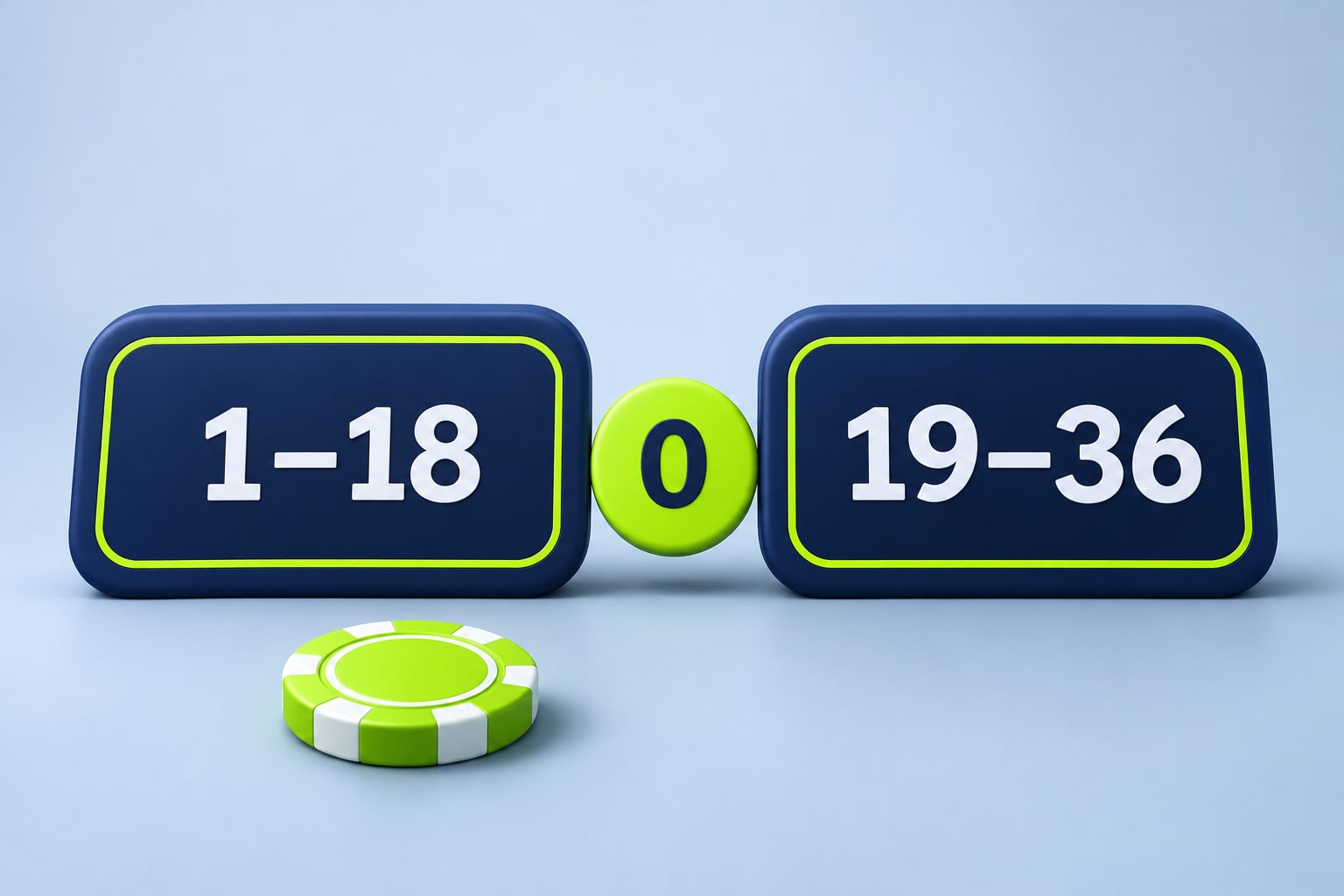
Two separate outside choices
High and low divide roulette's positive numbered sequence into two groups of 18. Low covers 1 through 18, and high covers 19 through 36. French layouts may use manque for low and passé for high. Each group has its own betting area outside the main grid. A high-low description in a guide normally refers to this pair of available choices, not a single wager that wins on all 36 numbers. To cover both, you would need two accepted bets and would risk the combined amount. The ranges concern number values, not a pocket's position on the wheel or screen. They also differ from high-card or high-low side games in other casino products, so always confirm that the definition is being used in a roulette context.
Boundary numbers and settlement
The boundary is between 18 and 19. A low wager wins on 18 but loses on 19, while a high wager does the reverse. Both ordinarily lose on 0, and both lose on 00 where that pocket exists. At the standard 1:1 payout, a $9 winning wager returns $18, including $9 profit and the original $9 stake. The same chip value on the other range has the same ordinary payout. A digital interface may show a short label such as 1–18 or 19–36 rather than LOW or HIGH. Inspect the highlighted range if orientation changes on a phone. One misplaced tap can select a nearby odd/even or color box, which has a different set of winning numbers despite paying the same ratio.
Chances and the house edge
Either range covers 18 of 37 outcomes on a fair single-zero wheel, giving a 48.65% winning probability. On a double-zero wheel, each covers 18 of 38, giving approximately 47.37%. Under ordinary settlement, the house edges are approximately 2.70% and 5.26%. Some single-zero games offer la partage for eligible even-money bets, returning half the stake when zero lands and reducing that wager's edge to approximately 1.35%. Check the actual rule rather than assuming a French table label guarantees it. The word high does not mean a higher return or better chance than low. Both groups have the same number of pockets and ordinary payout. Their different recent histories do not change those mathematical facts in an independent fair game.
What happens if both ranges are backed
Consider $5 on low and $5 on high, a total stake of $10. If any positive number wins, one position returns $10 and the other loses $5, so the total return equals the total stake. Under ordinary rules, zero loses both wagers and costs the full $10. This combination therefore creates frequent break-even rounds and occasional full losses, not a risk-free way to generate turnover. Adding $1 on zero changes the outcomes again: a positive number returns $10 against $11 staked, a $1 loss, while zero returns $36, a $25 net gain. The distribution looks different but retains an unfavorable expectation under standard single-zero rules. Promotions may also prohibit opposing or low-risk bets, independently of what the game interface permits you to place.
Comparing high-low with other outside bets
High-low, odd-even and red-black each provide 18-number groups, but their memberships overlap in different ways. A result of 20 is high, even and black; 21 is high, odd and red. Placing several outside bets can therefore make multiple positions win or lose together. Count the total stake and evaluate outcomes rather than treating each label as an independent source of protection. Past low results do not make high due, and alternating ranges does not remove the zero disadvantage. Use the terms to understand coverage, not to infer a pattern. Before playing, check table limits, bonus eligibility and the exact zero rule. Keep spending and time limits fixed, including when a run of one range makes the other seem overdue or a winning sequence tempts you to increase the wager.