An even number bet in roulette covers the 18 positive even numbers from 2 through 36 and normally pays 1:1; neither 0 nor 00 wins this wager.
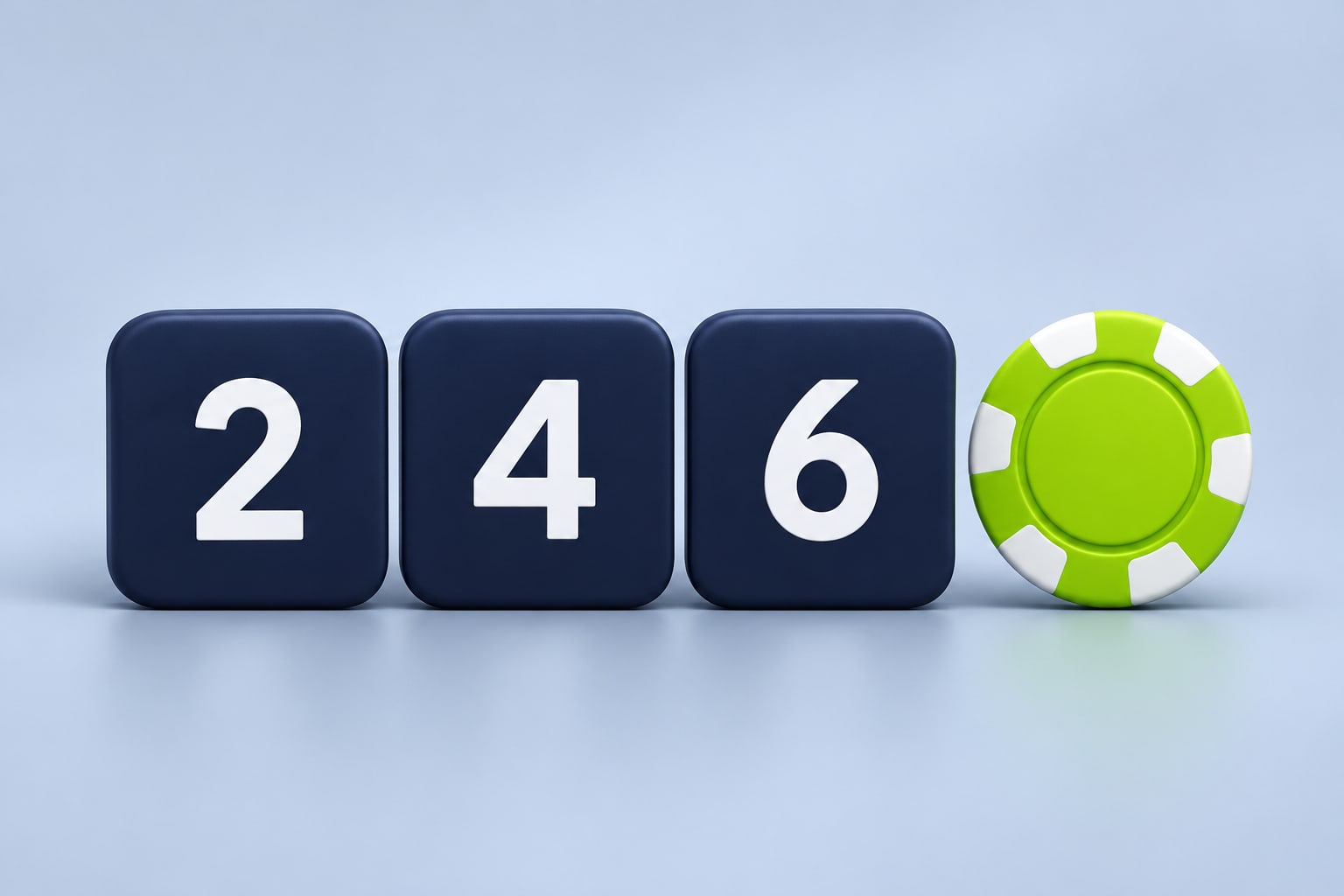
Which numbers count as even for this wager
The roulette even-number group contains 2, 4, 6, 8, 10, 12, 14, 16, 18, 20, 22, 24, 26, 28, 30, 32, 34 and 36. It is commonly labeled EVEN, or pair on a French-style table. Although zero is even in arithmetic, roulette's even outside bet excludes the zero pockets. This is a rule-defined betting category, so a mathematical observation about divisibility does not override the paytable. The same exclusion applies to double zero. The wager covers both red and black numbers and both halves of the numbered range. For example, 2 is black and low, while 36 is red and high. Choosing even is therefore distinct from choosing a color, a dozen or a high/low group.
Placing and settling the wager
A chip inside the EVEN box applies its full value to the group. It is not divided into 18 straight-up chips. With a $7 stake and a result of 24, the ordinary 1:1 payout produces $7 profit plus the original $7, a $14 total return. A result of 23 loses the stake, and zero ordinarily does as well. If your balance was $50 before betting, a win leaves $57 after settlement, not $64. Casino interfaces differ in whether their win display reports profit or total return, so reconcile the transaction using the original balance and total stakes. If you tapped twice with a $7 denomination selected, the accepted amount may be $14. Always inspect the total rather than assuming the chip selector shows the full round cost.
Why the chances are slightly below half
The group contains 18 winning pockets. A single-zero wheel contains 37 total pockets, so an even wager wins with probability 18/37, about 48.65%. The other 19 outcomes lose under ordinary full-loss rules. On a double-zero wheel, the probability is 18/38, about 47.37%. The resulting standard house edges are 1/37, about 2.70%, and 2/38, about 5.26%. A one-unit single-zero calculation is especially simple: 18 equally weighted outcomes earn one unit and 19 lose one unit, leaving a negative one-unit total divided by 37. The term even-money describes the payout ratio, not an exact fifty-fifty chance. It also does not mean that an even bet is financially safer than its identical-coverage odd counterpart on the same table.
Special zero rules and combined positions
Where la partage applies to eligible even-money wagers, zero returns half the stake instead of losing it all. For a single-zero even bet, that gives an expected loss of half a unit across 37 equally weighted outcomes, approximately 1.35% of the amount staked. En prison uses a holding procedure whose exact later settlement should be read in the game rules. Neither rule is universal. Betting both even and odd also does not remove the green-pocket risk. With $4 on each, a positive numbered result returns $8 from the winning side and loses the other $4, leaving the complete round even. An ordinary zero result loses all $8. Adding a separate zero wager changes the distribution and total cost but does not automatically create a favorable expectation.
Reading recent results sensibly
A run of odd numbers can occur without making even more likely next. In a fair independent game, the next spin still has its original 18/37 or 18/38 probability. A history display may highlight the imbalance, but it does not measure a debt the wheel must repay. Switching sides after losses or doubling the stake affects your balance swings rather than the underlying chances. Check the wheel type and zero rule before comparing games, then set a total stake and time limit. If playing under a promotion, review whether roulette qualifies and whether outside wagers have reduced contribution or restrictions. A straightforward even bet still carries real loss risk and can be placed repeatedly at high speed. Stop at the planned boundary rather than waiting for the recent odd/even counts to become equal.