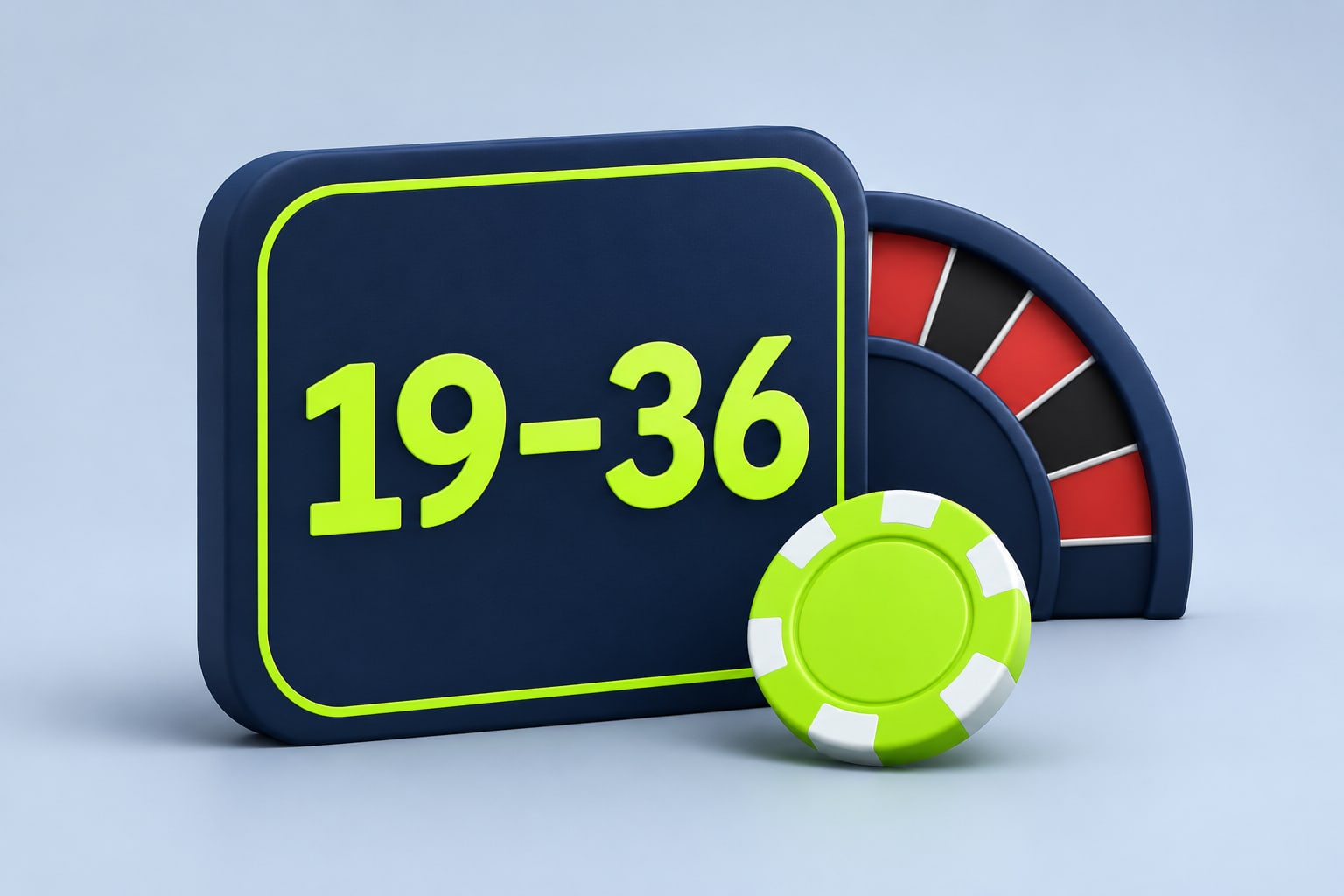
A high bet in roulette covers the 18 numbers from 19 through 36 and normally pays 1:1 profit; it does not mean a large stake.
High describes the number range
In roulette terminology, high refers to the upper half of the positive numbered sequence, 19 through 36. A high bet can be made with a small stake, so the term should not be confused with high-stakes gambling or a high-limit table. The betting box usually reads 19–36, HIGH or the French equivalent passé. Its opposite is low, covering 1–18. These are separate outside wagers. The high group includes red and black outcomes and odd and even outcomes. It also occupies many different locations around the wheel, rather than one uninterrupted sector. A chip in the high box therefore predicts a numerical category, not where the ball will land physically relative to the dealer or camera. The exact range remains the same when the layout rotates on a mobile screen.
How a high wager pays
The standard payout is 1:1 profit. A $12 high wager returns $24 when any number from 19 through 36 wins, consisting of $12 profit and the original $12 stake. If 18 wins, the wager loses; if 19 wins, it pays. Zero and double zero ordinarily lose because neither belongs to the high group. A casino display showing $24 won may be presenting total return rather than net profit. To reconcile the balance, subtract the amount staked from the amount returned. If other positions were active, include their costs and returns too. For example, $12 on high plus $3 on a losing straight-up number produces $9 net profit when high wins: $24 returned against $15 total staked. The winning outside wager alone does not describe the entire round.
Probability on different wheels
There are 18 high-number pockets on both conventional single-zero and double-zero wheels. The totals differ: 37 pockets on the first and 38 on the second. The winning probabilities are therefore 18/37, approximately 48.65%, and 18/38, approximately 47.37%. With ordinary full-loss settlement on zero outcomes, the house edges are approximately 2.70% and 5.26%. A single-zero la partage rule, where explicitly offered for this wager, returns half the stake when zero lands and reduces its edge to approximately 1.35%. An en prison rule uses a different holding procedure, which should be read separately. The amount of the stake does not alter these percentages in a standard fair game. Raising a high bet from $2 to $20 multiplies the money exposed without making the high group more likely.
Overlap with dozens, columns and colors
The high group is not the same as the third dozen. The third dozen contains 25–36, while high also includes 19–24. A high bet can overlap with a dozen or column wager, causing both to win on some outcomes and only one on others. Suppose you place $5 on high and $5 on the third dozen. A result of 30 returns $10 from high and $15 from the dozen, producing $15 net profit against $10 staked. A result of 20 returns only $10 from high, making the round break even. A result of 12 loses both wagers. These examples show why broad labels do not reveal the whole risk profile. List the distinct outcome categories and total stakes when comparing combinations, rather than treating an additional outside bet as automatic protection.
Reading streaks and setting limits
A string of low results does not make a high result overdue. Independent spins retain the same probabilities regardless of the recent high/low count. Nor does a high result imply that nearby high numbers will follow. The number order on the betting grid is a placement convenience, not a sequence the wheel must complete. Use the high label to understand coverage and the rules to understand return. Before playing with bonus funds, check roulette eligibility, contribution and restrictions on opposing bets. Review the total after using repeat or double, since those controls can affect every position. Keep a fixed entertainment budget and stopping time. A high bet remains a wager with a negative standard expectation, even though it covers many numbers and has a simple even-money settlement.
Related glossary terms
Sources and further reading
- Antonym:
- Low Bet