A corner bet in roulette covers four numbers meeting at one grid intersection and normally pays 8:1 profit; the French term is carré.
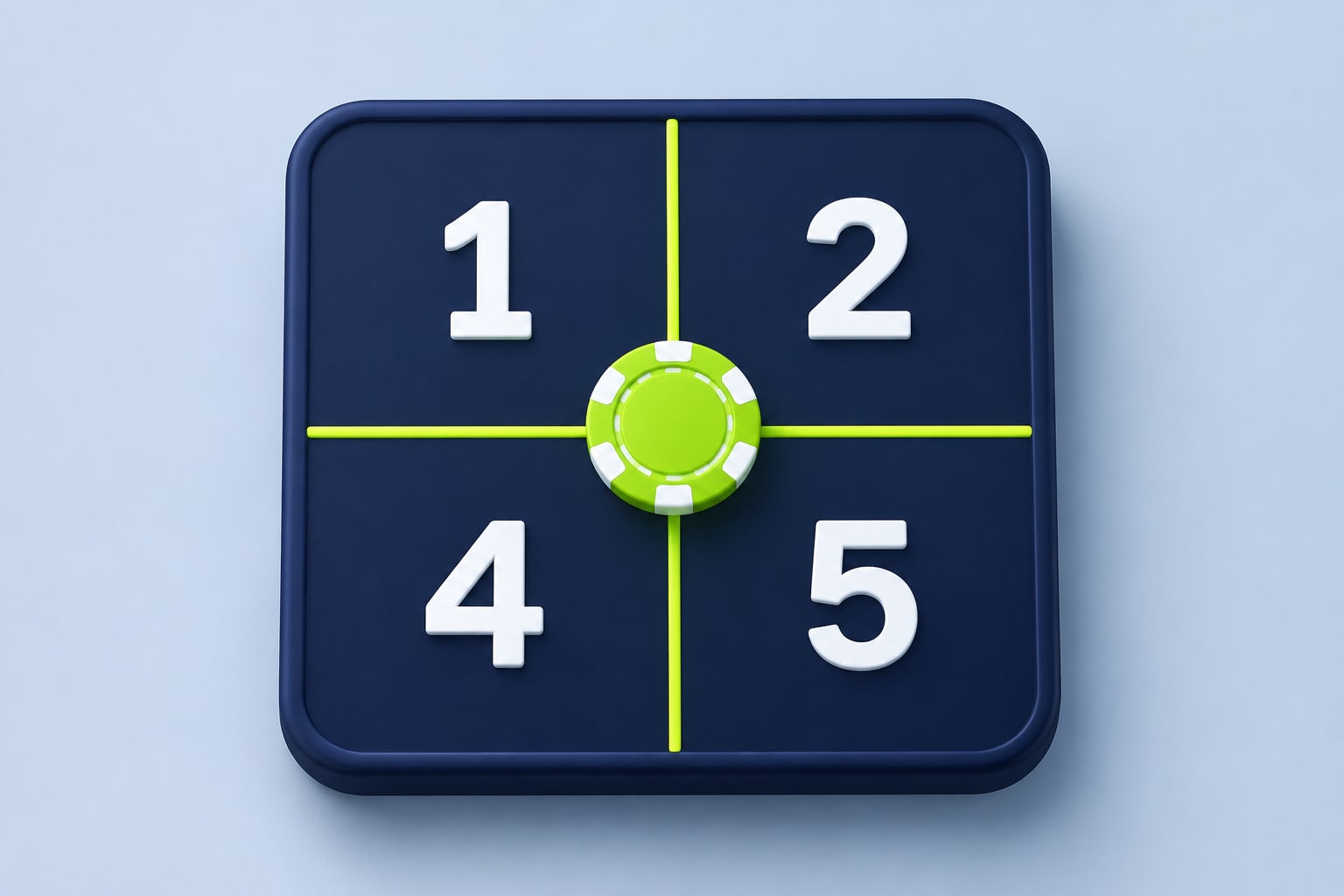
Roulette layout example
A corner covers four adjoining numbers
Example: a chip at the junction of 1, 2, 4 and 5. Green cells show the covered numbers.
Layout excerpt
Covered: 1, 2, 4, 5. The number 3 is not included.
One $5 corner wager
Any covered number wins → $45 returned.
$40 profit at the standard 8:1 payout, plus the $5 stake.
Every other result loses this wager.
The betting grid differs from the number order around the wheel. Confirm the interface highlights all four intended numbers. Explore: Inside Bets · Street Bet.
Four adjoining boxes, not any four numbers
A standard corner bet covers a two-by-two block of number boxes on the roulette layout. The group 1, 2, 4 and 5 is a valid example because all four boxes meet at one intersection. Another valid group is 16, 17, 19 and 20. Four consecutive integers do not necessarily form a corner: 1, 2, 3 and 4 do not make a two-by-two block on the ordinary positive-number grid. That distinction separates a permitted corner from four arbitrary straight-up selections. The physical order around the wheel is also different from the cloth, so the wager does not necessarily cover four neighboring wheel pockets. Carré is the common French name for the same grid-based wager. The exact highlighted numbers are more useful than the informal description alone.
The chip position determines coverage
The conventional position is the point where the four chosen boxes meet. A chip shifted onto a single shared edge can instead become a split, covering two numbers, while a chip fully inside a box becomes a straight-up bet. Digital interfaces can make these targets close together, especially on a phone. Use the preview or accepted wager record to confirm the intended group. A single $4 corner chip costs $4 for all four outcomes; it is not $4 on each number. Four separate $4 straight-up bets would cost $16. The zero area can contain special first-four positions that should be checked by their exact number list and payout. Do not assume every four-number wager uses the same physical placement as an ordinary corner within the 1–36 grid.
Payout and overlapping corner examples
At the standard 8:1 profit payout, a winning $4 corner returns $36, including $32 profit and the original $4 stake. A result outside its four numbers loses the $4. Consider two $4 corners: 1/2/4/5 and 4/5/7/8. Their combined stake is $8, and they cover six distinct numbers because 4 and 5 appear in both. If 4 wins, both corners pay, returning $72 and producing $64 net profit. If 1 wins, only the first pays, returning $36 and producing $28 net profit. Any uncovered result loses $8. This example illustrates why a winning chip's payout is not always the complete round profit. It also shows that adding corners can increase the amount on existing outcomes instead of expanding coverage by four new numbers every time.
Probability and standard return
On a fair single-zero wheel, one corner has a 4/37 chance of winning, approximately 10.81%. It has 33 losing outcomes. The expected profit on a one-unit wager is (4 × 8 − 33)/37, or minus 1/37 unit, giving approximately a 2.70% house edge. On a double-zero wheel, the same four-number coverage has probability 4/38, approximately 10.53%, and a standard edge of 2/38, approximately 5.26%. Corners win more often than straight-up bets and less often than six-number lines, but their ordinary payouts adjust accordingly. A more frequent small return does not automatically represent better mathematical value. These calculations assume standard payouts and equally likely pockets; special roulette variants with multipliers or reduced base payouts need their own published rules.
Using corners within a fixed round budget
Corners can be convenient for describing compact groups on the grid, but their neat appearance should not obscure the total stake. Check the amount after every repeat, double or saved-bet action, since those controls may restore several corners and other positions at once. A previous run outside the selected block does not improve its next-spin chance. Nor does a corner that just won become inherently more favorable. If using promotional funds, read roulette eligibility, contribution and any restrictions on broad or overlapping coverage before starting. The game's acceptance of a chip does not establish that a bonus permits it. Decide a total entertainment budget and stopping time independently of the pattern you choose, and count all component stakes when reviewing whether a round made money or exceeded the intended exposure.
Related glossary terms
Sources and further reading
- Synonym:
- Carré