A split bet in roulette covers two permitted adjacent numbers on the betting layout and normally pays 17:1 profit; a single chip is placed across their shared border.
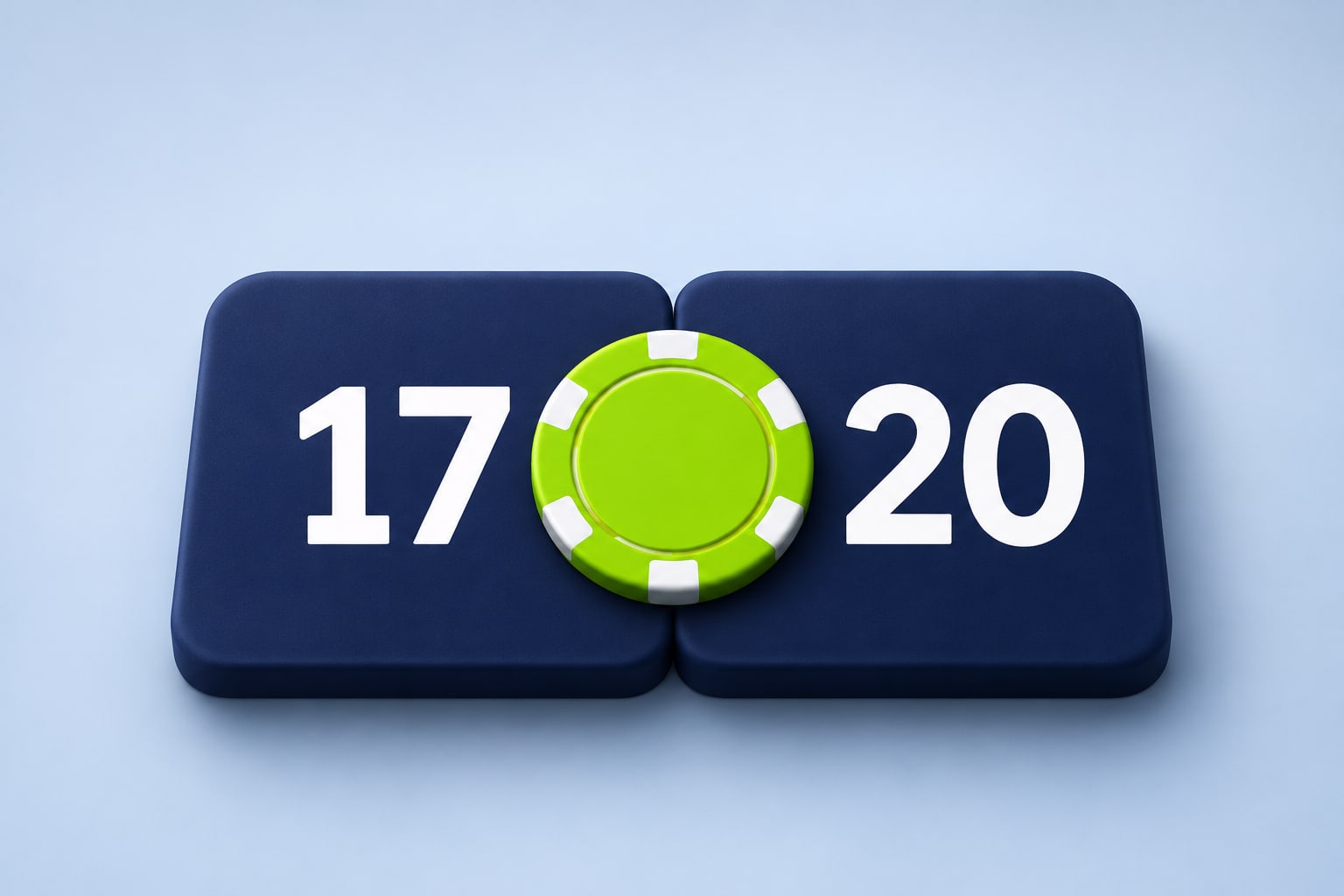
KeyToCasinos • Visual explainer
A split covers two adjoining numbers
Illustration: a chip on the shared boundary between 1 and 2 covers both numbers in a standard roulette layout.
Coverage
2 pockets
Either covered number wins; other results lose.
$2 stake at 17:1
$34 profit
The total return is $36 including the stake.
Use the table’s actual split placement areas. Neighbours on the wheel are not necessarily adjoining numbers on the betting layout. Related: Single number bet · Paytable.
Two outcomes from one chip
A roulette split selects two specific numbers that form a permitted pair on the layout. One accepted chip covers either number, so the wager wins if the round's single result matches either member of the pair. The chip is placed across their shared boundary, which gives rise to the French term à cheval. A split is not two spins, a divided payout or a requirement for both numbers to appear. Standard examples include 17/20 and 17/18 because those pairs share edges on the conventional grid. Two boxes touching only at a corner do not automatically form a split. The special zero area can have its own permitted pair positions, so confirm the game's highlighted coverage rather than extending ordinary grid assumptions into that area.
Grid adjacency versus wheel adjacency
The order of numbers on the roulette wheel differs from the arrangement on the betting cloth. A pair of neighboring wheel pockets may not be a permitted split on the grid. Conversely, a valid grid split does not necessarily cover neighboring wheel pockets. A racetrack neighbors selection usually creates a set of straight-up wagers, while a split is one two-number component. These distinctions affect chip count and the way the total stake is displayed. If one $2 split chip is placed, the round cost is $2. Two separate $2 straight-up wagers on the same outcomes cost $4. With equal total money and standard payouts, the coverage can be made equivalent, but minimum denominations and betting limits can affect which arrangement is available in practice.
Payout with a worked example
The ordinary split payout is 17:1 profit, plus the winning stake returned. A $3 split on 17/20 therefore returns $54 if either number wins: $51 profit and the original $3. Every other result loses the $3 wager. Suppose a second $3 split on 14/17 is also active. A result of 17 wins both components, returning $108 against the $6 total stake, or $102 net profit. A result of 14 or 20 wins only one, returning $54 and producing $48 net profit. All other numbers lose $6. The two splits cover three distinct outcomes rather than four because 17 overlaps. This is why the number of chips times two is not always a correct count of unique numbers covered.
Winning probability and house edge
A single ordinary split wins on two pockets. On a fair single-zero wheel, the probability is 2/37, approximately 5.41%. For a one-unit stake, expected profit is (2 × 17 − 35)/37, or minus 1/37 unit, approximately a 2.70% house edge. On a double-zero wheel the probability becomes 2/38, approximately 5.26%, while the edge becomes 2/38 as well under the standard payout. Those equal-looking percentages in the double-zero example describe different concepts: one is the chance of a winning round, the other the expected loss divided by total stakes. A split hits twice as often as one chosen number on the same wheel, but its smaller payout offsets that advantage in the standard return calculation. Coverage and value should be assessed separately.
Placement checks and larger combinations
On a small touchscreen, a chip intended for a split can accidentally select one number or a four-number corner. Check the accepted wager name and highlighted pair before the round closes. Larger French combinations such as tiers and orphans contain several splits, so their total cost is the chip denomination multiplied by all components, with overlaps affecting possible returns. Do not treat a shortcut's component payout as the profit ratio for the whole combination. Review bonus rules separately because roulette contribution and number-coverage restrictions can differ from the game's ordinary acceptance rules. Recent misses do not make the pair due, and increasing its stake does not improve its probability. Use a fixed round budget and a session limit, including all simultaneous positions when deciding whether another click is affordable.
Related glossary terms
Sources and further reading
- Synonym:
- Cheval