An underlay is a bet whose offered return is less favourable than the return justified by its actual or estimated chance of winning. It describes the price of the wager, not a guarantee that the next result will lose.
Visual explainer
An underlay pays less than the fair price
Hypothetical event: exactly 25% chance to win, $1 stake, and no fees or other outcomes.
Fair price: 3:1 profit
Lose: −$1 with probability 75%.
Expected net: $0.
Offered price: 2:1 profit
Lose: −$1 with probability 75%.
Expected net: −$0.25.
Offered-price calculation: (0.25 × $2) − (0.75 × $1) = −$0.25 per $1 wager. A successful 2:1 wager returns $3 total: $2 profit plus the $1 stake.
This expectation is an average under the model, not the result of every wager. If the true probability is uncertain, the underlay assessment is uncertain too. Related: Expected Value or EV · True Odds.
A comparison between price and probability
An underlay is a wager offered at a price that is worse for the bettor than its chance of success would justify. The comparison is between the return being offered and a fair return based on probability. It is not simply a synonym for an unlikely outcome. A very likely outcome can still be an underlay when its payment is too small, while an unlikely outcome can be fairly priced if the payment is large enough. In casino games with fixed rules, probabilities may be calculated from the possible outcomes. In other settings, the probability may be an estimate and needs to be treated with appropriate uncertainty.
A simple example using one chance in six
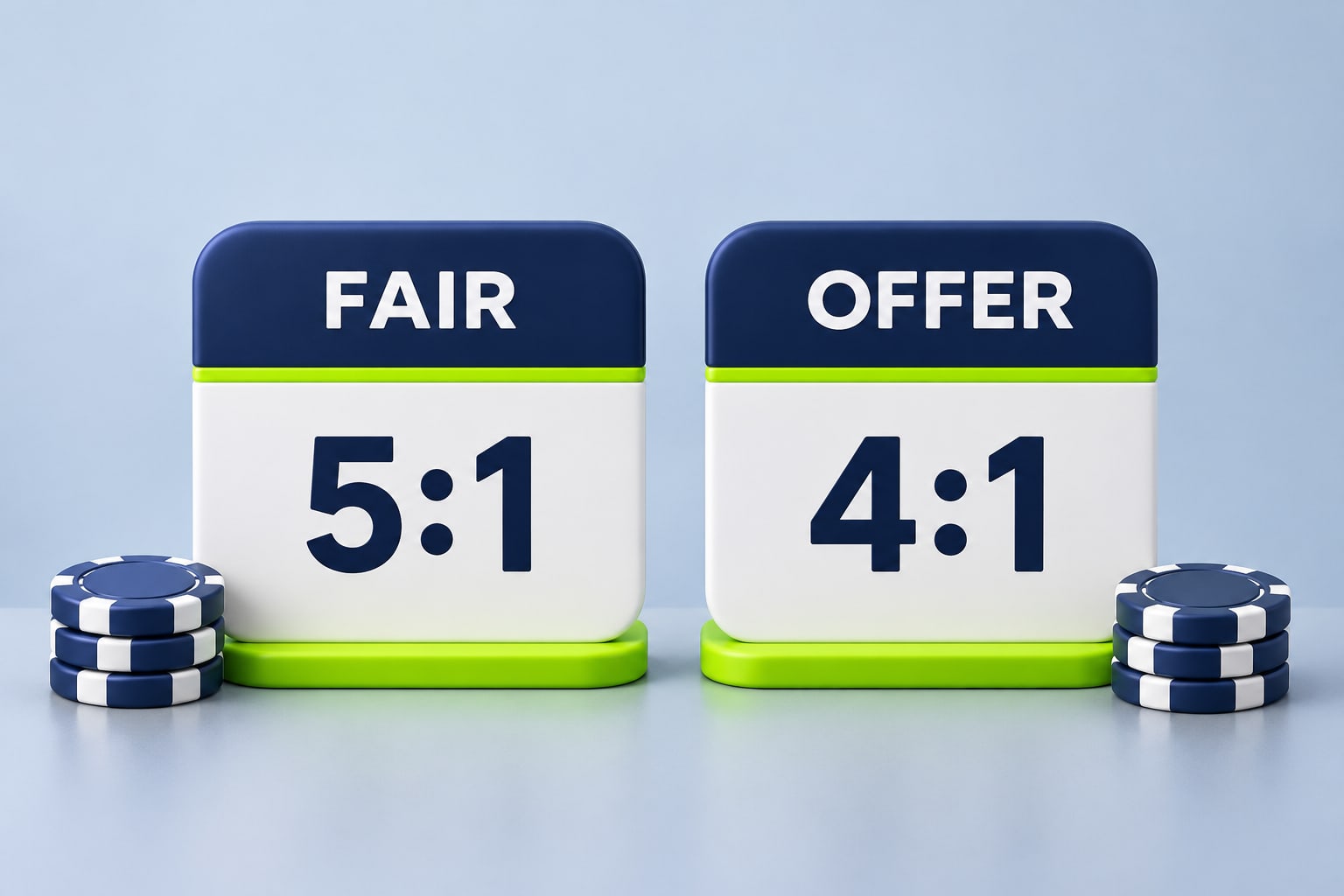
Imagine a clearly defined event with exactly one chance in six of winning. For each one-unit stake, fair profit odds would be five to one: the winning outcome earns five units while the five losing outcomes each lose one. Now suppose the offered profit is only four units. Across six equally weighted possibilities, the calculation is four units gained minus five units lost, or a net loss of one unit. Dividing by six produces an expected loss of one sixth of a unit per one-unit wager. The offered four-to-one price is therefore an underlay relative to the assumed probability in this deliberately simplified example.
A winning bet can still have been an underlay
The result of one wager does not tell you whether its price was favourable. The example above can win on the first attempt and pay exactly as advertised. That outcome does not change the original comparison between the one-in-six chance and the four-to-one profit. Equally, a fairly priced wager can lose several times in succession. Expected value describes a probability-weighted average under stated assumptions, not a schedule of results. Keeping the distinction clear prevents a common mistake: judging a decision solely by whether it happened to win. A lucky result does not turn an unfavourable price into a sound mathematical proposition.
Check what the displayed odds actually include
Price comparisons require consistent units. Profit odds of four to one mean four units won in addition to the returned one-unit stake. Decimal odds of five represent the same total return, whereas decimal odds of four represent only three units of profit. Confusing those formats can reverse a comparison. Fees, commission, partial refunds and special settlement conditions can also change the calculation. If a bet sometimes pushes, include that possibility rather than pretending every non-win is a full loss. A reliable assessment starts with the exact event, the amount at risk and every possible net result, all expressed on the same basis.
Estimated chances are not established facts
When an underlay claim depends on a probability estimate, its accuracy depends on that estimate. Suppose someone believes an event has a twenty percent chance and another person estimates fifteen percent. The same offered price can look different to them because they disagree about the underlying chance. A confident label does not resolve that disagreement. Ask what evidence or model supports the probability and whether uncertainty is material. Casino examples based on a known fair die are useful teaching tools because their assumptions are explicit. Real products can add rules or conditions that make a quick analogy incomplete or misleading.
Use the term to understand value, not chase results
Underlay is the opposite of an overlay in the price-versus-probability sense. Neither word promises an individual result, and neither justifies increasing stakes beyond an affordable limit. Betting more often or using a progression does not repair an unfavourable underlying price. In a casino glossary, the term helps explain why a game can offer real wins while retaining a mathematical advantage over repeated play. Read the payout schedule, distinguish calculated probabilities from opinions and include the whole cost of the wager. If the relevant rules or chances are unknown, describe the value as uncertain instead of attaching a precise mathematical conclusion to incomplete information.