Short or partial pay tables are video-poker payout schedules that reduce one or more awards compared with a recognised full-pay reference for the same game. The complete schedule determines the return.
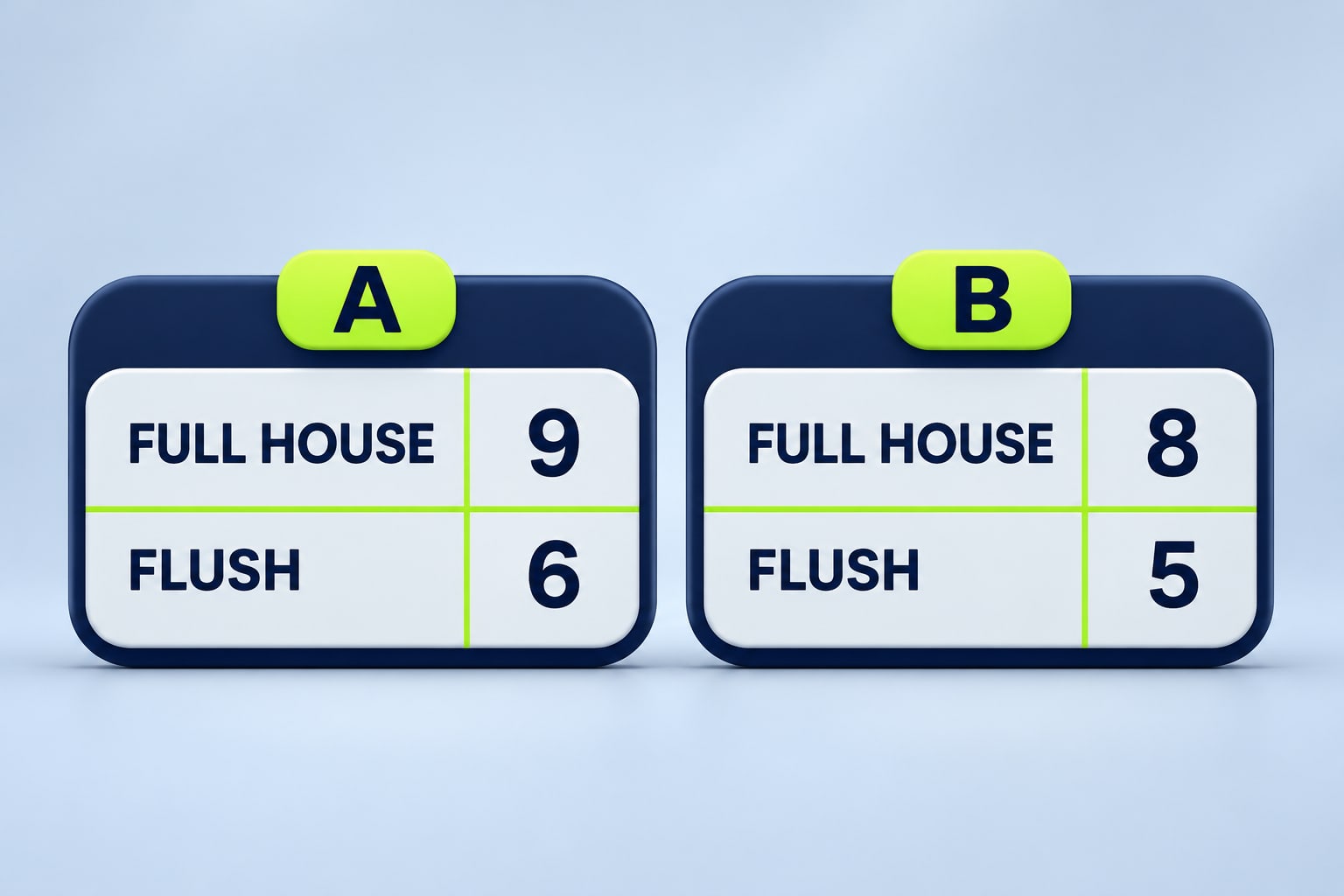
Visual explainer
A small row change affects the award
Illustrative five-credit Jacks or Better wagers, with proportional full-house and flush payments.
Full house
45 → 40
9-per-credit row: 45 credits. Reduced 8-per-credit row: 40. Difference: 5 credits.
Flush
30 → 25
6-per-credit row: 30 credits. Reduced 5-per-credit row: 25. Difference: 5 credits.
At $0.25 per credit, a five-credit difference is $1.25. This compares individual awards, not the complete game’s theoretical return.
Assumes the illustrated rows and stake. Other rows, royal-flush treatment and strategy also matter. Related: Full-pay VP (fp) · Bonus Deluxe Video Poker.
A comparison with a reference schedule
Short pay or partial pay describes a video-poker paytable that pays less on one or more categories than a recognised full-pay version of the same game. The reference matters: full pay is a conventional description of a particular schedule, not a promise that the player receives every wager back. Nor does short pay necessarily mean a machine has malfunctioned or failed to honour a winning hand. The listed awards may be lower by design. To evaluate the difference, compare the exact variant, every paytable row, the number of credits wagered and any special features. A reduced schedule should not be judged by its title or artwork alone.
The familiar 9/6 and 8/5 example
In common Jacks or Better shorthand, 9/6 identifies a schedule paying nine units for a full house and six for a flush per unit wagered, within the relevant paytable convention. An 8/5 schedule reduces those two figures to eight and five. If otherwise comparable five-credit columns pay proportionally on these hands, the full-house awards would be 45 versus 40 credits and the flush awards 30 versus 25. These examples isolate two rows; they do not specify every prize or prove that two machines are otherwise identical. Check the royal-flush treatment, other awards and game rules before using the shorthand as a complete mathematical description.
Why small reductions affect return
The return contribution of a hand depends on how often it occurs under the chosen strategy and how much it pays. Reducing an award removes value each time that category is reached, even if the jackpot row remains unchanged. Across many possible hands, those differences affect the expected return. A player looking only at the largest advertised prize can therefore miss a meaningful change in the schedule. The precise reduction is not calculated simply by subtracting one percentage point for every missing credit. It requires the game's probabilities and strategy. A lower payout on a relatively common hand can matter more than its modest-looking credit difference suggests.
The best hold can change too
A changed paytable can alter the expected value of competing draws. If a flush pays less, a hold aimed partly at making a flush may become less attractive relative to another option. The correct strategy therefore belongs to the exact payout schedule, not merely to the broad name Jacks or Better. A familiar full-pay chart can still contain many suitable decisions while differing on particular hands. Use a matching chart or calculator when assessing the theoretical return. The resulting figure assumes the model's decisions and rules; it does not promise a particular session outcome or compensate for choosing a stake larger than the player can comfortably lose.
Avoid comparing different games by two numbers
The same shorthand can appear in different video-poker families whose other awards vary substantially. Bonus Poker, Double Double Bonus and Jacks or Better do not become identical because two paytable rows share numbers. Wild-card games require another comparison again. Some variants add features that change the stake, probabilities or award distribution, so a base-game schedule alone may not describe the whole product. Record the full paytable rather than relying on a label remembered from another cabinet. The practical question is which complete rules and awards apply to the actual wager being considered. Full pay and short pay are useful comparative labels only after that context is established.
Reading the label without overreacting
A short-pay schedule can still produce a large win, and a full-pay schedule can still produce a losing session. Those observations do not disprove their different expected returns. Likewise, full pay does not automatically mean a positive expectation, while a lower-return game is not made financially safe by a smaller-looking jackpot. The label helps identify a less generous schedule relative to a stated reference. It should prompt a rules comparison, not a claim that a machine is dishonest or that losses must be recovered elsewhere. Decide whether to play at all, keep a fixed entertainment budget, and treat any theoretical return calculation as a long-run model rather than a withdrawal forecast.