In video poker, 9/6 commonly identifies a paytable paying nine credits for a full house and six for a flush per credit wagered; the rest of the paytable still matters.
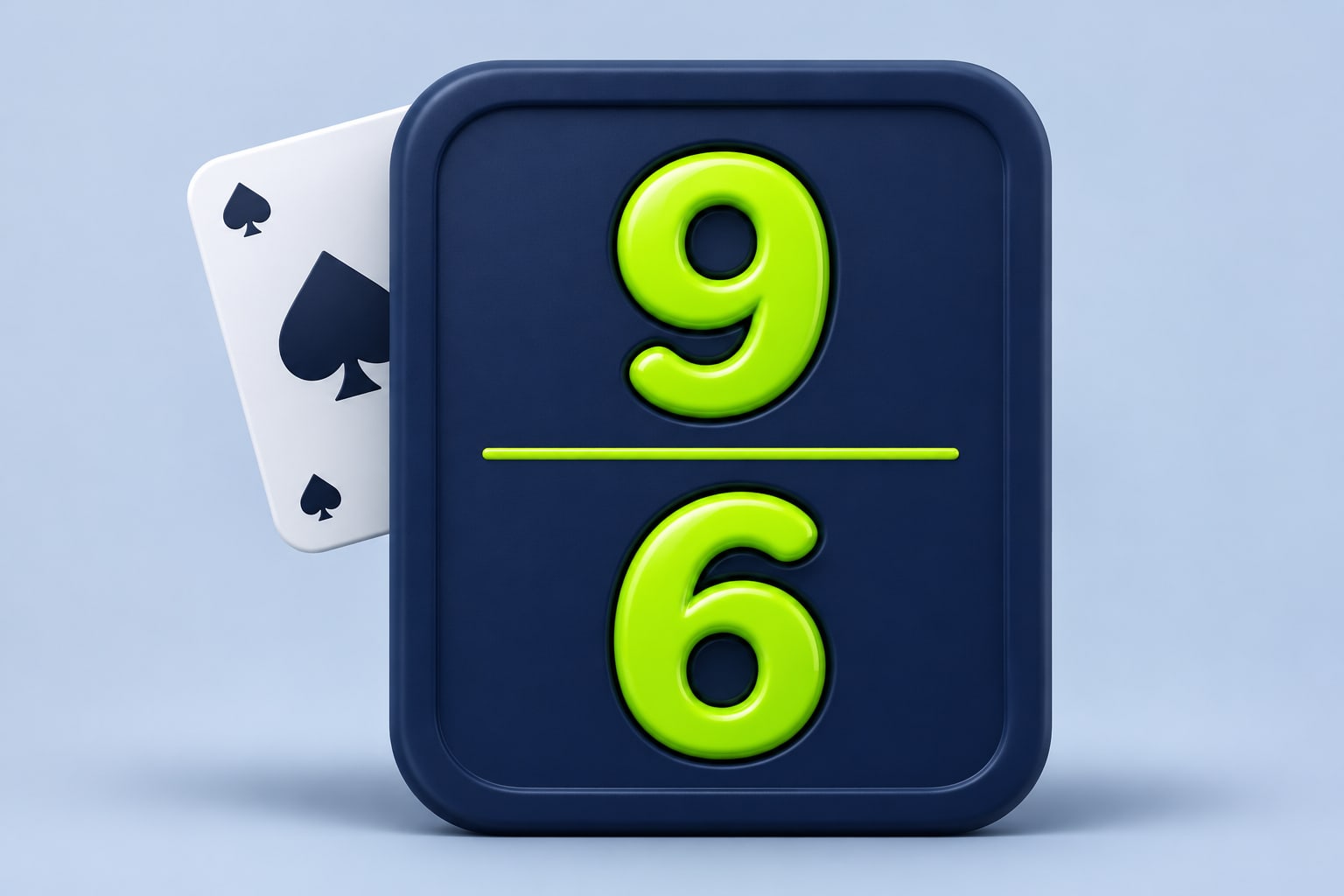
What the two numbers describe
The notation 9/6 is a shorthand for two award rows rather than a complete game name. In the familiar Jacks or Better context, nine refers to the full-house payout and six to the flush payout per credit bet. It does not describe nine cards, six decks or the chance of making either hand. Writers may also use 9/6 when discussing other video poker variants with those same two awards. Always read the title alongside the numbers. Two different games can share a 9/6 label while offering different payments for four of a kind, two pair or a royal flush.
Visual explanation
9/6 names two paytable rows
In conventional 9/6 Jacks or Better, these are awards per credit bet.
Full house9 credits
With five credits bet: 9 × 5 = 45 credits returned.
Flush6 credits
With five credits bet: 6 × 5 = 30 credits returned.
Check every row, including the royal-flush award and the number of credits bet. The shorthand alone does not establish a complete game return. See paytable.
Converting the rows into credits
If the awards scale normally with the number of credits wagered, a five-credit full house on a 9/6 table pays 45 credits and a five-credit flush pays 30. At a denomination of 25 cents per credit, those totals equal $11.25 and $7.50 respectively. The five-credit round itself costs $1.25. Video poker award displays generally show the total credited for the winning hand, so do not automatically add the stake again when calculating the balance change. Read the game's specific notation and review a round history if necessary. A denomination change alters the cash amounts even when the 9/6 label remains identical.
Why Jacks or Better uses the label
The full-house and flush rows are convenient comparison points because common Jacks or Better versions reduce one or both of these awards while leaving many other rows unchanged. A conventional full-pay 9/6 Jacks or Better table, with its standard remaining awards and qualifying royal-flush configuration, has a theoretical return of about 99.54 percent under optimal play. That familiar figure belongs to the complete rule and paytable package. It should not be attached to any game merely because two rows happen to show nine and six. Confirm the royal flush, straight flush, quads, straight, trips, two-pair and high-pair awards as well.
The importance of the royal-flush column
Many traditional video poker paytables give a disproportionately large royal-flush award when five credits are wagered. For example, a table might pay 250 credits per credit at lower settings but 4,000 credits for a five-credit royal. The effective per-credit return therefore changes with the wager configuration even though the full-house and flush rows still look like 9/6. This is why a published return should specify its coin assumptions. It is not a reason to play above a comfortable budget. A lower denomination, a different game or choosing not to play may be more appropriate than increasing the monetary stake solely to match a quoted theoretical percentage.
Strategy and variance remain relevant
Video poker requires hold decisions, and the return calculation assumes the strategy appropriate to the exact awards. Keeping the wrong cards can reduce expected return even on a favourable paytable. A player should not expect the theoretical percentage to appear in every hundred hands or every session. Rare hands contribute to the long-run calculation, and short sessions can finish far above or below it. A 99.54 percent theoretical return also does not mean a 99.54 percent probability of winning a hand. Return measures money paid relative to money wagered over the mathematical model, whereas hand frequency and session-profit probability answer different questions.
Using the shorthand in a comparison
Record the full game title, software version where shown, denomination, credits wagered and every payout row when comparing two machines or online games. Note optional multipliers or extra-credit features because they can change both cost and return. If bonus funds are involved, separately check game eligibility and contribution toward wagering requirements. A game with attractive mathematical rules may be excluded from a promotion or subject to a different contribution rate. Treat 9/6 as a quick clue that tells you where to look in the paytable. It is useful vocabulary, but it is not a complete rating of a casino, a promise of profit or a substitute for reading the rules.