Odds off means a craps odds wager is temporarily not working and cannot win or lose on that roll. Come odds are commonly off on a new come-out roll, while the underlying established Come bet remains active.
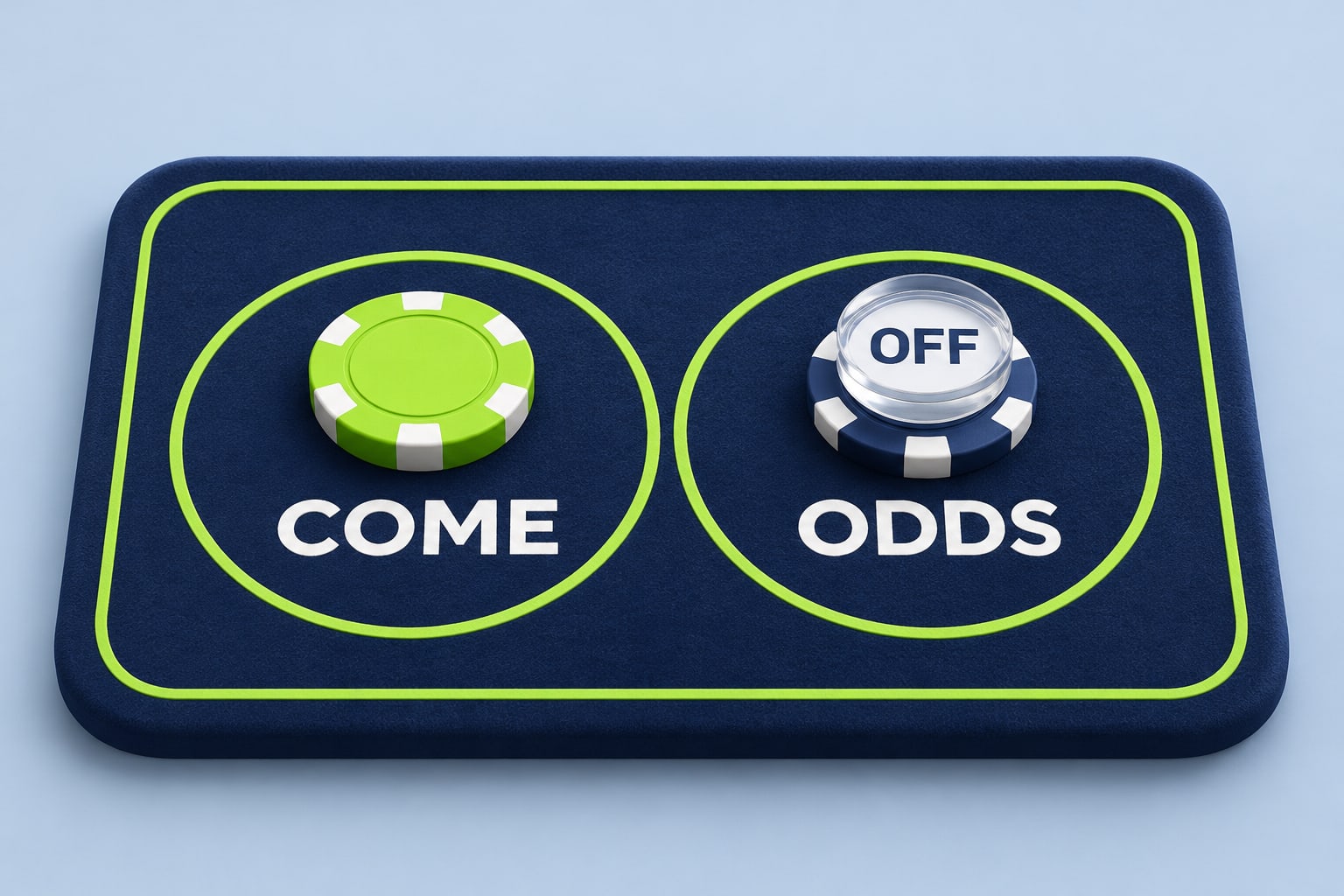
Visual explainer
Odds off does not turn off the base bet
Example: an established $5 Come bet on 6 carries $10 odds. A new come-out roll begins with those odds off.
New roll is 7
Base loses $5
The inactive $10 odds do not lose and are returned. Net result: −$5.
New roll is 6
Base wins $5
The inactive $10 odds earn nothing and are returned. Net result: +$5.
The established Come bet remains working in this example. “Off” describes the odds portion; it does not change the probability of a 6 or 7.
Common default treatment; confirm the dealer or interface’s working status and the table rules. Other roll totals leave this example unresolved. Related: Come · Come Out Roll.
A wager temporarily stops working
Odds off describes the working status of an odds wager in craps. When the odds are off for a roll, that portion of the player's money does not win or lose on the result. It is a temporary suspension of the wager's action, not a change to the dice probabilities or the payout ratio when the bet is working. The phrase is particularly useful for odds attached to an established Come bet during a new come-out roll. The odds portion and the underlying flat bet must be considered separately. Turning one off does not necessarily remove or protect the other.
Why Come bets can survive into a new round
A Come bet establishes its own number after it travels from the Come area. That number can differ from the shooter's Pass Line point. If the shooter makes the Pass Line point first, the table moves to a new come-out roll while an earlier Come bet may still be waiting on its own number. Under common rules, the odds attached to that Come bet are off on this new come-out roll unless called working. The flat Come bet remains active. This overlapping timing explains why a player can have a settled Pass Line wager and an unresolved Come wager at the same table.
An example with a seven
Suppose an established ten-unit Come bet is on the six with ten units of odds attached. The shooter has made a different Pass Line point and is beginning a new come-out roll. If the Come odds are off and a seven appears, the ten-unit flat Come bet loses, while the ten-unit odds stake does not lose and is returned under the usual procedure. The off status therefore protects only the odds portion for that roll. It does not turn the established Come bet into a new Come wager that wins on seven. The bet's existing number and stage remain important.
An example with the Come number
Using the same established Come bet on six, suppose the next come-out roll is a six while its odds are off. The flat Come bet wins at its normal even-money rate, but the odds portion does not earn the six-to-five odds payout because it was not working. The odds stake is returned under the usual settlement procedure. If the player had properly called those odds working before the roll, both the exposure and possible payment would be different. Off is therefore not a free option to avoid a losing outcome while still collecting a win. It suspends both sides of that wager's action.
The table puck is a different signal
The main ON or OFF puck indicates whether the shooter has an established Pass Line point. It does not by itself describe the working status of every individual wager on the layout. Some bets continue to work during a come-out roll, and defaults differ by bet type and house procedure. Odds on Don't Come bets, for example, commonly remain working under standard arrangements, unlike Come odds. Do not transfer one bet's default to every other stack of chips. Ask the dealer to confirm exactly which wager is being discussed and whether a separate marker or verbal instruction is required.
Give instructions before the roll
Any request to turn eligible odds off or on must follow the table's timing and acceptance procedures. Make the request while betting is open and obtain a clear acknowledgment before the dice are thrown. A request after seeing the result cannot retroactively change whether a wager worked. Electronic versions may use different controls or fixed rules, so read their help screens instead of assuming the live-table procedure applies. Removing a permissible odds wager and leaving it on the layout but off can also be administratively different. The essential check is the accepted status of the particular odds bet for the upcoming roll, together with the separate status of its flat wager.