Multiple paylines are several defined paths across a slot’s reels on which qualifying symbol combinations can pay. The total cost depends on how the game prices those lines; more lines do not automatically mean better value or a profitable spin.
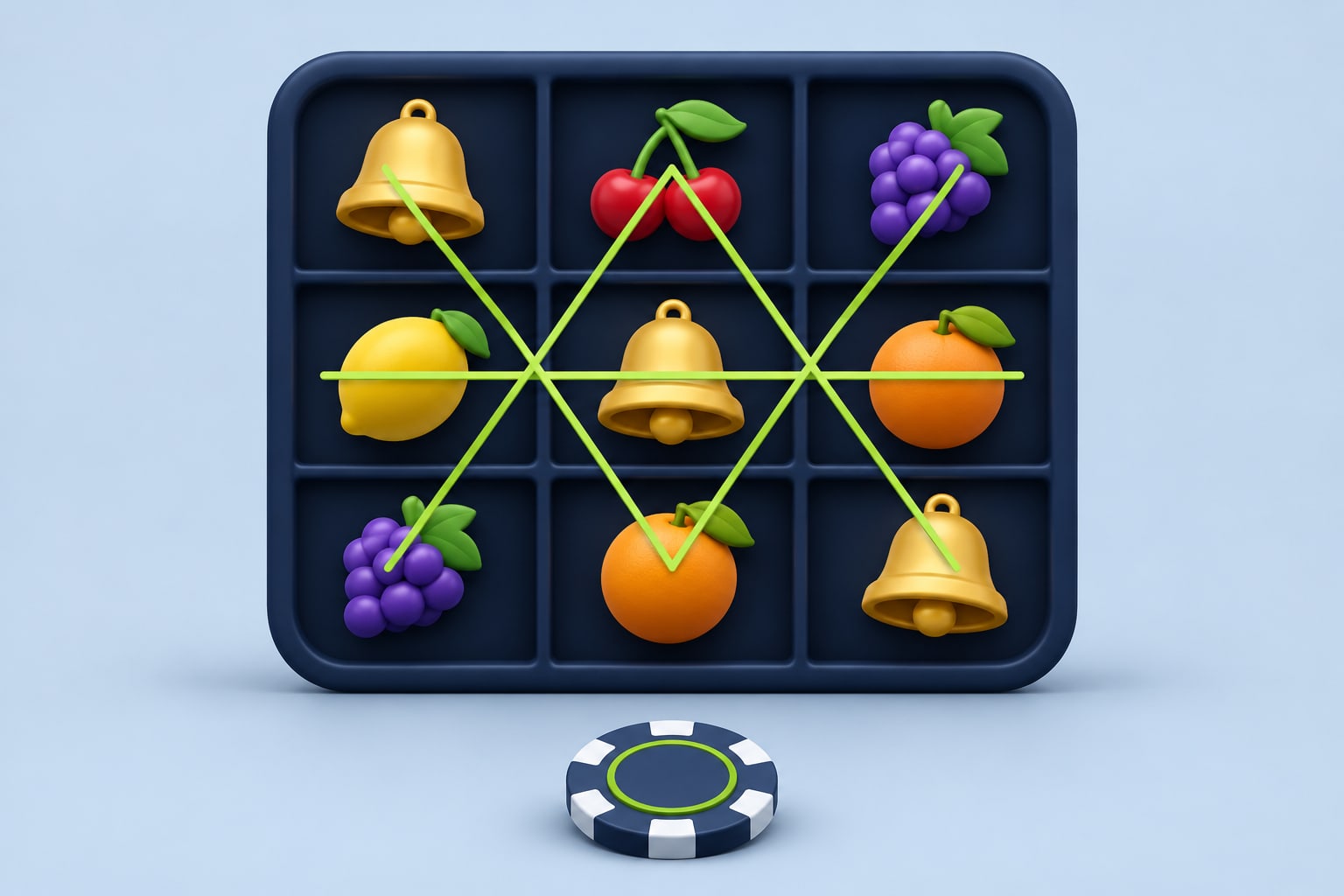
Several paths across the reels
A payline is a defined path used to evaluate certain symbol combinations on a slot. Multiple paylines means that the game has more than one such path. Lines can run horizontally, diagonally or through a more elaborate sequence of reel positions. The screen's rows and the game's paylines are therefore not necessarily the same thing. A five-reel screen with three visible rows can support many defined paths. Read the line diagram and paying direction rather than assuming every group of similar symbols forms a win. The rules determine which positions must connect and how many matching symbols are required.
Active lines and total stake
On a game with selectable lines and a separate stake per line, the total line wager is generally the number of active lines multiplied by the amount on each line. For example, twenty lines at 0.05 units per line cost one unit for the spin, before any separately priced feature. Increasing to forty lines at the same line stake doubles that cost. Other games keep all lines active and offer a single total-bet control instead. The interface should explain which model applies. Always read the final total before starting a round; a small line amount can disguise a much larger combined wager.
More coverage is not free coverage
Activating more lines can allow additional defined combinations to pay, but that benefit must be considered alongside the price. It does not follow that buying more coverage improves the expected return per unit wagered. Nor does a greater number of paying paths guarantee that the final result will exceed the total stake. A spin costing two units might produce several small line awards totalling 0.80, leaving a net loss of 1.20. Count the combined return against the combined cost. The number of highlighted lines, sounds or animations is not a substitute for checking the actual balance change.
Line wins and other awards
A slot can include payline wins alongside scatter awards, bonus triggers or other features that use different conditions. A scatter may pay or trigger a feature without following an ordinary line, depending on the rules. Conversely, a visually impressive pattern may not pay if it falls outside the active line structure or fails the required direction. Some games evaluate wins from left to right, while others use different arrangements. Check whether only the highest qualifying combination on a line is paid and how simultaneous awards are combined. These details explain the result more accurately than a simple count of identical symbols on the screen.
Different from ways and cluster systems
Not every slot evaluates ordinary wins through fixed paylines. A ways-to-win game or a cluster game can use a different method of identifying qualifying groups. Large advertised numbers of ways should not be read as an equivalent number of separately selected line bets without consulting the rules. Likewise, comparing a twenty-line game with a game advertising thousands of ways does not by itself identify which has the higher RTP or lower volatility. The mathematics, prize distribution and wager structure matter. Use the appropriate terminology for the actual mechanic so that a comparison does not mix unlike measures of coverage.
Reading the settings before a spin
Identify whether lines are selectable, whether the control shows a line stake or total stake, and whether an additional feature changes the amount charged. Check the active currency or credit value and the paytable for the chosen configuration. If a game requires a particular setting for a jackpot or bonus, read that condition separately rather than assuming maximum coverage is always necessary. Keep the total wager within a limit set before play. Multiple paylines explain how some slots organise their paying patterns; they do not make a spin predictable, create a reason to increase expenditure or establish that a game is due to produce a profitable combination.