Expected win rate is a theoretical average result expressed per stated unit, such as money wagered, hands played or time. It must identify whose result is measured and is not the same as the frequency of winning outcomes.
Visual explainer
Convert the percentage into a stated unit
Illustrative model: 50 wagers per hour, $10 per wager and a 2% house edge on that wager base.
Casino perspective
+$10 expected
2% × $500 = $10 expected casino win per modelled hour.
Player perspective
−$10 expected
The same model describes $10 expected player loss, before any separately excluded costs.
This is a theoretical hourly average—not a win frequency, a spending limit or a guaranteed hourly result. Changing stake or pace changes the calculation.
All assumptions are illustrative. Extra stakes and different rules must be included where relevant. Related: Games per hour · Negative Expectation.
Define the unit before comparing the number
Expected win rate describes an average result predicted by a mathematical model, stated relative to a particular measure of play. That measure might be money wagered, a hundred hands or an hour. The phrase is incomplete without the unit and the point of view. A casino's expected win is generally a cost to the player, while a player's expected profit is stated from the opposite side. A percentage of turnover cannot be compared directly with units per hour without knowing the pace of play and the average stake. Before using a figure, establish what is counted, what is excluded and which rules or decisions the calculation assumes.
A percentage example from the house perspective
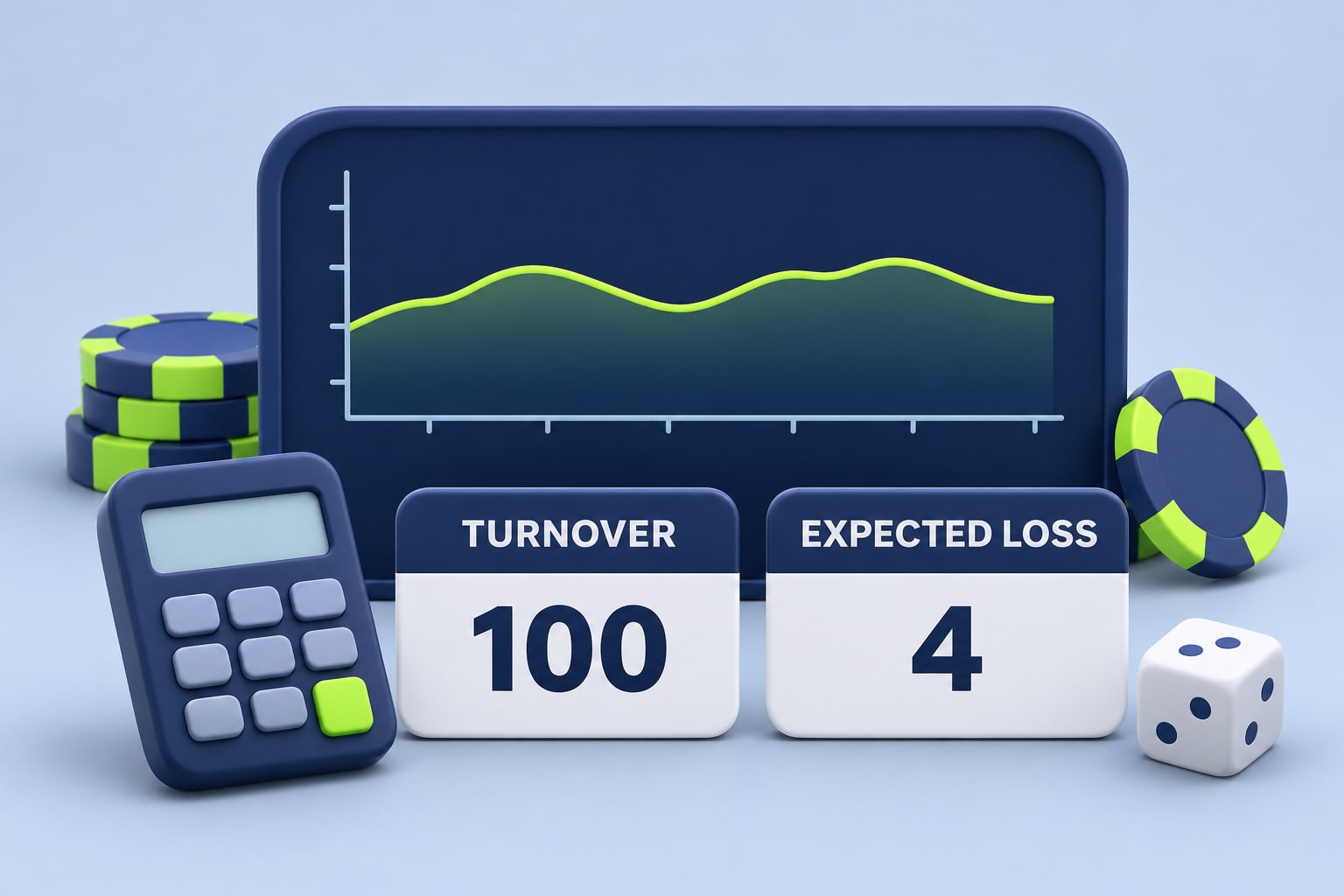
Consider an illustrative game with a four percent house edge measured against its defined wager base. If qualifying turnover is 100 units, the casino's expected win is four units and the player's expected net result is minus four units. This is a probability-weighted average, not a bill collected after exactly 100 units of play. The actual result can be positive or negative for either side over a short sample. If the corresponding return-to-player measure uses the same wager base and includes the same payments, it would be ninety-six percent. The shared basis matters when translating between these descriptions.
Winning often is a different measurement
Suppose a hypothetical game pays 0.90 units of profit on a winning one-unit wager and loses the one-unit stake otherwise, with each outcome equally likely. Its win frequency is fifty percent, but the expected net result is minus 0.05 units per wager: half of 0.90 minus half of one. Calling the game a fifty percent expected win rate would therefore be ambiguous. It might describe frequency while sounding like profitability. Slot hit frequency introduces another distinction because a paying spin can return less than the total stake. State whether a counted win means any payment or a positive net result.
Converting a rate into a session estimate
If a model assumes fifty wagers per hour, ten units per wager and a two percent player disadvantage, expected loss is ten units per hour under those assumptions. The calculation is fifty times ten times 0.02. Changing the pace or average stake changes the estimate even when the percentage edge stays fixed. Extra wagers, doubles or side bets may also change the relevant wager base. This example is an estimate of exposure, not an hourly spending guarantee. A player can lose more quickly, finish ahead or stop before the assumed hour ends, so it should not replace an affordable spending limit.
Observed results do not prove the expectation
A record of past profit divided by hands or hours is an observed rate. It may help describe that sample, but it is not automatically the true expectation for future play. Chance, changing opponents, different rules and incomplete records can all affect the inference. A player who won 200 units in a short session has established that session's outcome, not a dependable income level. In games where decisions matter, the model must also reflect those decisions accurately. Keep measured results, theoretical assumptions and uncertainty separate instead of presenting a favourable run as proof of a permanent advantage.
Use the figure to understand risk
A useful expected-rate statement names the game, rule set, unit, perspective and important assumptions. It also explains that individual outcomes vary and that a favourable theoretical figure, where one genuinely exists, does not guarantee a winning session. Do not multiply a claimed hourly rate by unlimited hours as though gambling were a fixed wage. Bankroll constraints, changing conditions and the possibility of losses remain relevant. When reading a casino review, prefer a transparent explanation over an unexplained percentage badge. The purpose of the term is to clarify the average economics of play, while leaving the uncertainty of actual results visible.