Manque is the French roulette term for the low-number outside bet covering 1 through 18 inclusive. It normally pays even money.
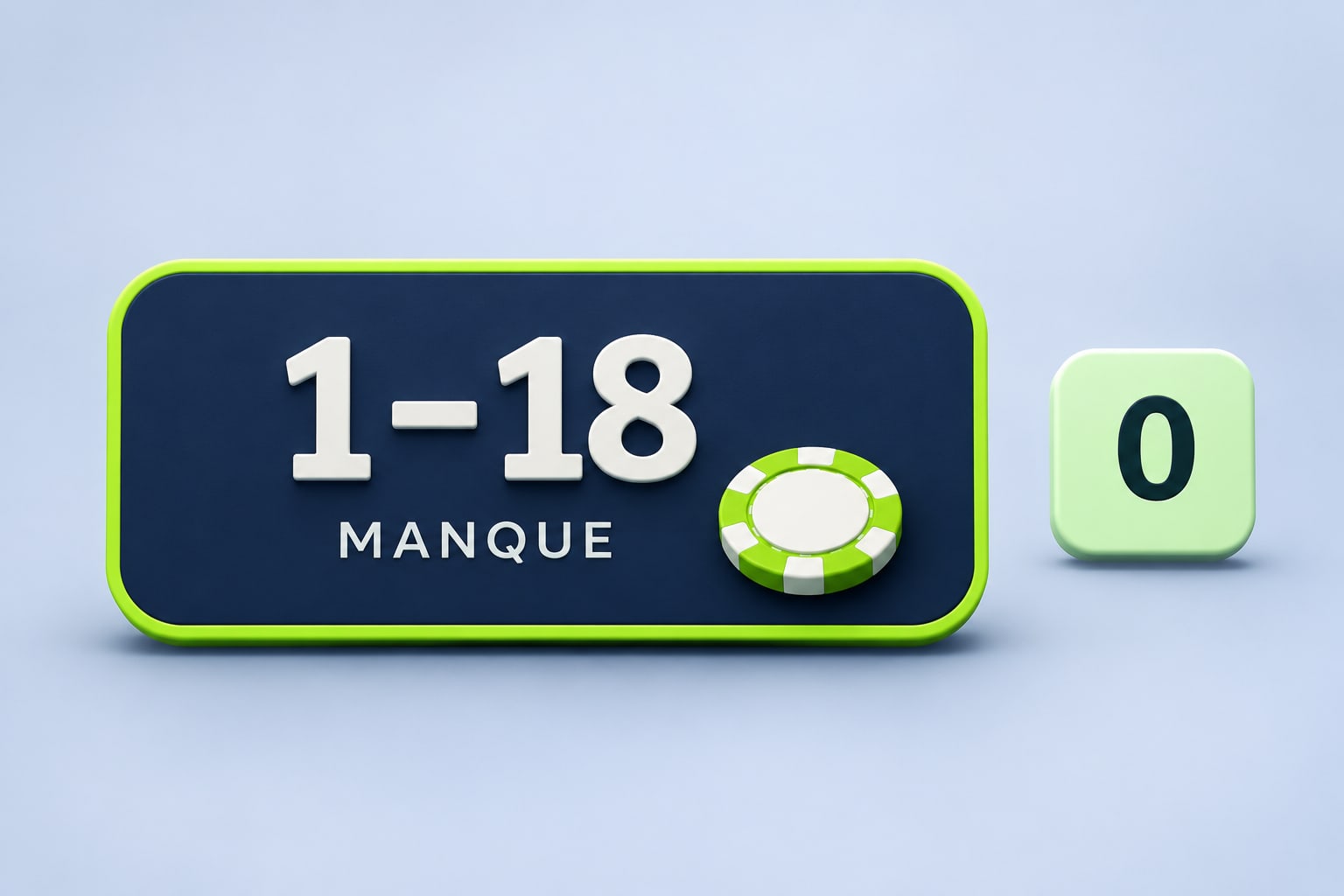
Visual explainer
Manque means the low half of the numbered grid
Ordinary single-zero roulette: low numbers 1–18, not a colour selection.
Covered by manque
Not covered
Example result: 7
Wins
7 is in 1–18.
Example result: 20
Loses
20 is outside 1–18.
Example result: 0
Loses
Zero is not included under these ordinary rules.
A $4 winning wager returns $8 altogether: $4 profit and $4 original stake. The range, not the pocket’s colour, decides coverage.
Confirm the wheel and any special zero treatment in the actual rules. Related: Outside Bets · Roulette.
The low-number bet
Manque is the French roulette label for a wager on numbers one through 18 inclusive. It is often called low or 1–18 on an English-language layout. The opposite high-number category, covering 19 through 36, is called passe. These are outside bets because they are placed in the category areas around the numbered grid rather than on a single number. Manque is not a bet that the ball will physically land on one half of the wheel. The covered numbers are distributed around the wheel, while the category is defined by their numerical values. The French name changes the terminology, while the printed range makes the coverage clear to readers of any language.
Winning and losing results
A manque bet normally pays even money if the winning number is between one and 18. A result from 19 through 36 loses. Zero is outside both categories and is settled under the game’s zero rules. For example, a winning eight-unit manque wager earns eight units of profit and returns the eight-unit stake, producing 16 units in total. A result of 18 qualifies, while 19 does not. The boundary is inclusive at both one and 18. Checking these endpoints helps avoid confusing the wager with a dozen bet, which covers only 12 numbers and has a different payout.
A category rather than a wheel sector
The numbers one through 18 are consecutive on a numerical list, but they do not form one continuous arc of a standard roulette wheel. A wheel-sector wager such as neighbours of zero is a different proposition with its own chip placements and coverage. Manque also differs from betting on a column, which selects every third number in the layout. A player should not infer the wager from where the ball has recently landed around the rim. The accepted betting area determines the coverage. Use the label 1–18 or manque to identify this particular category, regardless of the visual wheel arrangement.
Probability and house edge
On a fair single-zero wheel, manque covers 18 of 37 pockets, a winning probability of approximately 48.65 percent. If every other pocket loses the full stake and winners pay even money, the house edge is approximately 2.70 percent. A double-zero wheel has 38 pockets with the same 18 low winners, producing a different probability and a house edge of approximately 5.26 percent under full-loss zero rules. These are conditional calculations, not universal figures for every table labelled manque. Extra zero pockets or special settlement conditions require the calculation to be adjusted to the actual game.
Check the treatment of zero
French terminology does not by itself guarantee a particular zero rule. Some tables apply la partage to qualifying even-money wagers, returning half the stake when zero appears. Others use an en prison procedure that holds the wager for later resolution, with details specified by the game. A table can therefore use the familiar low-number label while offering materially different conditions from another table. Read the rules rather than relying on the language or theme. Zero is never one of the numbers one through 18; any partial return is a special settlement provision, not a winning manque result.
What recent results cannot tell you
A run of high numbers does not make a low number due on the next independent spin. The wheel does not track whether manque has received its fair share during a short session. Betting more after a losing sequence changes the amount at risk without changing the category’s coverage. Likewise, backing both manque and passe with equal stakes does not create a free bet: ordinary numbered outcomes offset, while zero treatment still matters for both stakes. Keep the total exposure clear and choose a spending boundary before play. The term is useful vocabulary for reading roulette layouts, not a signal of a favourable betting opportunity.