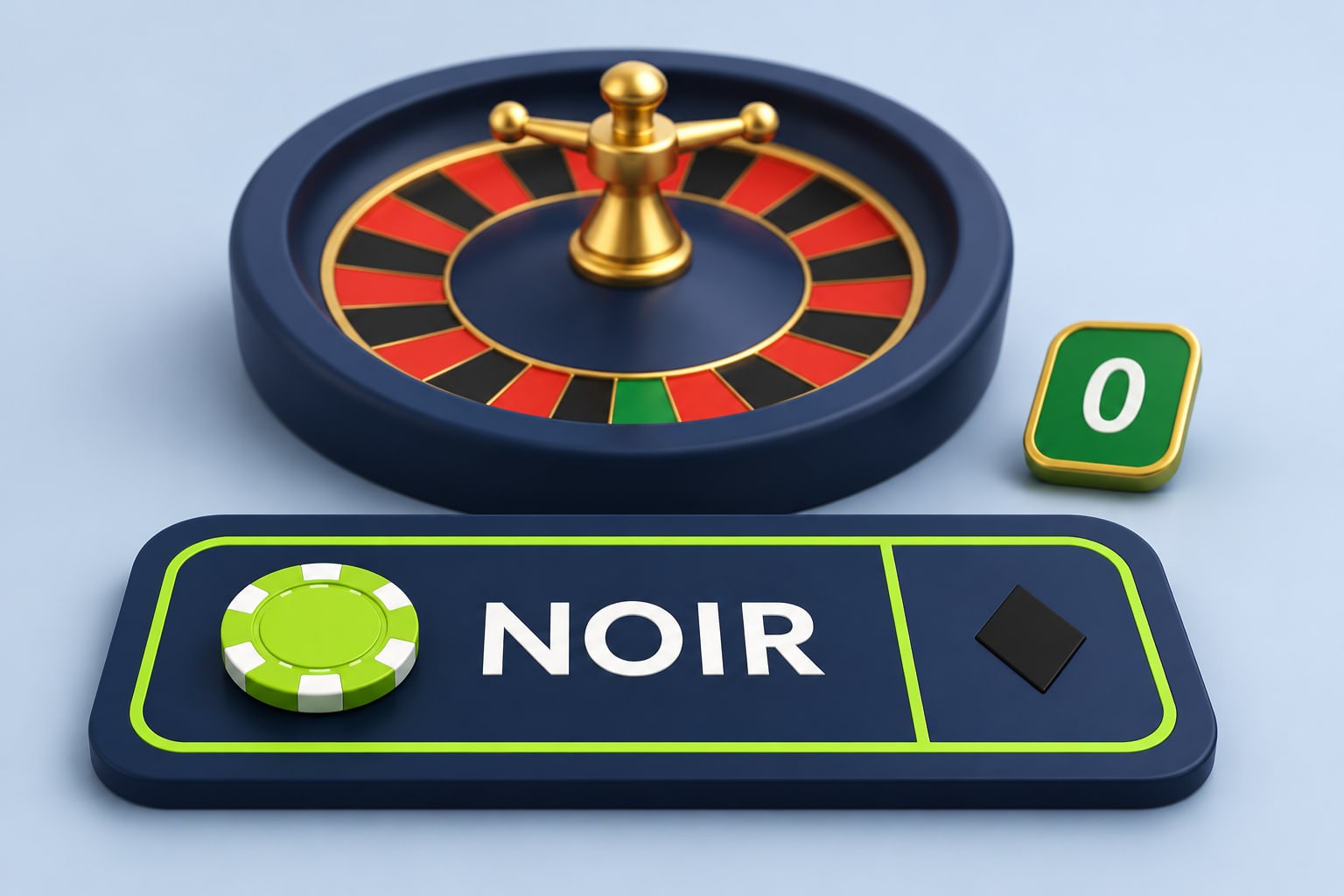
Noir is French for black. On a roulette layout, it identifies the outside bet that wins when the ball lands on a black numbered pocket, subject to the particular game rules.
Visual explainer
Black covers 18 pockets, not half the wheel
Ordinary single-zero roulette; zero loses the full outside stake.
Black: winning pockets18 / 37
18 black pockets win the noir bet.
Red plus zero: losing pockets19 / 37
18 red pockets + 1 green zero.
Illustrative stake
$3
One wager on black.
Black result
$6 returned
$3 profit plus the original $3 stake.
The win probability is 18/37 ≈ 48.65%. An even-money payout is not a 50% win probability.
Bars share a zero-to-37 scale. Special zero rules can change settlement; a French label alone does not establish them. Related: Roulette · House Advantage or House Edge.
Reading the label on a roulette table
A French-language roulette layout may label its black betting area noir and its red area rouge. The words identify colours rather than different versions of the underlying wager. Placing a chip on noir normally covers all 18 black numbers on the standard numbered wheel. It does not cover zero, which belongs to neither the black nor the red outside bet. Some digital layouts use a black diamond instead of a word, while others show both. Use the help screen or the highlighted coverage if the design is unfamiliar. The same colour selection can appear on several wheel types, so the label alone does not establish the number of zero pockets.
How a standard black bet settles
Under conventional rules, a winning black bet pays even money, meaning profit equal to the amount staked. A three-unit wager therefore produces three units of winnings and returns the original three units when a black number appears. A red result loses the wager. A zero result also normally loses it unless a specific zero-related rule changes that settlement. Software may show the total credited amount rather than profit, making the successful return appear as six units in this example. Read the payout convention carefully before comparing games. An even-money payment describes the amount won; it does not mean that the chance of winning is exactly one half.
The role of zero in the probability
On a fair single-zero wheel there are 18 black pockets among 37 total pockets. That gives a black wager 18 winning outcomes and 19 losing outcomes under ordinary settlement. For a one-unit bet, the average net result is therefore negative one unit divided by 37, approximately negative 2.70 percent of the stake. A conventional double-zero wheel has 38 pockets and the same 18 black winners, so its additional zero changes that calculation. These are theoretical long-run averages for the stated assumptions. A short session can produce outcomes far above or below the average, including several consecutive wins or losses. Neither run changes what the label noir means.
Checking special zero rules
Some roulette tables provide la partage or en prison for eligible even-money wagers. These rules can reduce the cost of a zero result, but their operation and availability must be confirmed for the particular table. A French word on the betting cloth is not proof that either feature applies. La partage commonly returns half an eligible stake after zero; en prison can hold a stake under additional settlement conditions. Do not assume those descriptions cover every implementation, especially repeated zeros or special online variants. Read the rule panel before relying on a reduced house-edge figure. The wheel configuration, payout and zero treatment all belong in an accurate comparison.
Why recent colours do not predict the next spin
A display showing several red results can make black seem overdue. On independent fair spins, that history does not increase the chance of black on the next round. Likewise, a streak of black does not establish that the wheel will continue favouring noir. Betting progressions change the amount exposed after wins or losses; they do not change the pocket probabilities. For example, doubling a stake after each loss makes the next wager larger even though its underlying colour chance is unchanged. Finite funds and table limits can prevent continued doubling. Interpret the result history as a record of completed spins, not as a promise about the next outcome.
Using the term without increasing exposure
Before placing a noir wager, confirm the accepted chip amount, the table minimum and whether any previous bets remain on the layout. An online rebet control may restore several selections at once. Betting on both black and red at equal stakes does not remove the zero risk under ordinary rules; the colour outcomes offset while a zero can lose both wagers. Keep the total round stake visible and within an affordable limit chosen beforehand. In a glossary or game review, noir is simply useful vocabulary for recognising a familiar outside bet. Understanding the French label should make the rules clearer, without suggesting that its language or appearance offers a mathematical advantage.