In slot terminology, a line usually means a payline: a defined path through symbol positions used to evaluate a winning combination. Some games use other systems, so not every slot win requires symbols to lie on a payline.
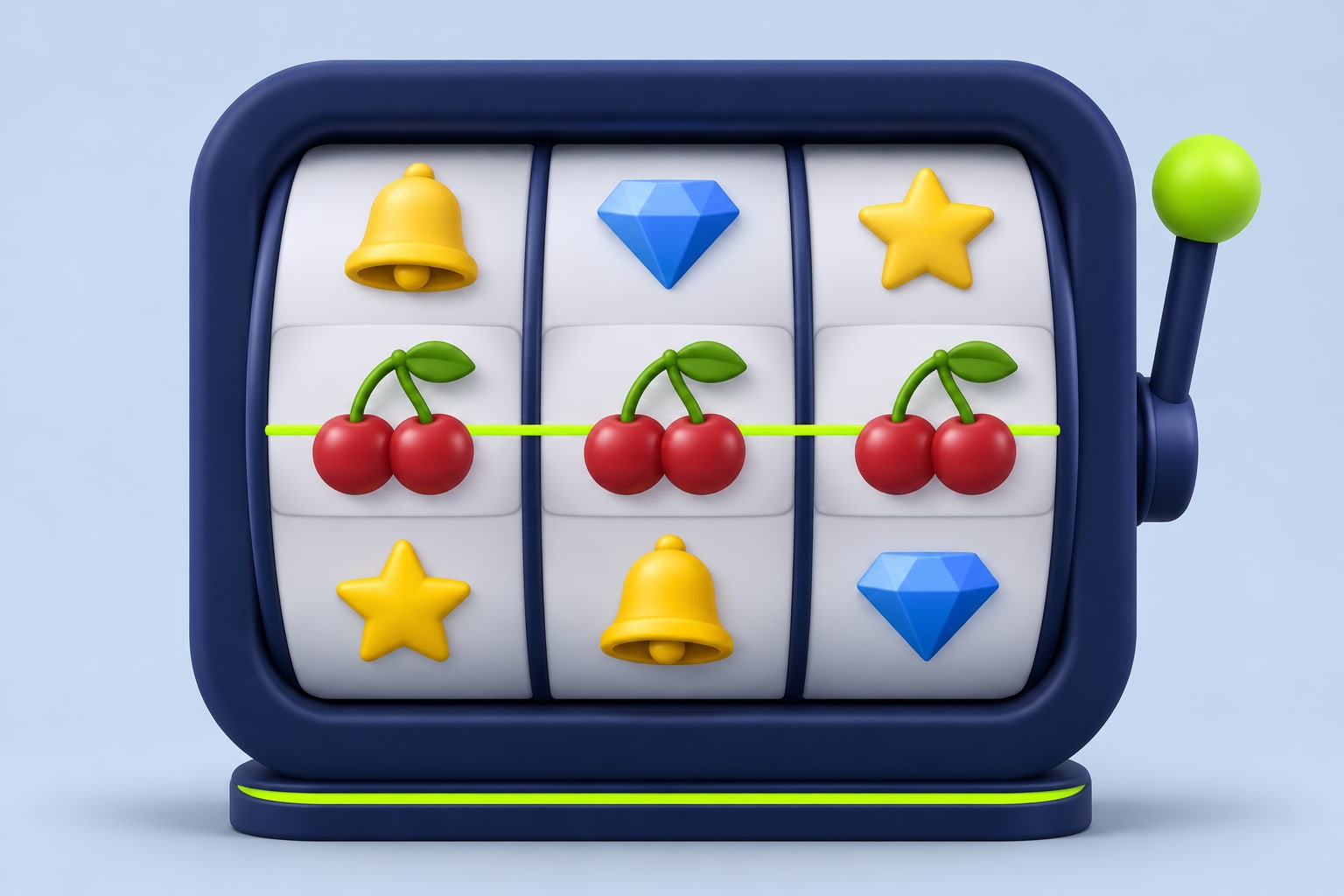
Visual explainer
A payline is a path through the reels
Hypothetical three-reel game: three matching A symbols on the active middle line pay.
Read the highlighted middle row from left to right: A → A → A. Symbols elsewhere do not form part of this example’s line.
The rule is illustrative. Scatter, cluster and ways-to-win games can evaluate symbols differently. Related: Payline · Scatter Pays.
A route through the symbol positions
A payline defines which positions the game reads together when evaluating a line-based combination. A simple three-reel example may use the middle position on each reel as one horizontal line. More elaborate games can include diagonal or zigzag paths across several reels. The line is a rule-defined route rather than a physical line that must always be visible during the spin. Many interfaces display it only when selected or when explaining a result. To understand a claimed line win, identify the path, the symbols occupying it and the matching sequence required by the paytable.
Matching pictures must satisfy the complete rule
Suppose a hypothetical slot pays for three cherries on an active horizontal middle line. Cherries in the middle position of all three reels satisfy that example, while cherries scattered in unrelated top and bottom positions may not. A different game could evaluate those positions through a scatter or cluster rule, so the illustration should not be applied universally. The line may also require matching to begin at the first reel, while another game permits different directions. Read the starting-position and length conditions. Seeing the right number of matching pictures somewhere on the screen is not enough to establish a line-based award.
Active lines can affect the total stake
In a game that allows separate line selection, the number of active lines and the amount staked on each can combine to determine the total bet. Twenty lines at five cents each would cost one dollar for the spin under that structure. Activating forty such lines would cost two dollars. Other games keep all lines active and offer a single total-bet control instead. The visible number of lines therefore does not always function as an independently adjustable multiplier. Check the actual currency amount deducted for the spin rather than assuming that a small line stake is the full price of the round.
More lines do not necessarily improve the percentage return
Adding covered paths can change the chance of receiving some award and the amount wagered, but it does not automatically improve the game's theoretical return percentage. The mathematics depends on the complete model and any rules tied to stake or line settings. A higher frequency of small awards can also include returns below the total spin cost. For example, a fifty-cent prize on a two-dollar spin is a net loss of one dollar and fifty cents, even if one line wins. Keep hit frequency, total return and net result separate. A busy display of winning paths can make those distinctions less obvious without changing the arithmetic.
Some slot systems do not use ordinary paylines
Ways-to-win games, cluster games and certain feature mechanics evaluate symbols using other relationships. Scatter awards can also operate independently of an ordinary line in a game that otherwise uses paylines. This is why the statement that all slot symbols must be on a line to count is too broad. The help screen should identify which evaluation system applies to each category of award. A familiar reel display does not prove that the game uses traditional lines underneath. When explaining a result, use the game's own coverage rules rather than forcing every visible combination into a line-based description.
Check the result and avoid pattern predictions
The game history or win explanation may highlight the line, qualifying symbols and credited amount. Compare that amount with the stake basis used by the paytable, which may be credits, line-bet multiples or another specified unit. If a result appears wrong, retain the round identifier and settings rather than relying solely on a screenshot after the animation ends. A line that has not paid recently is not owed a win on the next independent spin. Understanding paylines helps explain coverage and cost; it does not supply a way to forecast where symbols will land or recover previous losses by adding more paths.