Hot is informal gambling slang for a player, table or machine with recent favourable results. It describes an observed streak; it does not establish that the next independent outcome is more likely to win.
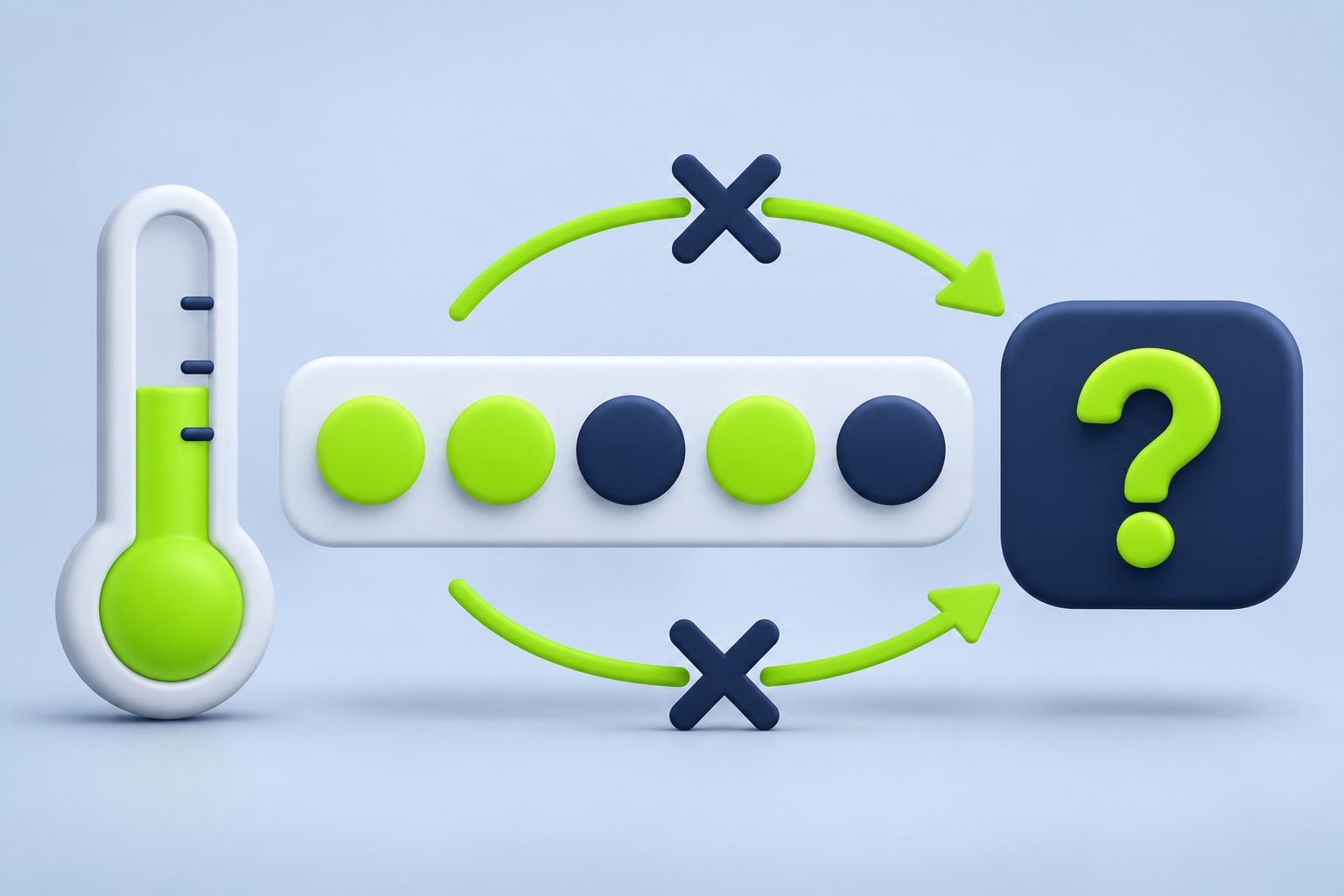
Visual explainer
A hot streak describes the past, not the next spin
Illustrative fair single-zero roulette with independent spins and ordinary full-loss zero treatment.
Observed history
Next spin: red
18 / 37
About 48.65%, under this model.
Next spin: black
18 / 37
About 48.65%, under the same model.
Next spin: zero
1 / 37
About 2.70%.
Red is not made more likely by the streak, and black is not due. Changing the stake changes exposure, not these probabilities.
The independence assumption matters; this illustration does not describe card depletion in a finite deck. Related: RNG (Random Number Generator) · Roulette.
A description of recent results
Hot is an informal label applied to a player who has been winning, a table with several favourable results or a machine that has recently paid prizes. The word does not have a standard numerical threshold. One person may call two successive wins hot, while another may mean a profitable hour or an unusually large award. Ask what observations support the description before treating it as meaningful information. Even a correctly reported streak is a statement about the past. It does not, by itself, establish that the game has changed its probabilities or that another player can expect the same experience next.
Random play can produce clusters
Random outcomes do not need to alternate neatly between wins and losses. Clusters can occur without a hidden switch that makes a machine generous for a while. A short sequence may look striking precisely because people notice patterns more readily than uneventful results. To describe it accurately, record the number of rounds, the stakes and the actual returns. A machine paying something on several spins may still leave the player behind if the returns are smaller than the total wagers. Calling the sequence hot without those amounts can confuse frequent prize animations with a profitable session.
An independent next result is not changed by the streak
In a game with independent rounds under unchanged rules, earlier wins do not make the next round more likely to win, and earlier losses do not make a payment due. Consider a simple hypothetical fair coin experiment: after several heads, the next toss still has the same chance of heads if the coin and process are unchanged. Casino games have their own outcome distributions rather than necessarily using equal chances, but the independence principle is similar. The previous display does not provide a new advantage merely because it looks unusual. A prediction needs relevant information about the game, not just a colourful description of its recent history.
Some game states matter for a different reason
Not every gambling situation is a fresh independent experiment. Cards removed from a finite shoe can change the remaining composition, and a game may have an explicitly disclosed persistent feature or jackpot condition. Those are specific rule-based facts to analyse, not proof of a general hot-machine theory. If a feature changes, identify exactly what changed and how the rules treat it. A visible meter is not enough to infer an undisclosed advantage. Keep legitimate information about the current game state separate from the unsupported idea that a machine must continue paying because someone recently won on it.
A player can feel hot without having a better decision
Winning can affect confidence and encourage larger stakes or longer play. The feeling is real, but it is not evidence that the next bet has become safer. For example, a player who wins twenty units and then risks fifty has increased the amount exposed, even if they describe the extra stake as playing with winnings. Money already won remains part of the player's funds and can be lost. Compare each decision with the original budget and the actual rules. A profitable start does not require another bet, and another bet should not be justified solely by the momentum of the session.
Use precise measures instead of the label
When comparing games, look for defined measures such as the paytable, theoretical return, volatility and hit frequency, while recognising that they answer different questions. Hit frequency can count prizes that are smaller than the stake, and theoretical return is not a promise for a short session. When describing a personal result, net profit or loss over a stated number of rounds is clearer than hot. Avoid chasing a machine after another player wins or increasing stakes because the table appears lively. The label can remain harmless conversational shorthand when it is understood as a past observation rather than a reliable forecast.
Related glossary terms
Sources and further reading
- Antonym:
- Cold