Finales are roulette combinations that group numbers by their final digit, such as 3, 13, 23 and 33; the underlying wagers and total cost must be checked before placing the combination.
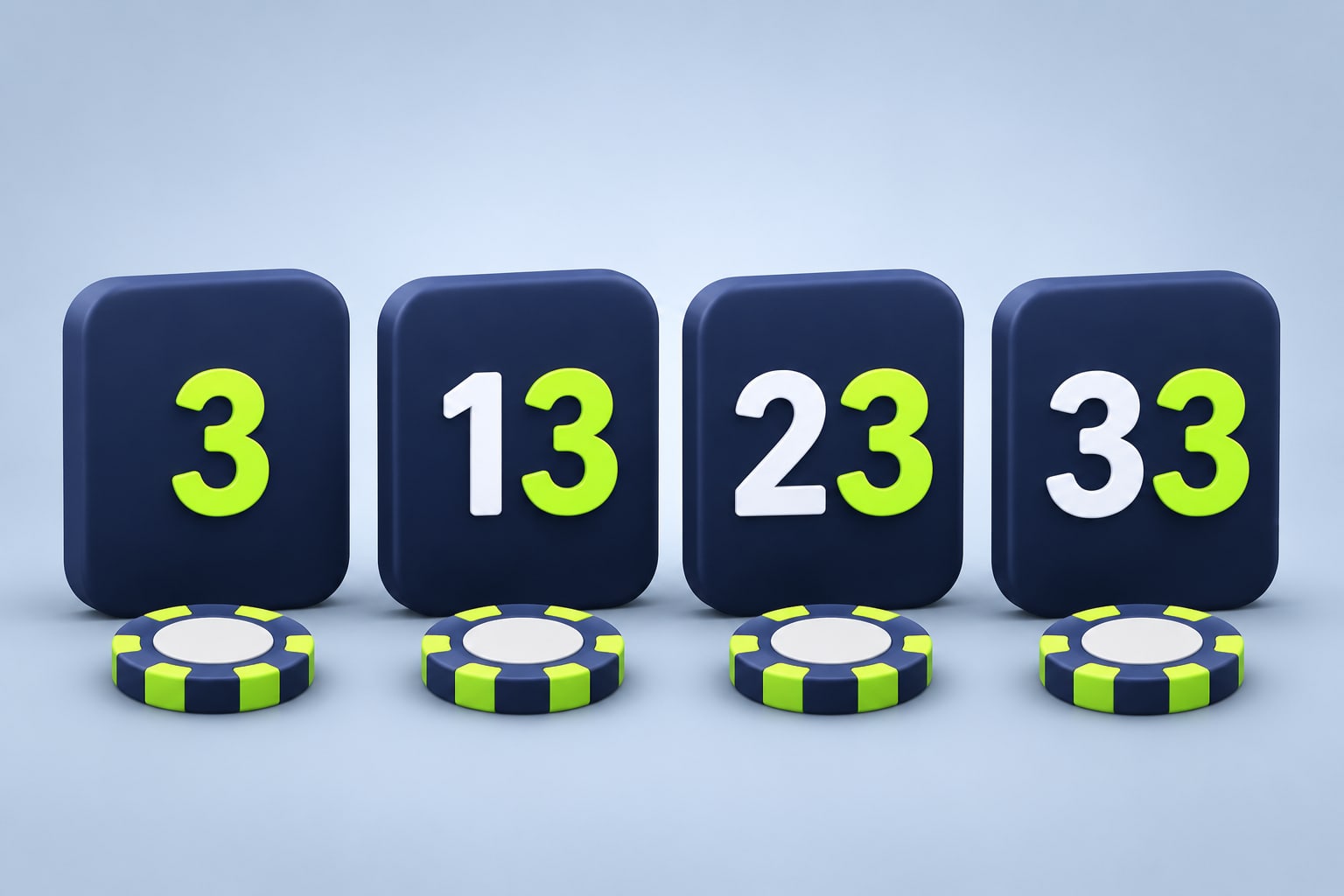
Grouping numbers by their last digit
A finale groups numbers sharing the same final digit. A simple finale 3 therefore selects 3, 13, 23 and 33. The plural, finales, refers to these combinations collectively. They are a way to organize several wagers rather than a new wheel outcome. On a single-zero layout, the straightforward final-digit groups from 0 through 6 each contain four numbers, while groups 7, 8 and 9 contain only three because the numbered sequence ends at 36. Finale 7, for example, contains 7, 17 and 27. These groups are based on written number labels, not neighboring wheel positions. Numbers ten apart on the cloth do not automatically form a continuous physical sector, and a finale should not be confused with a neighbors bet.
A simple straight-up finale example
Suppose a game offers a finale 3 made from four equal straight-up wagers. With a $1 chip on each of 3, 13, 23 and 33, the total cost is $4. If 23 lands, its $1 straight-up wager returns $36 at the standard 35:1 profit payout, including the winning stake. The other three dollars lose. Your net profit for the complete combination is therefore $32, calculated as $36 returned minus $4 staked. It is not $35 profit for the whole round. If none of the four numbers lands, the loss is $4. A finale 7 using three $1 straight-up wagers costs $3 and would return the same $36 when one wins, producing $33 net profit. Different group sizes create different costs and coverage.
Coverage and expected value
With four distinct numbers selected on a fair single-zero wheel, the chance that the combination wins is 4/37, about 10.81%. A three-number finale has a 3/37 chance, about 8.11%. The larger group hits more often but also costs more when each component carries the same stake. For the four-unit example, the expected net result is (4/37 × 32) minus (33/37 × 4), which equals a loss of 4/37 unit per round. Relative to the four units staked, that is the usual 1/37, or approximately 2.70%, house edge. Grouping wagers by their last digit does not change the value of the underlying straight-up bets. It changes the pattern of coverage and the size of the total wager.
Names and interfaces can differ
A table or software menu may use finale terminology for more elaborate combinations, including split-based arrangements or special named selections. Do not assume every button bearing the word creates four equal straight-up bets. Expand the bet preview and inspect the individual positions, chip count and total amount. Zero needs particular care: a standard single-zero finale 0 can include 0, 10, 20 and 30, but the treatment of 00 on a double-zero product must come from that game's definition. The symbol 00 identifies a separate pocket, not simply another spelling of 0. Likewise, a chip denomination of $2 does not necessarily mean the whole shortcut costs $2. If the shortcut places four chips, its cost is $8. Repeating or doubling the combination affects every included wager.
When the term is useful
Understanding finales helps you read French-style roulette menus and identify exactly what a shortcut is doing. It does not establish that numbers with the same ending share a favorable probability. A previous result of 13 does not make 3, 23 or 33 more likely on the next independent round. Nor is the final digit of a timestamp, balance or previous win a useful probability input. Choose any combination only after its full cost fits the amount you intended to risk. Check whether a bonus restricts number coverage or roulette play, since a convenient shortcut can still place several separate bets. Keep the accepted bet record when reviewing settlement. The meaningful questions are which pockets were covered, how much was on each and what the game actually paid, rather than whether the chosen ending felt lucky.