Face Up describes visible cards and, in this glossary's blackjack context, a Double Exposure-style variant in which both initial dealer cards are shown and compensating rules change the game.
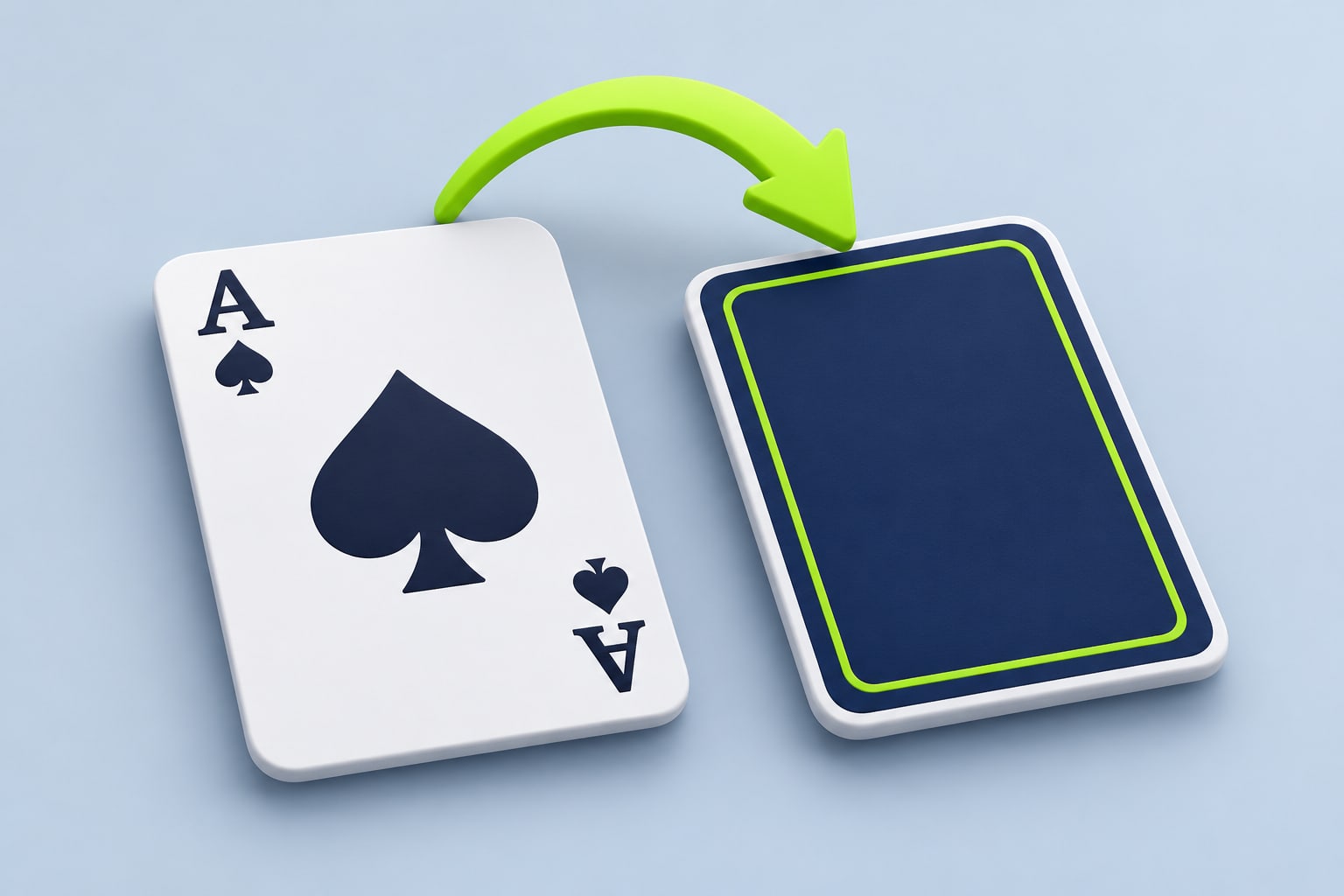
Visual explainer
Seeing both dealer cards changes the information
Dealer starting cards in a hole-card blackjack game compared with a Double Exposure-style game.
Ordinary hole-card format
Double Exposure-style format
Illustrative player total 17 versus dealer total 17:
Ordinary equal-total rule → push; stake returned.
A variant in which the dealer wins this tie → player loses the stake.
Tie exceptions and blackjack payouts vary by product. Use the exact variant rules and a matching strategy; extra information alone does not establish a player advantage. Related: Hole Card · Push or Tie.
Visible cards and a named variant
A face-up card has its rank and suit visible to the table. That ordinary description appears in many card games and does not by itself identify a special rule. In this glossary, Face Up also refers to the blackjack family often called Double Exposure or Face Up 21. Its defining information change is that both of the dealer's initial cards are exposed. The player can therefore see the dealer's starting total before choosing an action. This is different from ordinary blackjack with one exposed dealer card and one concealed hole card, and different again from a game where the dealer's second card is not dealt until later.
More information comes with other changes
Seeing both dealer cards would benefit the player if every other rule remained the same. Casinos compensate through changes elsewhere in the game. Depending on the version, these may include the dealer winning certain ties, a reduced payout for a player blackjack or restrictions on doubling and splitting. Do not assume one universal compensation package. Read the actual rules for natural blackjacks, equal totals, split hands, surrender and the dealer's treatment of soft seventeen. A familiar title does not guarantee a familiar payout. The entire ruleset determines the game's expected return, not the visibility of the dealer cards considered alone.
Why tie rules need special attention
In ordinary blackjack, equal non-busted totals usually push, returning the player's stake. A face-up variant may instead award many of those ties to the dealer. That change affects both settlement and strategy. Reaching the same total as the exposed dealer hand may no longer be a satisfactory outcome. Check exceptions carefully, especially when both sides have a natural blackjack or when a winning combination has special treatment. A general statement that ties lose can be incomplete if the particular game makes an exception. For a disputed result, the exact total and whether the hand was a natural or a later multi-card twenty-one are relevant details.
Use a strategy designed for the rules
A conventional basic-strategy chart normally uses the player's hand and one dealer upcard. A Double Exposure chart can use the dealer's visible total and the variant's compensating rules. These are different decision problems. A choice that looks unusual compared with standard blackjack can follow from the fact that a tie would lose or that the dealer's full hand is known. Conversely, copying a strategy chart from another face-up version can be wrong when payout or splitting rules differ. Confirm the number of decks and all major conditions before using a chart. Information is useful only when interpreted under the rules that actually govern the hand.
The dealer's final result can still change
Seeing the starting dealer cards does not necessarily reveal the dealer's final hand. If the total requires a draw, additional cards will be dealt according to the stated hitting and standing rules. Those future cards remain uncertain. A visible weak total does not guarantee a bust, and a visible strong total does not make every player decision hopeless. The player is still choosing among uncertain outcomes, using more starting information than in ordinary blackjack. Avoid treating the displayed dealer total as a prediction of the last total. Track which decisions remain and which cards are still to be drawn.
Checks for online and live play
Before staking money, confirm that the displayed game really exposes both starting dealer cards and read its payout information. Some products use similar wording for different mechanics, including other face-up poker or blackjack games. A demo can help establish how cards and action buttons are displayed, but it does not replace the rules. Record the game name, version, player cards, dealer cards, action and stake if a settlement needs review. Explain the variant when discussing a hand with support or another player. Without that context, a perfectly correct settlement under Face Up rules may appear inconsistent with standard blackjack expectations.