An upcard is a card dealt face up. In blackjack, the term usually means the dealer's visible starting card, which helps determine the player's strategy and whether insurance or a dealer-blackjack check may apply.
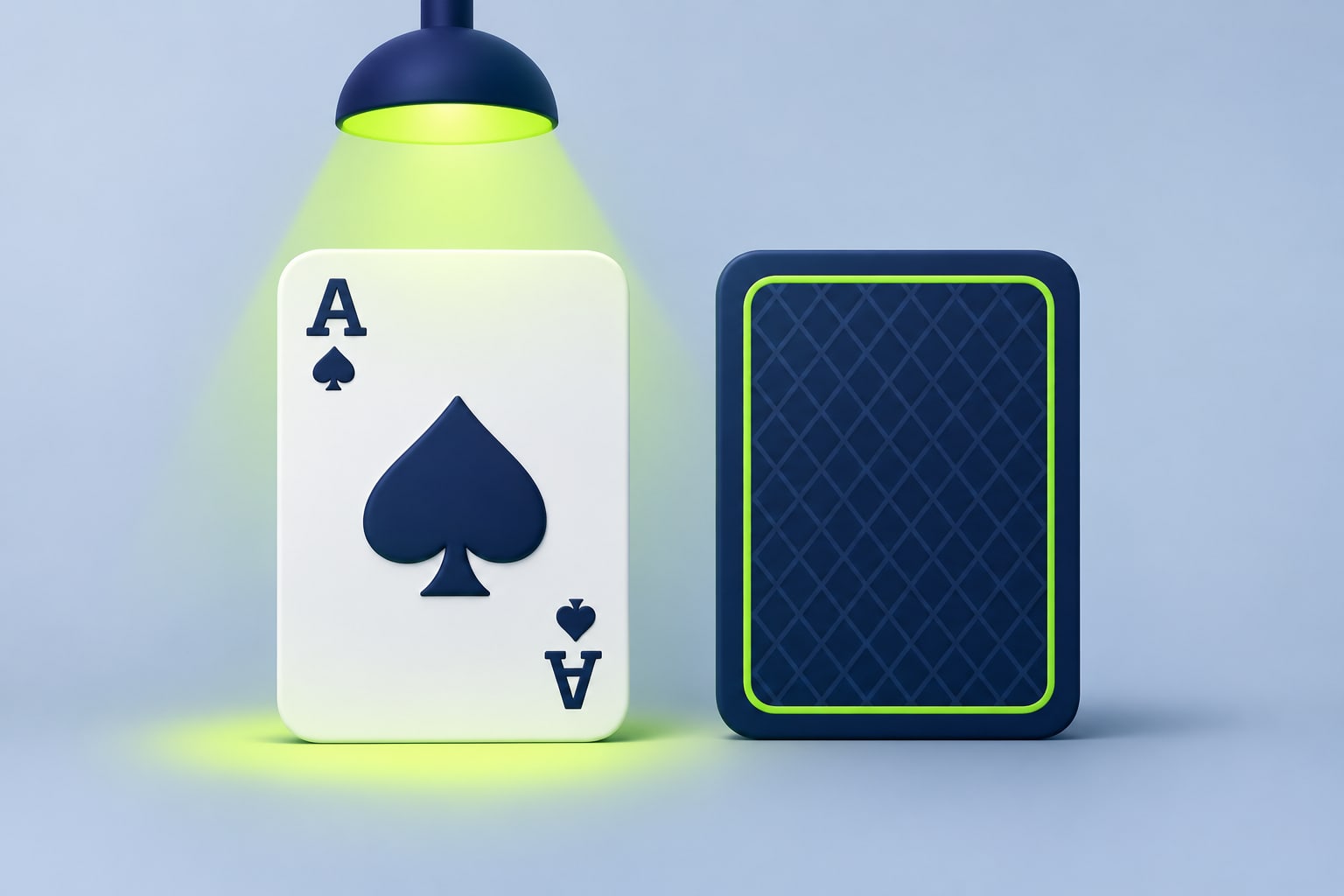
The visible part of the dealer's hand
In a conventional blackjack deal, the dealer has a visible card and a concealed hole card. The visible one is the upcard. In a no-hole-card game, the dealer still has an upcard but has not yet received the second card. In both cases, the player can use the visible rank as information; the difference concerns what remains unresolved and how later dealer blackjack is handled. An upcard is not a complete dealer total. A six showing does not mean the dealer has 16, and a ten showing does not prove a 20. Those are only possible combinations with the unseen or later card. Read the exposed rank accurately before using any strategy table or deciding whether the available controls make sense.
How strategy charts use it
A basic-strategy chart usually places dealer upcards along one axis and player hands along the other. The intersection gives an action for a specified set of rules. Player hand categories commonly distinguish hard totals, soft totals and pairs, because the same displayed number can imply different risks and options. Ace-six and ten-seven both display 17 but should not be treated as the same type of hand. Dealer tens, jacks, queens and kings are generally grouped together as ten-value upcards in conventional main-game strategy. A side bet may distinguish their ranks or suits, however. Make sure the chart describes the actual product and not a similarly named variant with different payouts, dealer rules or card composition.
Aces and ten-value upcards can signal blackjack
Dealer blackjack requires an ace and a ten-value card as the initial two-card hand. Therefore, an ace upcard or a ten-value upcard can make a dealer check relevant in a peek game. An ace showing commonly triggers an insurance offer, which is a separate wager on dealer blackjack rather than a way to improve the player's cards. A dealer check that finds no blackjack supplies information about the concealed card, but it does not reveal its exact rank. If the upcard is six, the dealer cannot have an initial two-card blackjack under ordinary values. The absence of a check in that situation is therefore normal. No-hole-card and other variants can use different procedures, so connect the upcard with the game's stated checking and settlement rules.
Weak and strong are probability descriptions
Players often describe small dealer upcards as weak and high ones as strong. These are shorthand assessments of possible outcomes, not promises about the next draw. A dealer six can still finish on 21, while a dealer ten can eventually bust. The player must compare the expected results of available actions rather than imagine one fixed hidden card. A run of dealer wins does not make the next weak upcard more certain to bust. Nor does a previous exposed ace change the rules for insurance on a later round. In a persistent shoe, visible card removals can affect composition, but that is a separate calculation from merely naming the upcard. Avoid treating casual table predictions as established probabilities.
Checking the display and round record
At a live table, wait until the dealer's visible card is clear before acting. In an online game, distinguish the dealer's row from the active player hand, especially when several split hands are shown. The upcard may stay visible while the hole card turns over later, so a final screenshot can make the original sequence less obvious. A detailed history should identify the initial deal and later cards. If the apparent upcard changes because of a corrected misdeal or another irregularity, ask the operator to explain the recorded procedure rather than assuming a normal draw occurred. For an educational example, always state the player cards and dealer upcard together. A recommendation that mentions only one side of that comparison leaves out information necessary to understand the decision.