Double Bonus is a video poker family with different four-of-a-kind awards by rank. Its return and strategy depend on the full paytable, including the full-house, flush, straight and quad payouts.
Visual explainer
Double Bonus separates the quad ranks
Example from the published 10/7 Double Bonus schedule, with five credits wagered.
Four aces
800 credits
160 credits per credit wagered.
Four 2s, 3s or 4s
400 credits
80 credits per credit wagered.
Four 5s through kings
250 credits
50 credits per credit wagered.
These categories depend on quad rank. Do not import Double Double Bonus kicker premiums into this schedule.
The 10/7 label identifies the full-house and flush rows, not every payment. Check the entire displayed table. Related: Double Double Bonus Video Poker · Full-pay VP (fp).
What the bonus refers to
Double Bonus is a draw video poker game in which some four-of-a-kind hands receive enhanced awards. The name does not mean that every winning hand pays twice the amount offered in another game. Players receive five cards, select which to hold, and replace the discarded cards before the final hand is evaluated. The exact award schedule is central to the game's identity. Aces, low quads and other quads can occupy separate rows, while ordinary combinations such as two pair may pay less than a player expects from Jacks or Better. Read the complete schedule rather than treating the title as a mathematical description.
Reading a representative table
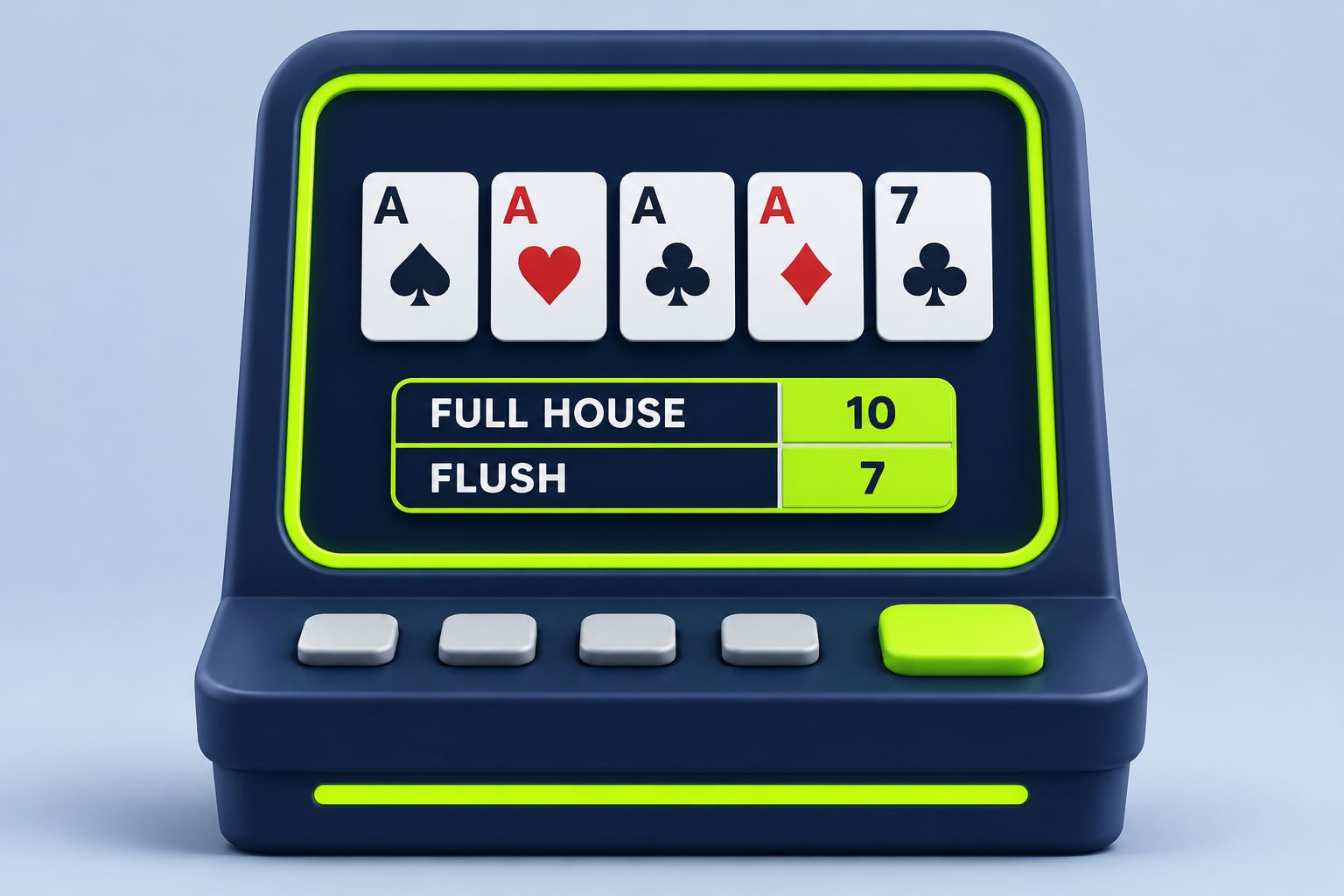
A well-known 10/7 Double Bonus table pays ten units for a full house and seven for a flush on its stated per-unit basis. In the published table, four aces pay 160, four twos through fours pay 80, and four fives through kings pay 50. A straight pays five, three of a kind three, and two pair or a qualifying high pair one. These figures identify a particular schedule, not every game sold under the Double Bonus name. Royal-flush awards also need careful reading because the coin-count column can affect the effective payout. Compare the actual screen with the entire reference table.
Why two numbers are not enough
The shorthand 10/7 describes only the full-house and flush rows. It leaves the other awards unspecified. A version that pays less for a straight or changes one group of quad awards can have a different theoretical return even though those two headline numbers remain the same. For that reason, matching only the name and the first two numbers is insufficient when choosing a strategy reference. Record the full schedule, the number of coins played and any special feature or additional charge. Two games with nearly identical artwork can still be mathematically different. The table is more informative than the promotional label beside it.
Return assumes the matching decisions
The commonly analyzed full 10/7 schedule has a theoretical return of approximately 100.17% with optimal play under its specified conditions. That figure is a long-run mathematical result, not a promise of a profitable session or a claim that the table is currently offered at a particular casino. Different awards, unsuitable coin settings, strategy errors and additional costs can change the effective result. A small theoretical advantage can coexist with substantial short-term losses. Do not interpret a percentage above 100 as protection from variance, or assume that a familiar hold from another video poker family is optimal in this one.
Separating Double Bonus from other titles
Double Bonus and Double Double Bonus are separate game families. A player should not transfer special kicker rules or payouts from one title to the other without checking the displayed schedule. Likewise, a generic Bonus Poker chart may not match Double Bonus. The final five cards determine the applicable row under the actual rules, and the unused card in a four-of-a-kind hand is relevant only if that game's schedule makes it relevant. The word bonus is also unrelated to a casino deposit promotion in this context. It describes the game design, so promotional wagering requirements and the machine's hand awards must be read separately.
Checking a game before playing
Start with the denomination and coin count so that the stake is clear. Five coins at a denomination of 0.25 cost 1.25 for a single ordinary hand, before any separate feature charge. Then compare every payout row with the strategy reference, including the royal-flush treatment and all quad groups. Confirm whether the displayed numbers are credits or currency and whether multiple hands multiply the total stake. A practice mode can help identify controls, but it does not establish the terms of a real-money version. The useful question is whether the exact rules and decisions match the mathematical analysis, not whether the game has a familiar name.