DD is an abbreviation that can mean double deck or double down in blackjack. Double deck describes the card supply; double down describes a permitted wagering action. The surrounding sentence or rules legend determines the intended meaning.
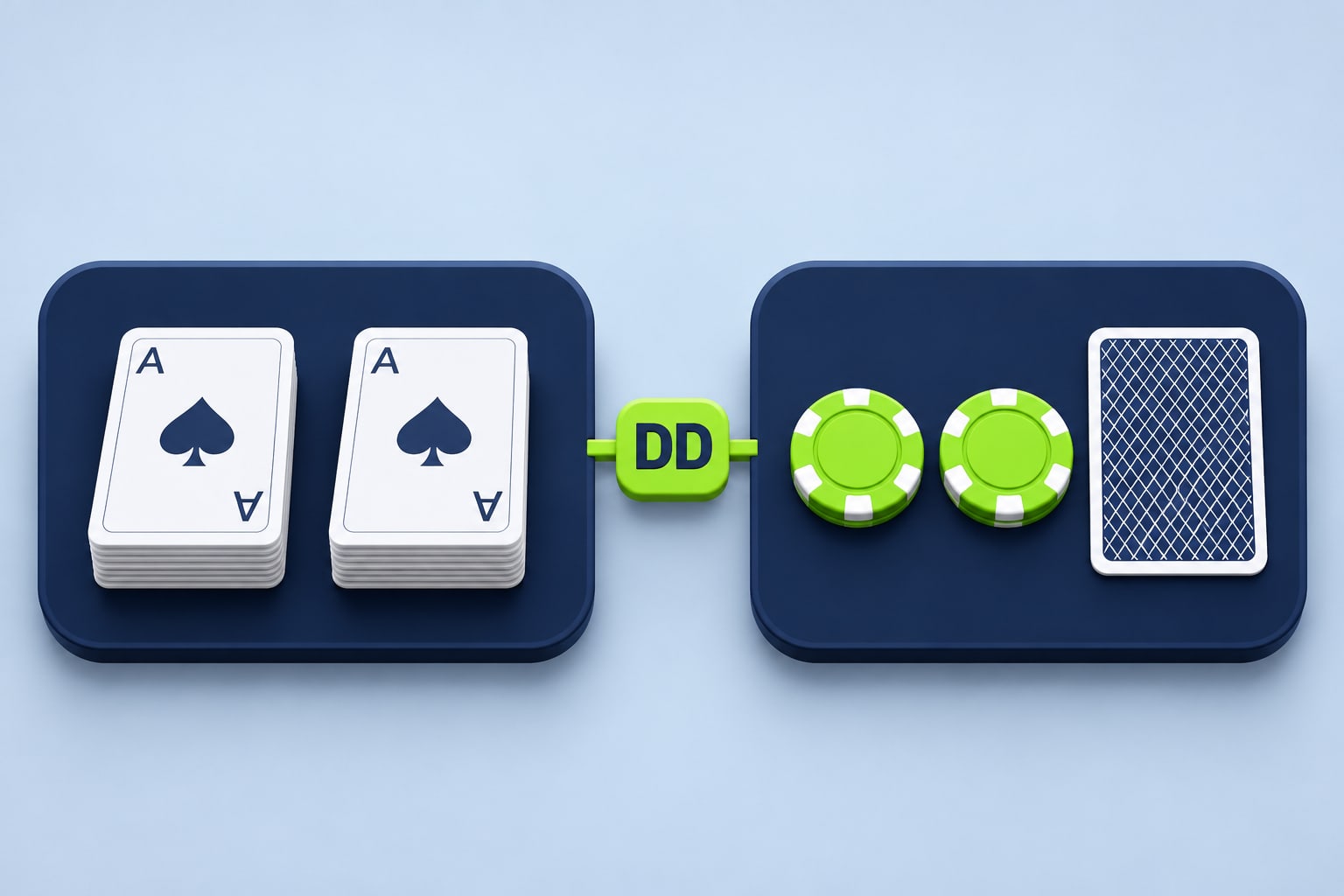
Two common meanings in blackjack
DD has two common blackjack meanings: double deck and double down. The first describes the number of decks used to form the game's card supply. The second describes an action that increases a wager under the rules for the current hand. These are different pieces of information, even though the abbreviation looks identical. A listing that describes a DD table is likely referring to two decks, while a discussion of whether to DD a particular total is likely discussing a playing decision. Context is essential. When recording game rules for comparison, expand the abbreviation so that another reader does not have to guess which meaning was intended.
Double deck describes the card supply
A conventional double-deck blackjack game uses two standard decks, giving 104 cards before any procedural removal or dealing. That tells you the starting composition, not every rule of the game. It does not establish the blackjack payout, the dealer's soft-17 rule, permitted doubles, splitting conditions or how deeply the cards are dealt before a shuffle. A two-deck game can therefore differ materially from another two-deck game. Avoid treating DD as a complete quality rating. The number of decks is one input to understanding the game, and the remaining rules still need to be read and compared on their own terms.
Double down describes an action
In conventional blackjack, doubling down generally means adding a further wager equal to the original stake and receiving one additional card, after which the hand stands. A ten-unit original wager would therefore become a twenty-unit total exposure if doubled in full. The player is increasing the money at risk while accepting a restriction on further drawing. It is not simply a free extra card or a way to replay the original hand. Variants can change the permitted procedure, so the game's rules control. Read the available action and resulting stake carefully rather than assuming every button labelled Double behaves identically across all products.
Restrictions can change the decision
Some games allow doubling on any initial two cards, while others restrict it to particular totals. Rules may also differ about doubling after a split, doubling for less than the full original stake or handling a dealer blackjack discovered later. These details affect both eligibility and the mathematics of the decision. A strategy recommendation written for one set of rules should not be transplanted into another without checking its assumptions. If an interface does not offer a double option, the reason may be the current hand, the game rules or an account balance constraint. Do not infer a rule change from the abbreviation alone.
Reading listings and strategy notes
A compact table description might place DD beside other rule abbreviations, while a strategy discussion might use it as a verb. Read the legend and the complete sentence. If a table lists deck count separately, the same letters in an action column may have a different purpose. A useful editorial practice is to write double deck when describing the game and double down when describing the action, introducing DD only after the meaning is clear. This prevents a reader from confusing the structure of the shoe with an instruction about the current wager. Clarity matters especially when several abbreviated rule conditions appear together.
Neither meaning promises an advantage
A double-deck label does not guarantee favourable overall rules, and a permitted double-down action is not automatically the best action on every eligible hand. Both require context. The first should be assessed with the full rule set; the second should be understood as a specific decision that can win or lose a larger amount. DD also should not be confused with a loss-chasing instruction to double the next round's stake. That is a staking progression, not the ordinary meaning of doubling down on a current hand. Expanding the abbreviation and checking the rules turns a potentially ambiguous label into useful information without implying a guaranteed result.