DAS means double after split: a blackjack rule allowing an eligible hand created by splitting a pair to be doubled. It is separate from the rules governing resplitting and split aces, which may still impose additional restrictions.
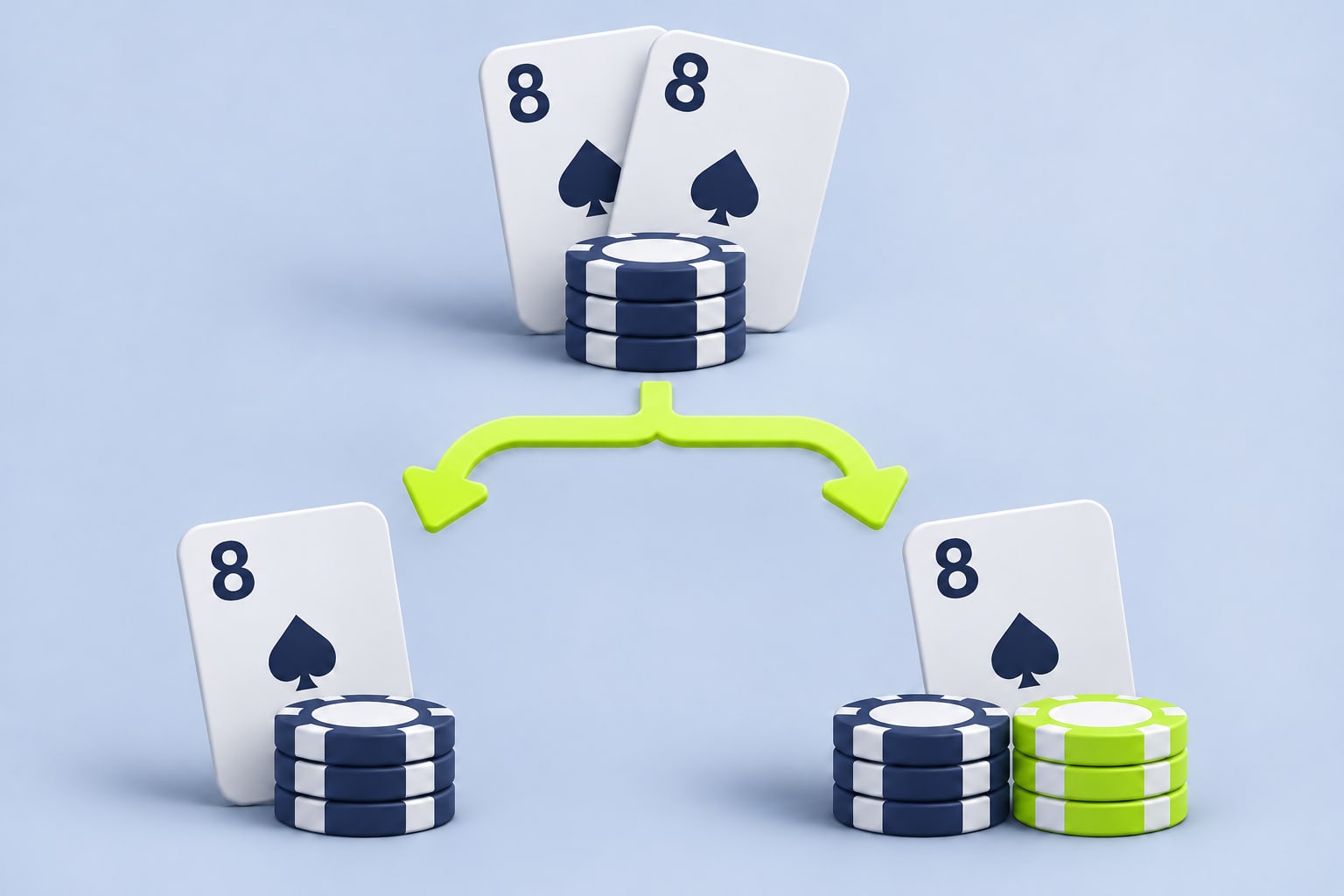
Visual explainer
How a split can lead to a double
Illustrative round with a 10-unit opening bet. Assume the rules permit splitting eights and doubling the resulting 11.
1 · Original hand
8 + 8
One hand with 10 units staked.
2 · Split the pair
10 + 10 units
Add 10 units. Each eight starts a separate hand.
3 · Double one hand
20 + 10 units
An eight receives a three. Add 10 to that eligible hand and take one final card.
Total committed: 10 + 10 + 10 = 30 units. The doubled hand carries 20 units; the other hand carries 10.
DAS means doubling after splitting is allowed on eligible hands. Split-ace restrictions and permitted doubling totals still apply. This shows the mechanics, not a recommendation for a particular dealer upcard. Related: Split Hand · Double Down.
Expanding a compact rule label
A blackjack comparison table may use DAS for double after split and NDAS for no double after split. The label answers a specific question: after a pair is separated and a new card arrives, can the player increase the wager and take the usual single double-down card? It does not say that every resulting hand is eligible. The game may still restrict doubles to certain totals or exclude ace hands. Read the detailed rule alongside the abbreviation. A table allowing ordinary doubles on an unsplit hand can prohibit them after a split, so the two permissions must not be combined into one vague field. For a player using a strategy chart, this difference can affect the earlier decision about whether to split the pair at all.
A worked split-and-double sequence
Start with two eights and a $10 wager. A split adds $10 and creates two separate hands. If the first eight receives a three, it now totals 11. Under a rule allowing a double on that hand, the player can add another $10 and receive one final card. The first hand then has $20 committed, while the second still has its own $10 unless another permitted action changes it. If the doubled hand wins and the other hand loses, the ordinary net result is a $10 profit: $20 won on one hand minus $10 lost on the other. That result differs from a simple one-win, one-loss cancellation because the stakes are unequal. Track each hand's exposure separately throughout the round.
Why the option can improve a split
Splitting changes the starting cards and creates possible future decisions. If those new hands can be doubled when favourable cards arrive, the split has an additional opportunity that is absent under NDAS. Consequently, a pair-splitting chart can change when DAS is available, even before anyone knows which cards the split hands will receive. This is an expected-value comparison across possible future draws, not a promise that a particular split will produce an ideal double. The player can still receive weak totals or lose both hands. Under otherwise identical rules, adding an optional action cannot worsen the best achievable strategy because it need not be used. Comparing two different casinos still requires checking their other rules rather than treating DAS as the whole assessment.
Ace restrictions and other exceptions
Split aces often follow a special rule that gives each ace only one additional card. In that case, a general DAS label does not necessarily permit an extra doubled draw on those hands. Resplitting aces is also a different permission, usually abbreviated RSA. A game can allow one, both or neither of these features within its stated limits. Check whether a resulting ace-ten counts as ordinary 21, what happens after the maximum number of split hands is reached and whether reduced doubles are allowed. In a no-hole-card game, establish how a later dealer blackjack treats added split and double wagers. Those settlement conditions can change the risk attached to an otherwise attractive opportunity and should be reflected in the strategy used.
Budgeting and checking the round history
The opening stake can understate the possible total commitment. One $10 hand split into two and doubled on both becomes $40 at risk. If further splits are permitted, exposure can rise again. Choose a base wager that leaves room within a predetermined limit, and do not increase that limit merely because a chart identifies a preferred double. When reviewing a round, record the original pair, the split card on each hand, each double amount and the final dealer outcome. A screenshot of only the final balance cannot explain unequal split-hand wagers. If the double control was unavailable, first check the active hand, total restrictions, ace rules and available funds. Those details can explain the interface without requiring another wager to test what happened.