Gambling Analytics
Dating in 2026: how habits have changed

Research update: 19 November 2026. Our original 2016 poll asked 1,000 Americans about first dates. This edition uses newer national research to look at dating habits and how they have changed. Different surveys answer different questions; none gives the odds that a particular date will lead to sex or a relationship.
Online dating use from 2024 to 2026
In SSRS’s 2026 survey, 37% of U.S. adults had ever used a dating site or app and 6% were current users. The corresponding figures were 37% and 7% in 2024, then 39% and 7% in 2025. Lifetime use and current use describe different groups.
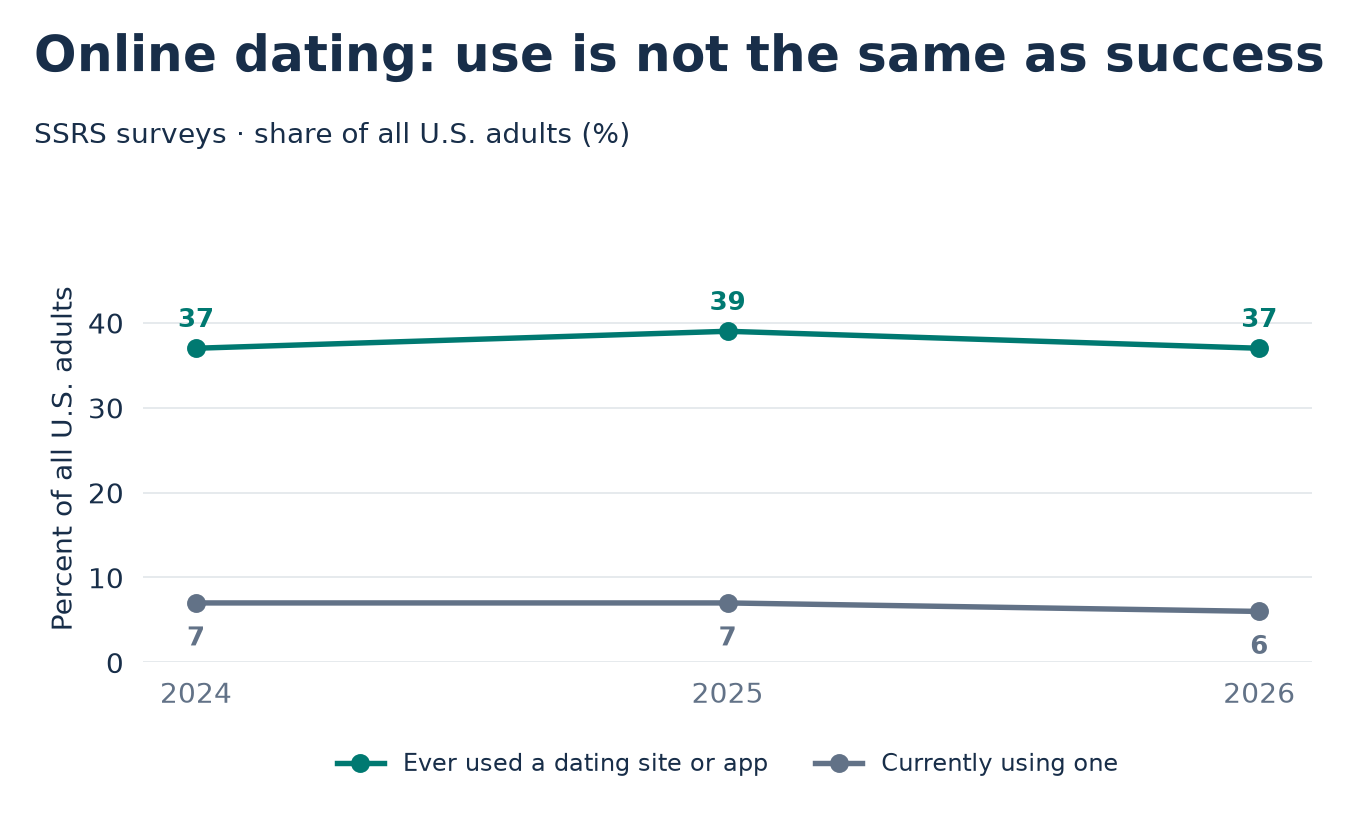
| Survey wave | Ever used | Currently using | All-adult sample |
|---|---|---|---|
| January 2024 | 37% | 7% | 2,011 |
| February 2025 | 39% | 7% | 2,016 |
| January 2026 | 37% | 6% | 2,012 |
The SSRS 2026 topline (PDF, pages 1–2) reproduces the earlier waves. Interviews for 2026 ran on 2–4 and 16–20 January, online and by phone. The total-sample margin of error was ±2.5 percentage points at 95% confidence. We have not tested the differences between waves for statistical significance; a one- or two-point movement alone does not establish a trend.
What people say they want in 2026
A separate Match-funded study, conducted with Kinsey Institute researchers among about 5,000 U.S. singles in March–April 2026, found 72% interested in or open to dating or a relationship. Just 16% said they were actively seeking a committed relationship. Being open to a relationship is not the same as actively looking.
The study also reported that 41% would consider another date even if the first was not exciting, and 49% had fallen for someone they were not initially attracted to. These are self-reported attitudes or experiences, not tested instructions for producing attraction. Source: Match’s 15th annual Singles in America release.
What a first-date statistic can and cannot tell you
The SSRS series covers U.S. adults, including people who are partnered. The Match study covers singles and uses a different sample and questionnaire. The 2016 KeyToCasinos poll is different again. Joining their percentages into one “success” trend would hide those differences.
A useful comparison names the population, question and survey date. It also distinguishes an attitude from an outcome: willingness to date, current app use and an established relationship are separate measures. Neither clothing choices nor a survey percentage can substitute for another person’s interest and consent.
For the full context, see SSRS’s 2026 research summary and the linked questionnaire. This article updates the evidence without assigning an individual reader a probability of romantic success.
Original research
Read the original 2016 study for the historical sample, questions and findings.