A soft hand in blackjack contains an ace currently counted as 11 without taking the total above 21. That ace can instead count as 1, giving the hand flexibility when another card is drawn.
What makes a total soft
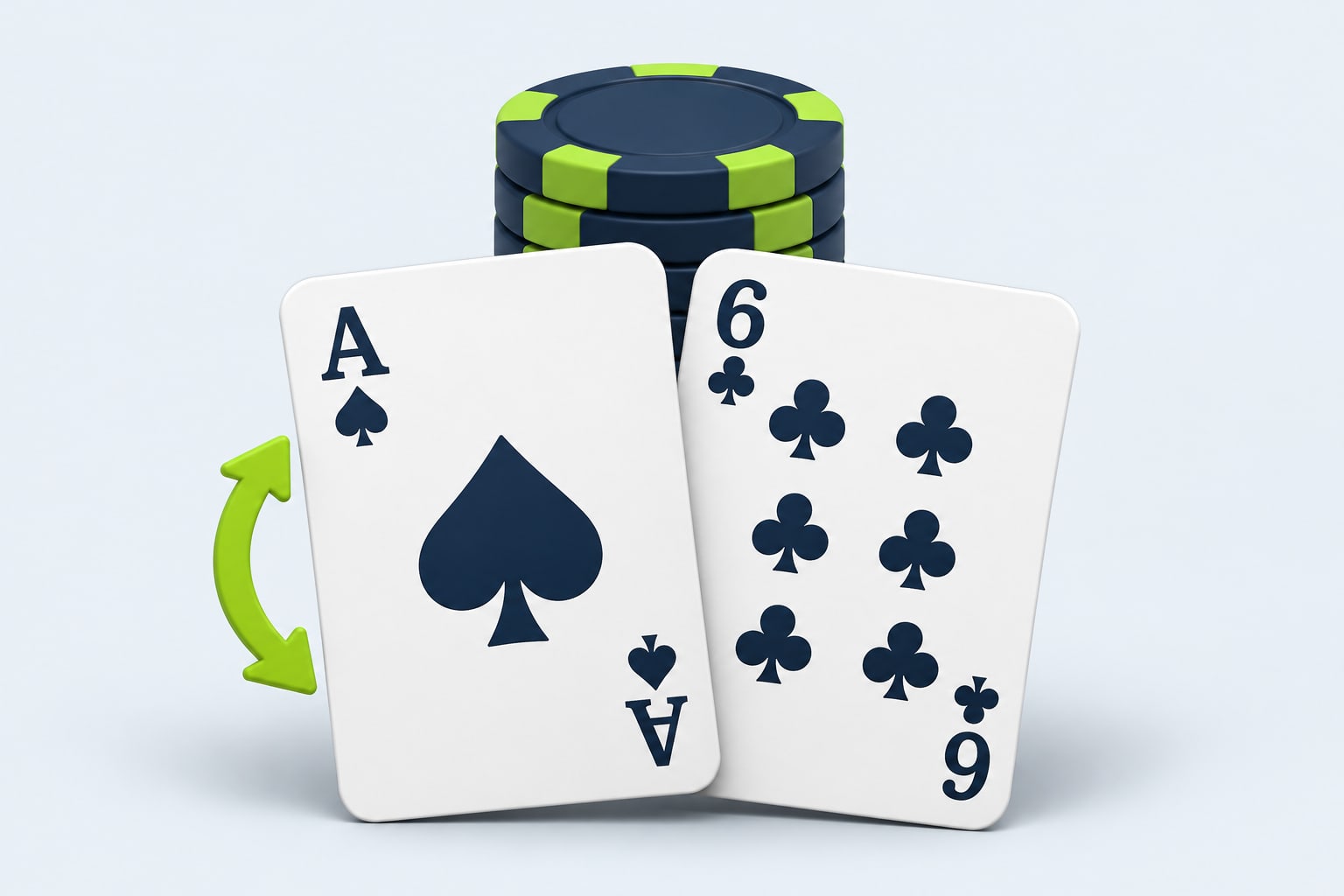
The test is whether an ace can currently count as 11 without busting the hand. Ace and six is soft 17: using the ace as 11 gives 17, while using it as 1 gives 7. The higher valid total describes the hand, but the lower alternative remains available if needed. The player does not receive a second wager or a second hand merely because two numerical totals can be displayed.
Having an ace somewhere in the cards is not sufficient. Ace, six and ten totals hard 17, because the ace must count as 1 to avoid exceeding 21. Counting it as 11 would produce 27. This is why a hand can begin soft and become hard later in the same round. The classification describes the current cards, rather than a permanent quality attached to the first two cards dealt.
Visual explanation
An ace can change from 11 to 1
Follow the total through one illustrated blackjack hand.
A + 6
Count the ace as 11: soft 17.
Then draw a 9
11 + 6 + 9 = 26, so count the ace as 1.
New total
1 + 6 + 9 = hard 16.
The ace can no longer count as 11 without busting. This explains card totals; it does not recommend hitting soft 17 in every situation. See blackjack.
Following a hand through another card
Start with ace and six. A two makes soft 19 because 11 plus 6 plus 2 is 19. A five instead makes hard 12, because 1 plus 6 plus 5 is the valid total. A ten makes hard 17. These examples show that taking a card does not necessarily improve the displayed number, even though the ace's flexibility prevents that immediate draw from busting the original soft hand.
That protection applies to one draw from the current soft state, not to unlimited future cards. After ace, six and five has become hard 12, drawing a ten produces 22 and busts. Recalculate after every card rather than continuing to treat the original ace as a safety net. A game may show both possible totals while the hand remains soft, then show only one when the ace has to become 1.
Several aces and several cards
Only one ace can count as 11 in a non-busted hand, because two such aces would already total 22. Two aces together are therefore soft 12, using 11 plus 1. With an additional five, the hand is soft 17. Add a ten after that and both aces must count as 1, producing hard 17. Counting all aces as 1 first, then adding 10 if the total permits, is a reliable calculation method.
A soft hand is not necessarily a two-card hand. Ace, two and four is soft 17 because one ace can still count as 11. However, the number of cards matters for the decisions allowed: an ordinary game may allow doubling only on the initial two cards. Knowing the soft total therefore does not, by itself, tell you whether a double, split or surrender control should be available at that moment.
Soft 17 and the dealer's rule
The familiar labels H17 and S17 describe what the dealer does with soft 17. H17 means the dealer hits that total; S17 means the dealer stands. They do not instruct the player to copy the dealer. The dealer follows a fixed procedure, while player decisions depend on the player's cards, the exposed dealer card and the options permitted by the game. A hard 17 remains a different category.
For example, a dealer with ace and six follows the table's soft-17 rule. A dealer with ten and seven has hard 17 instead. A dealer with ace, two and four still has soft 17, despite holding three cards. Read the rule card or game help before selecting a strategy chart. Small differences in dealer procedure can change the preferred player decision and the mathematical cost of the game.
Using soft totals in context
Soft does not mean weak, guaranteed safe or automatically worth doubling. It describes how the ace is counted. Soft 18 and hard 18 share a displayed total but do not have the same drawing possibilities. Use the soft-hand section of a chart that matches the actual rules, and read its fallback instructions when doubling is unavailable. A recommended action can still lose; the classification does not predict the dealer's result.
Also distinguish a soft total of 21 from the special status of a natural blackjack. An original ace and ten-valued card usually receives that status, while a multi-card 21 does not. An ace and ten obtained after splitting commonly counts as ordinary 21 under the rules. The cards' numerical total, the hand's origin and its payout category answer different questions, so check each rather than relying only on the large number displayed.
Related glossary terms
Sources and further reading
- Antonym:
- Hard Hand