A hard total in blackjack has no ace counted as 11. Any aces in the hand must count as 1 to keep the total at or below 21.
What is a hard total?
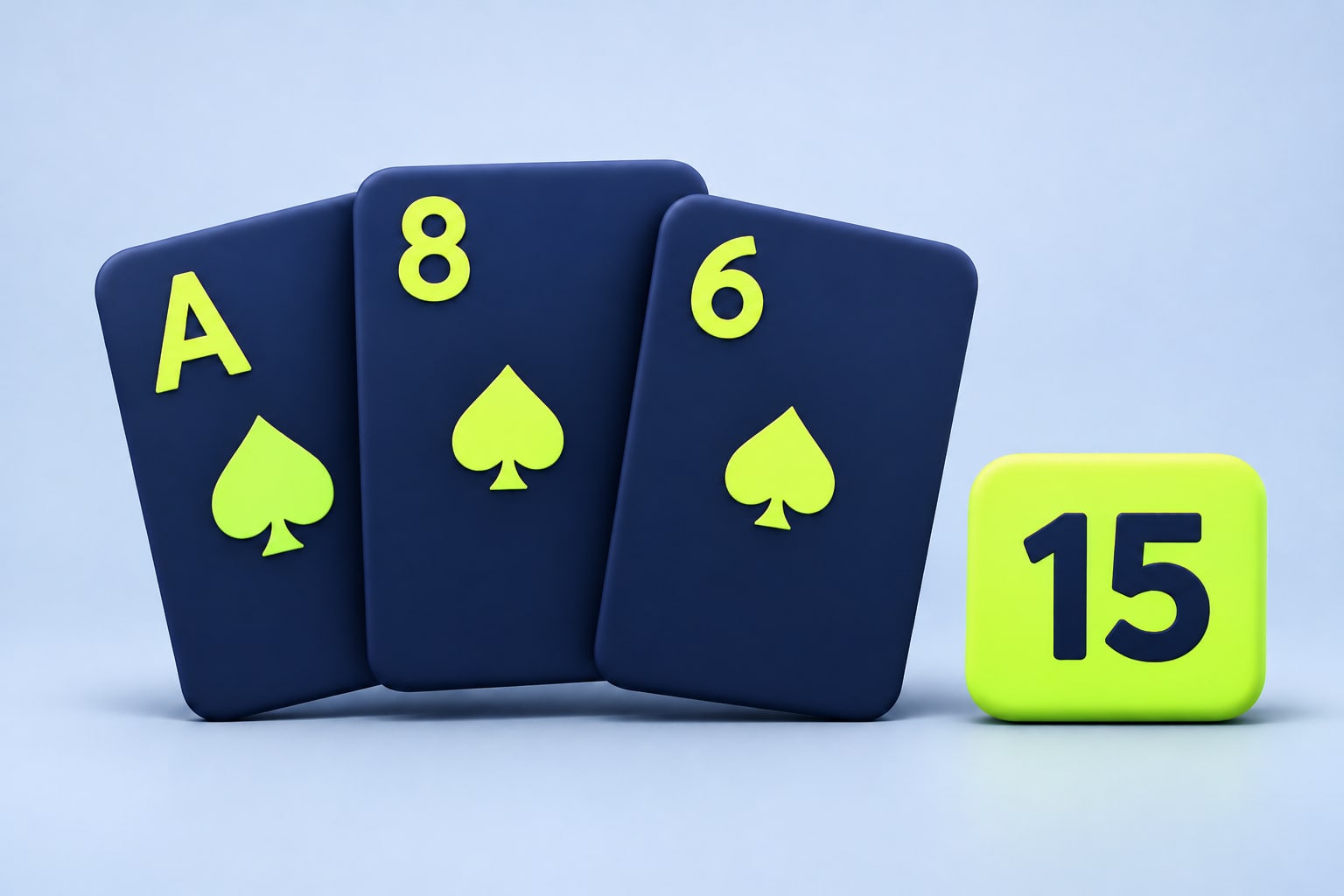
A hard total is a blackjack hand total that does not use an ace valued at 11. A hand without an ace is hard, but a hand containing an ace can also be hard if that ace must count as one. Ten-six is hard 16. Ace-eight-six is hard 15, because counting the ace as 11 would produce 25. This is the important distinction: hard does not mean that the hand has no ace, nor does it mean that the hand is necessarily weak. Ten-ten is a strong hard 20. The word describes how the total is calculated and whether the hand has the flexibility of an ace currently counted as 11. Strategy charts use that distinction to separate different kinds of decisions.
Calculating the value of an ace
Number cards from two through ten use their face values, and jacks, queens and kings each count as ten. Aces can count as one or 11. Add the other cards, then use 11 for an ace only when that keeps the hand at or below 21. For example, ace-four is soft 15. Add a six and it becomes soft 21; add a ten instead and it becomes hard 15. With two aces and a nine, one ace can be 11 and the other one, producing soft 21. With two aces, a nine and a five, both aces must be one, producing hard 16. A hand's classification can therefore change after a hit. Recalculate from all its cards, rather than treating the original label as permanent.
Hard totals and the risk of busting
A hard total of 11 or less cannot bust from one ordinary card, because the largest added card value is ten and an ace can be counted as one. A hard total of 12 or more can bust on at least some draws. For instance, a hard 12 busts on a ten-value card but survives an eight as 20. A hard 20 survives an ace as 21 but busts on any ordinary card valued two through ten. These examples describe possible outcomes, not recommended decisions. A hard hand is not automatically a hand you should stand on, and a soft hand is not automatically one you should hit. The dealer's upcard, available actions and game rules must be considered alongside the player's total.
Why strategy charts separate hard and soft hands
Hard 16 and soft 16 have the same displayed total but different possibilities. A hard 16 can bust immediately when hit, while soft 16 has an ace that can fall from 11 to one if necessary. That flexibility changes the expected result of taking another card. Basic strategy therefore uses separate sections for hard totals, soft totals and pairs. A pair may also have a splitting option that is not captured by its combined total alone. Use the row that matches both the hand's structure and the available rules. A chart designed for a different number of decks or dealer procedure can give an unsuitable recommendation. Even a correctly matched chart describes long-run decision quality; it cannot guarantee that the next card produces a favourable result.
Reading the table and interface
An online game may display a soft total as two numbers, such as 6/16, while another shows only the higher usable total. Read the help panel if the display is unclear. The actual cards determine whether the hand is hard or soft, not the visual style of the total indicator. Dealer rules also distinguish these states: a dealer who hits soft 17 normally still stands on hard 17. A player's choices need not copy the dealer's compulsory procedure. Before acting, confirm the active hand, total and stake, especially after a split. If a result appears incorrectly calculated, retain the round details and ask support to explain them before placing new wagers. Understanding the arithmetic avoids confusion, but it does not make higher stakes safer or recover previous losses.