A hard hand in blackjack has no ace that can currently count as 11 without busting. It may contain no ace, or it may contain aces that must all count as 1.
KeyToCasinos • Visual explainer
An ace can change from 11 to 1
The current total determines whether a hand is hard or soft.
Before the draw
11 + 6
The ace can count as 11 without busting.
After the draw
1 + 6 + 10
Counting the ace as 11 would make 27, so it counts as 1.
A hard hand can still contain an ace. These are counting examples, not advice to hit or stand. Related: Soft hand · Basic strategy.
Recognising a hard total
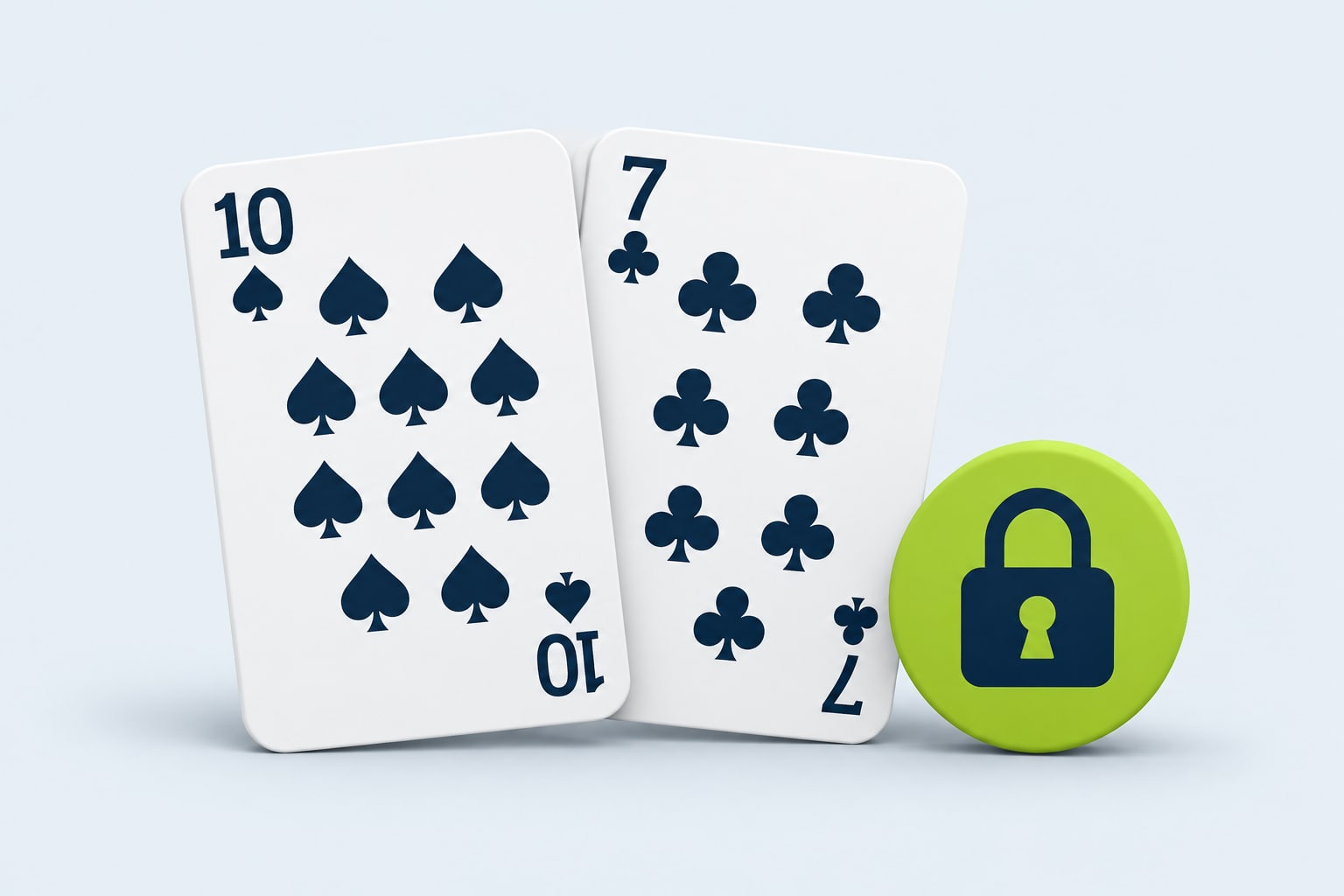
Ten and seven is hard 17 because neither card has an alternative value. Ace, six and ten is also hard 17: the ace must count as 1, making 1 plus 6 plus 10. If it counted as 11, the total would be 27 and exceed 21. The presence of an ace therefore does not automatically make a hand soft. What matters is the valid value it can hold now.
Hard describes the arithmetic, not the strength of the hand or the difficulty of a decision. Hard 20 and hard 12 are both hard, although their practical situations differ greatly. Nor does the word mean a loss is unavoidable. The final result depends on the completed player hand, the dealer's hand and the game rules. Classifying a total correctly is a starting point for reading those rules, not a prediction.
Counting aces without confusion
One simple method is to count every ace as 1 and add the other card values. If adding 10 still leaves the total at 21 or below, one ace can become 11 and the hand is soft. Otherwise, all aces must remain 1 and the hand is hard. For ace, eight and five, the starting sum is 14; adding 10 would make 24, so the total stays hard 14.
A hand can change category as cards arrive. Ace and four begins as soft 15. Add a nine and it becomes hard 14, because the ace now counts as 1. Conversely, a low hard hand can become soft when it receives an ace: two and three totals hard 5, and adding an ace produces soft 16. Reassess the actual cards after each draw rather than carrying forward the previous label.
Hard hands and the risk of busting
A hard total of 12 or more can bust when a sufficiently large card is drawn. Hard 12 followed by a ten becomes 22; followed by a nine it becomes 21. Hard 11 cannot bust on a single next card under ordinary blackjack values, because even a ten produces only 21. This illustrates why hard is not a synonym for unsafe to hit and why different hard totals need different decisions.
At hard 17, drawing a five produces 22 and drawing an ace produces 18 because that ace counts as 1. The absence of a currently flexible ace means there is no existing 11 to reduce by ten when a large card arrives. Soft 17 has that option. These examples explain the distinction without assigning a universal hit or stand instruction: the applicable strategy still depends on the dealer card and game rules.
Reading the right strategy section
Blackjack charts commonly separate hard totals, soft totals and pairs. A pair of eights adds up to hard 16, but it may also qualify for splitting, so its pair decision needs to be considered before treating it as an ordinary 16. A three-card hard 16 has no such original pair option. Two hands with the same numerical total can therefore have different available actions and require different chart instructions.
Match the chart to the number of decks, dealer soft-17 rule, surrender option and doubling restrictions. Read the meaning of conditional symbols, including what to do when doubling or surrender is unavailable. The dealer's own rule to stand on hard 17 does not create a general instruction for every player hard total. Players and dealers have different information and different permitted choices within the same round of blackjack.
Hand value is separate from settlement
A hard 21 formed from several cards is generally an ordinary 21, not a natural blackjack. A natural is a special starting combination under the game's rules and can have a different payout or priority. Likewise, hard 18 is not automatically a win: it may lose to a higher dealer total or push against an equal eligible total. Calculate the value first, then apply the correct comparison and payment rules.
When checking a confusing result, record the full card sequence rather than only the final number. Include whether the hand came from a split, whether it was doubled and the dealer's final cards. Those details can explain an apparent mismatch between a total and a payout. Understanding hard hands helps interpret the game, but it does not remove its house advantage or justify increasing stakes to recover a previous loss.
Related glossary terms
Sources and further reading
- Antonym:
- Soft Hand