A dozen bet in roulette covers one of three consecutive groups: 1–12, 13–24 or 25–36. A standard winning dozen pays 2 to 1 profit, with the original stake returned separately.
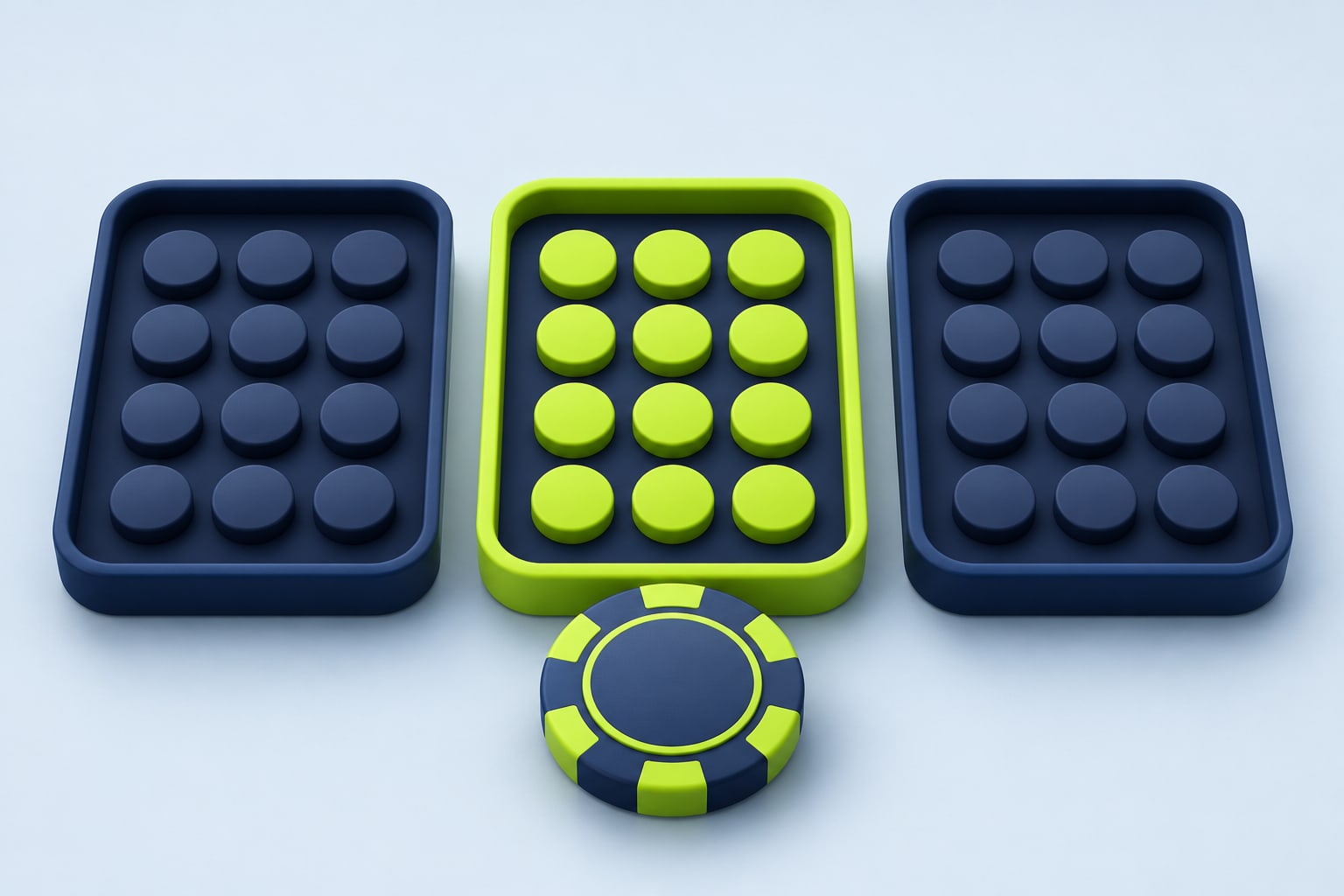
KeyToCasinos • Visual explainer
A dozen bet covers one block of twelve
The three standard dozen groups divide numbers 1–36.
One $5 dozen bet
12 numbers
Only the chosen dozen is covered; zero pockets are excluded.
If the dozen wins
$10 profit
At 2:1, the total returned is $15 including the $5 stake.
If another pocket wins
$5 lost
A result in another dozen or a zero pocket loses this bet.
On a single-zero wheel the win probability is 12/37; on a double-zero wheel it is 12/38. Related: European roulette · American roulette.
Finding the three groups
The first dozen contains 1 through 12, the second contains 13 through 24, and the third contains 25 through 36. The endpoints are included: 12 belongs to the first group, 24 to the second and 36 to the third. Zero and double zero belong to none of them. Labels such as first twelve or second twelve refer to these same consecutive blocks.
Dozens are outside bets because the selection boxes sit outside the numbered grid. Their numbers are consecutive on the list, not neighbouring pockets around the wheel. For example, the second dozen covers every integer from 13 to 24 regardless of where those pockets sit on the wheel. A racetrack selection covering a physical wheel sector is a different wager, even if it happens to contain twelve numbers.
Following one wager through settlement
Suppose you place $6 on the third dozen. If 30 is the winning number, the wager succeeds at the conventional 2-to-1 payout. You receive $12 profit plus the $6 stake, making an $18 total return. If 18 wins instead, the third-dozen wager loses its $6. An ordinary zero result also loses the stake because it is outside the selected group.
This payment can look confusing in a transaction log. From a $100 starting balance, placing the $6 bet leaves $94 available. The winning $18 credit then produces $112, a net gain of $12. A display describing an eighteen-dollar return has not paid eighteen dollars of profit. Checking the stake deduction and settlement credit together is more reliable than interpreting either transaction in isolation.
Probability on different wheels
With equally likely pockets, one dozen wins on twelve of the thirty-seven outcomes of a standard single-zero wheel. That is about 32.43%, rather than exactly one third. The difference comes from zero. A standard double-zero wheel has thirty-eight pockets, reducing the probability to 12/38, about 31.58%, while the conventional payout remains 2 to 1. Always identify the wheel as well as the wager.
For a $1 dozen bet on the single-zero version, twelve outcomes yield $2 profit and twenty-five lose $1. Adding those hypothetical results gives $24 minus $25, then dividing by thirty-seven produces an expected loss of about 2.70 cents. On the double-zero version, twenty-six outcomes lose, giving $24 minus $26 divided by thirty-eight: about 5.26 cents. These are long-run theoretical averages, not predictions for a particular session.
Betting on two or three dozens
Putting $5 on each of two dozens covers twenty-four numbers at a total cost of $10. When either selected dozen wins, that $5 wager returns $15 while the other loses. The net gain is consequently $5, not $10. A result in the uncovered dozen or a zero pocket loses both stakes. Greater coverage changes the pattern of wins and losses while also increasing the total amount committed.
Placing $5 on all three dozens commits $15. Any result from 1 through 36 produces one winning return of $15, exactly matching the combined stake; zero loses all three under ordinary rules. This arrangement therefore does not create a positive result on the covered numbers. It illustrates why counting how often a bet receives a payment is different from calculating how often the complete position earns a profit.
Practical distinctions to check
A column also covers twelve numbers and normally pays 2 to 1, but its membership follows a column on the rectangular layout. Dozens and columns overlap without being interchangeable. The number 14, for instance, belongs to the second dozen and the column containing 2, 5, 8 and 11. Check the actual highlighted coverage rather than identifying a wager only by the number of outcomes it includes.
Read the table's limits and accepted wager display before the spin. Each dozen position may have its own minimum, and a repeat control can restore several positions together. Special protection offered to even-money bets should not automatically be applied to dozens. Nor does a dozen become due after a long absence: on independent spins, the previous sequence does not change the next spin's probability for that group.