Splitting pairs in blackjack separates an eligible two-card hand into two hands. Each starts with one original card and carries its own stake, normally requiring an additional bet equal to the first.
From one hand to two
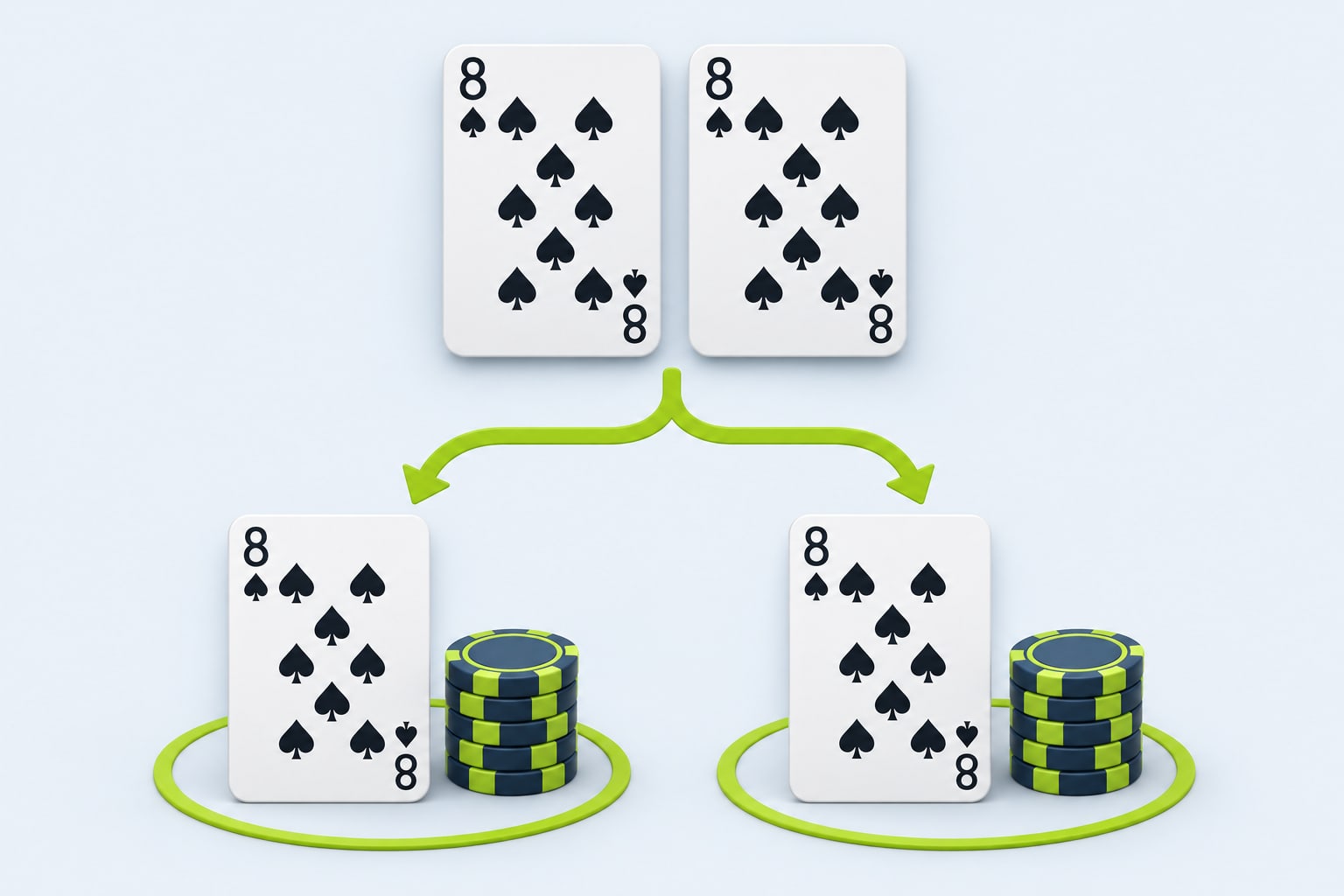
A split is available only when the cards and rules make the original hand eligible. Two eights are a familiar example: instead of continuing with a total of 16, the player can separate them and start a hand from each eight. Each new hand then receives another card. The hands are played and settled separately against the dealer, so one may win while the other loses or pushes.
Eligibility is not the same as a recommendation to split. A game may allow an action that basic strategy does not recommend in a particular situation. Also distinguish matching ranks from matching blackjack values. Tens, jacks, queens and kings all count ten, but the rules determine whether different ten-valued ranks can be split together. Check the game's own description if a pair-looking combination does not activate the split control.
Visual explanation
Splitting adds a second stake
Illustrative $10 blackjack hand split into two $10 hands.
Original pair: $10 committed
Hand A
$10
One eight starts the first hand.
Hand B
$10 more
The other eight starts a new hand.
Total committed after splitting = $20
Each hand settles separately. Further splits or doubles can add more money where allowed. Split-ace and blackjack-payout rules vary. See blackjack.
Following the money through a split
With an original $12 bet, a conventional split adds another $12, producing two $12 hands and $24 at risk before any further actions. Suppose the first hand wins at even money and the second loses. The winner returns $24 including its stake; the loser returns nothing. Against the $24 committed, the net result is zero. That is two separate settlements, not a push on both hands.
If the first hand wins and the second pushes, the combined return is $36: $24 from the winning hand and $12 from the pushed hand. The net profit is $12. If both lose, the loss is $24. Additional doubles or permitted resplits change these amounts. Write down the stake for each hand before comparing the final credit with the opening balance, especially when a game groups several settlements into one history entry.
Resplitting and doubling after a split
A new matching card may create another opportunity to split. This is called resplitting, and the rules normally limit the number of resulting hands. Each extra hand generally requires another stake. A rule allowing doubling after splitting lets an eligible split hand receive a further wager and one final card. The abbreviation DAS describes that permission; it does not mean every split hand must or should be doubled.
For example, two $12 hands with one subsequently doubled involve $36 altogether. If both are doubled, the amount becomes $48. These are arithmetic examples, not an instruction to increase a bet. They show why the opening table minimum can understate the possible cost of a complete round. Decide on an affordable total before play, and do not treat money already lost on one hand as a reason to enlarge another.
Split aces have special conditions
Aces commonly have tighter splitting rules than other pairs. A game may give each split ace only one additional card, prohibit another split or limit doubling. An ace followed by a ten-valued card after splitting usually produces an ordinary 21 rather than a natural blackjack. That distinction affects payment and comparisons with the dealer. Read the specific rule instead of assuming every two-card combination totaling 21 earns the advertised blackjack premium.
Another important distinction is the dealer's blackjack procedure. Where the dealer checks before player decisions, a dealer natural is resolved before additional split stakes are committed. Other game formats may reveal a natural later and have specific rules about which wagers are lost or returned. The words European, no hole card or original bets only need to be read in their full game context; they are not interchangeable guarantees about settlement.
Using the right comparison
Pair decisions belong in the pair section of a strategy chart. Treating two eights simply as hard 16 can skip the split option entirely. The correct chart must match the game's rules, including surrender availability and doubling after splitting. A strategy choice compares possible future results; it cannot ensure that two new hands will be stronger than the original hand in the particular round being played.
After a split, keep each hand's cards, decisions and stake distinct. For a payout question, record the round number, split sequence, any resplits or doubles and the dealer's final hand. Bonus terms may also place conditions on additional wagers or exclude blackjack from qualifying play. The fact that splitting is accepted by the game interface does not independently confirm how those stakes are treated under a promotion.