Spanish 21 is a blackjack variant using packs with the four numbered tens removed while retaining jacks, queens and kings. Its altered card composition is paired with special player rules and bonus payouts, which must be checked for the particular version.
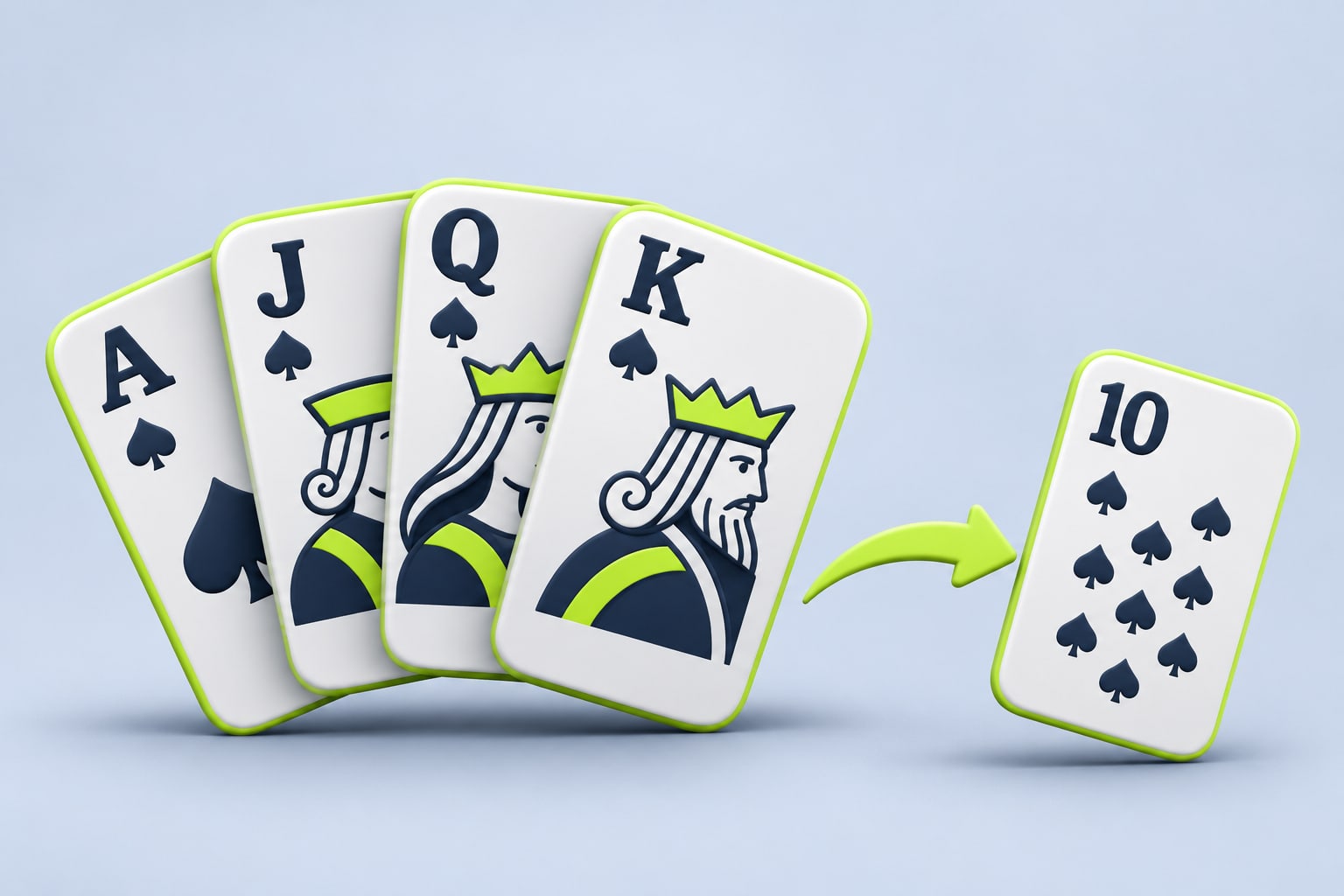
Visual explainer
Remove the numbered tens, keep the faces
One standard deck has four cards of each rank. A Spanish 21 pack removes 10♣ 10♦ 10♥ 10♠ while retaining J, Q and K in all four suits.
Standard deck16 ten-value cards
Four 10s + four jacks + four queens + four kings.
Spanish pack12 ten-value cards
Four jacks + four queens + four kings. All count as 10; numbered tens are absent.
Six packs: 6 × 48 = 288 cards, compared with 6 × 52 = 312 cards in six standard decks.
Pack composition is only one difference. Bonus payouts, doubling, rescue and settlement rules vary by version. Use rules and strategy for the specific Spanish 21 game. Related: Blackjack · Single or Double Decks.
The missing tens change the pack
A standard Spanish pack for this game contains 48 cards: the numbered ten of each suit is removed from a normal 52-card pack. Jacks, queens and kings remain and still count as ten points. It is therefore inaccurate to say that Spanish 21 contains no ten-value cards. Aces retain their flexible value, and cards two through nine keep their face values. Multiple packs are normally used, but the permitted count depends on the version and jurisdiction. Six 48-card packs contain 288 cards rather than the 312 cards in six standard decks. That difference affects starting hands and later draws. Treat Spanish 21 as a distinct game, not ordinary blackjack with a decorative name or a different table colour.
Player benefits compensate for the altered composition
Removing numbered tens would, by itself, change the value of conventional blackjack. Spanish 21 therefore includes additional player-friendly provisions, but their exact combination matters. The rules can include favourable treatment of player blackjack, special wins on 21, flexible doubling and surrender or rescue options. Do not compress all of this into the statement that every player 21 always beats everything. A dealer's original blackjack and a player's later multi-card 21 may have specific priority rules. For example, the cited New York rules distinguish those outcomes and state that a multi-card player 21 loses to dealer blackjack. A generic description found elsewhere may reflect a different implementation. Read the actual game instructions before relying on any claimed priority or payout.
Bonus hands require precise qualification
Spanish 21 rules commonly contain awards for certain multi-card totals of exactly 21 or particular card combinations. The important word is exactly: a five-card 18 does not automatically qualify merely because five-card 21 has a special payout. Suit, card count, whether the hand was doubled and whether it followed a split can affect eligibility. A combination such as six-seven-eight totals 21, but an advertised award may distinguish mixed suits, a shared suit or a particular suit. Do not add several overlapping payouts unless the paytable explicitly says they accumulate. When explaining a bonus, identify the qualifying cards, the eligible wager and any exclusions together. A headline multiplier without those conditions gives an incomplete account of what a player can actually receive.
Doubling and rescue are separate decisions
Some Spanish 21 versions permit doubles in situations where ordinary blackjack would not, and may offer a rescue option after a double. Rescue is not simply another name for ordinary two-card surrender. It concerns a wager that has already been increased and a hand that has already received an additional card. The amount forfeited and the amount returned depend on the specific rule and any permitted repeated doubles. A player who knows only standard blackjack should read that sequence carefully before acting. An available button can create a substantially larger total commitment than the opening stake suggests. Compare the final combined wager with the session limit, and never assume that a rescue option makes the original or added money risk-free.
Comparing versions and reading results
Use a strategy specifically designed for the Spanish 21 rules being played. An ordinary blackjack chart assumes a different card population and can omit the value of qualifying bonus hands. Record the pack count, dealer soft-17 policy, doubling limits, split rules, surrender timing, rescue conditions and complete payout table. Optional side bets must be assessed separately from the main game's return. For a disputed result, retain all cards in order and note whether the hand was split or doubled, since those details can determine bonus eligibility. The game name alone is not enough to establish a payout. Favourable individual features do not guarantee a profitable session; the combined rules and decisions determine theoretical return, while actual results remain variable and can include substantial losses.