A soft double down is a blackjack double made on an eligible hand with an ace counted as 11. The player adds a permitted wager and normally receives exactly one further card, after which the hand must stand.
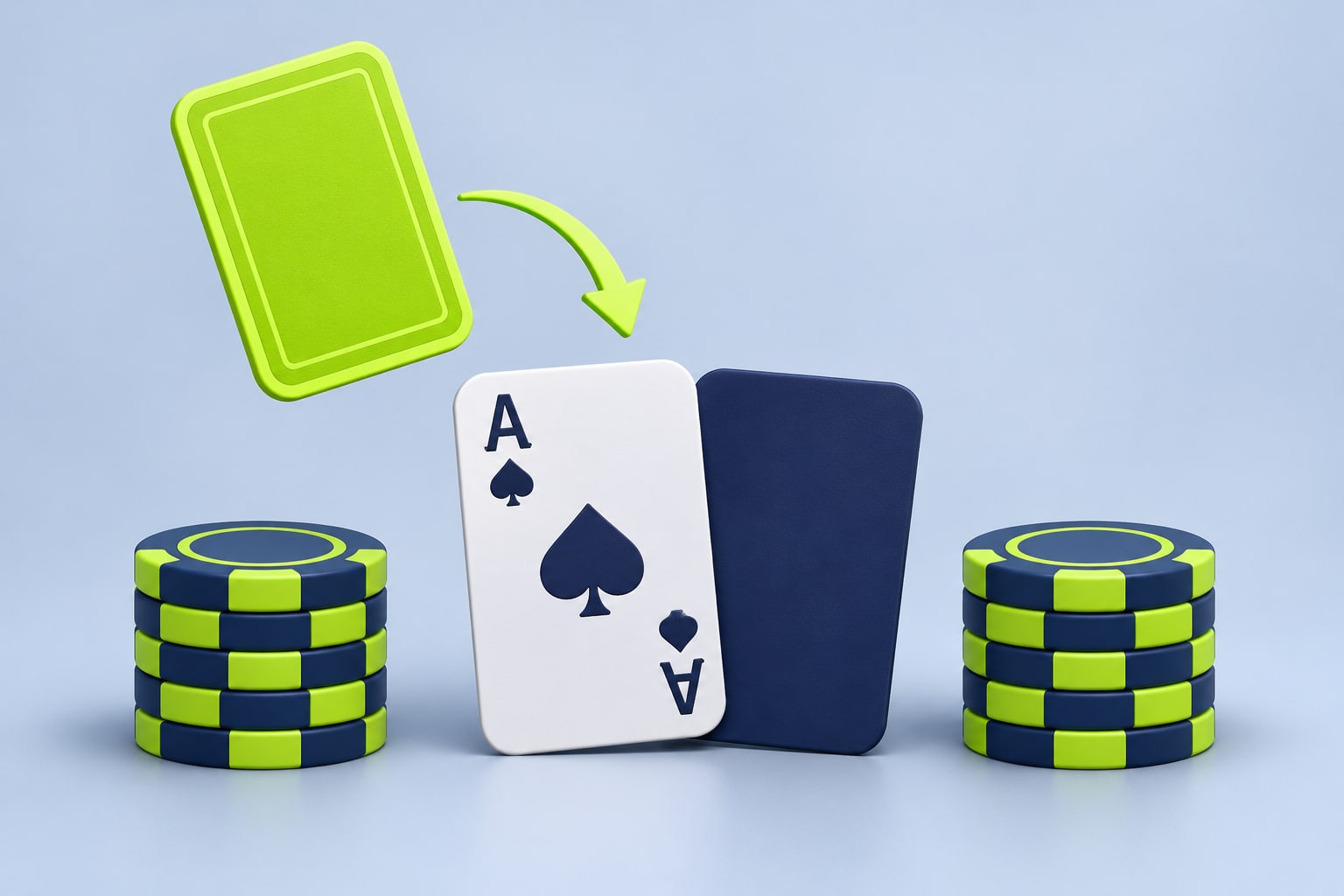
KeyToCasinos • Visual explainer
Soft double: the ace can still count as 1
Example of a hand total after a permitted double; this does not recommend doubling the starting hand.
Stake example
$10 → $20
A full double adds a wager equal to the original stake.
After the draw
Stand on 16
The ace counts as 1. Under normal double-down rules, no further card is available.
Which soft hands should double depends on the dealer upcard and exact rules. Related: Basic strategy · Hard hand.
What makes the starting hand soft
A hand is soft when an ace can count as 11 without making the total exceed 21. Ace-five is soft 16, and ace-seven is soft 18. A hand merely containing an ace is not necessarily soft: ace-eight-six is hard 15 because the ace must count as 1. A soft double therefore describes the starting hand at the time of the decision, not necessarily the final hand after the draw. The ace provides flexibility if a large card arrives, but it does not guarantee a strong result. Also distinguish the point total from the number of cards. A soft total assembled with three cards may be ineligible for doubling at a table that permits doubles only on the initial two cards.
Adding money and accepting one card
A normal double adds an amount equal to the original stake, although some games permit doubling for less. If the original bet is $10 and the player adds $10, the final hand has $20 at risk. The player then receives one card and cannot keep hitting under ordinary double-down rules. With ace-six, drawing a four makes 21. Drawing a ten makes hard 17, because the ace is reduced to 1. Drawing a two makes 19. These outcomes all come from the same starting soft 17 but have different prospects against the dealer. The decision purchases greater exposure on the hand while giving up further drawing choices; it is not simply a free way to obtain one extra card.
Why a safe draw can still leave risk
A soft hand cannot bust on its next single draw because its ace can change from 11 to 1. That fact makes soft doubling easier to understand, but safety from immediate busting is only one part of the decision. Ace-two plus a ten finishes at hard 13, a weak standing total. A player who merely hit that starting hand could ordinarily draw again, whereas a player who doubled is normally finished. The dealer can still beat a non-busted total, and the doubled wager can still be lost in full. Compare the expected outcome of doubling with hitting or standing under the actual rules. Do not use the statement that an ace is flexible as a substitute for that comparison.
Rules that change the correct choice
Some tables allow doubling on any initial total; others restrict it to particular hard totals and therefore do not offer soft doubles. Whether the dealer hits or stands on soft 17 also matters, as do deck count and the handling of dealer blackjack. A chart for a stand-on-soft-17 game can differ from one for a hit-on-soft-17 game. Split hands introduce another restriction: doubling after splits may be allowed generally while split aces still receive only one card with no double option. Read the table's full combination of rules before relying on a chart. When the preferred double is not permitted, follow the chart's stated alternative rather than guessing that standing is always the replacement for a soft double.
Reading the result and managing exposure
An ordinary winning $20 doubled hand produces $20 profit and returns the $20 stake, for $40 in total. A push returns the $20 without profit; a loss costs the full $20, subject to any specific dealer-blackjack protection. The original $10 bet alone is therefore not an adequate record of the money exposed. A soft double that produces a disappointing total was not necessarily a bad decision, just as a successful double was not necessarily a sound one. Judge the action from the information available before the final card. Keep enough room within a chosen spending limit for potential doubles, or start with a smaller stake. Never treat the availability of a mathematically preferred action as an obligation to exceed that limit. The amount committed matters as much as the displayed hand total.