A positive expectation game or situation has a mathematical average net return above zero for the player under specified assumptions. It can still produce losses, including substantial short-term losses.
Visual explainer
Positive expectation can coexist with frequent losses
Hypothetical one-unit wager: a 40% chance of 2 units net profit, otherwise a 60% chance of losing the unit.
Winning outcome40%
0.40 × 2 units profit = +0.80 weighted contribution.
Losing outcome60%
0.60 × −1 unit = −0.60 weighted contribution.
Expected net per wager
+0.20
+0.80 − 0.60 = +0.20 unit.
Chance of a loss
60%
A positive average does not prevent a losing individual wager.
The probabilities and payouts are invented to explain EV. They are not an available casino offer or a guaranteed result. Related: Expected Value or EV · Volatility.
What positive expectation measures
Positive expectation means that the probability-weighted average of all possible net outcomes is greater than zero for the player. It is a statement about a defined mathematical situation, not a guarantee about the next bet or a particular session. The calculation needs accurate probabilities, payouts, costs and assumptions about decisions. If any of those inputs change, the conclusion can change too. A game title alone is rarely enough to establish an advantage because different versions can have different rules and paytables. Always ask what exact wager or strategy is being evaluated and whether the quoted result includes every material condition and cost.
A simple hypothetical calculation
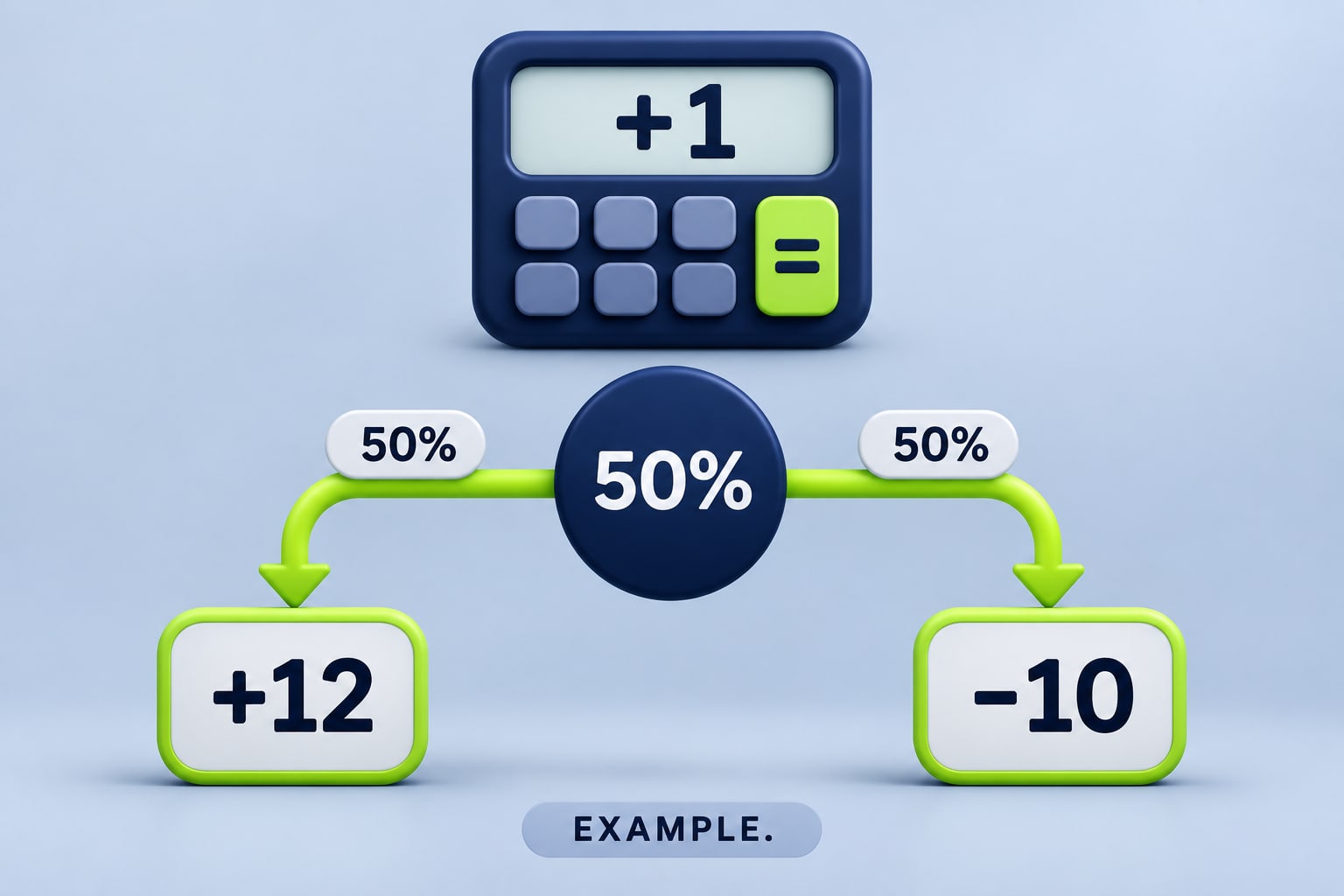
Imagine a wager with two equally likely outcomes: a net profit of twelve dollars or a net loss of ten dollars. Its expected value is one half of twelve minus one half of ten, which equals a positive one dollar per wager. The figures are net outcomes, so the original stake should not be added again to the winning profit. This example is an arithmetic illustration, not an offer or a claim that such a casino bet is available. It also shows why a positive average can coexist with frequent losses: half of the individual bets in the example still have a losing outcome.
A winning record does not prove an edge
A player can finish ahead in a negative-expectation game through ordinary variation, just as a player can lose in a favorable situation. Ten or twenty observed results cannot establish the underlying probabilities simply because the balance increased. A claimed advantage should be based on the game's actual rules or a well-supported model, with uncertainty made explicit. Selectively reporting winning sessions while omitting losing ones creates a distorted picture. Likewise, a large payout does not show that the chance of receiving it was high enough to make the wager favorable. Profit already realized and expected profit before a wager are different concepts.
Strategy and paytable assumptions
Some video poker analyses show theoretical returns above 100 percent for particular paytables with specified optimal decisions and stake conditions. That does not mean every version of the named game offers the same return or that a casual strategy achieves the published figure. Errors, altered awards, fees or ineligible stakes can reduce the result. A return figure should identify the complete paytable and calculation assumptions. An advertised bonus also needs separate analysis: wagering requirements, restricted games, cashout caps and other terms can change its value. A headline amount or multiplier is not sufficient evidence that the full offer produces positive expected value for a particular player.
Variance and resources still matter
Positive expectation does not remove the possibility of a long losing run or exhausting the money available to play. In the hypothetical equal-probability example, several consecutive ten-dollar losses remain possible even though the average value per bet is positive. Real games can have much more uneven distributions, with a small number of rare payouts contributing heavily to the theoretical average. A player might never experience the long-run pattern within an affordable period of play. Consider the size of possible losses, the uncertainty of the estimate and the spending limit independently of the positive sign in a calculation. Borrowing or chasing is not justified by a theoretical edge.
Claims that deserve scrutiny
Changing stake sizes after wins or losses does not by itself turn an independent house-edge game into a positive-expectation one. A progression changes exposure and the distribution of session results, while the underlying wager remains governed by its probabilities and payouts. Similarly, stopping after a win does not retroactively make earlier bets favorable. When evaluating a claim, request the precise rules, probability model, net payouts and complete assumptions rather than a list of selected successful sessions. Treat unknown inputs as unknown. Positive expectation is a useful mathematical description when established carefully, but it should never be used as shorthand for safe income, inevitable recovery or permission to exceed a limit.
Related glossary terms
Sources and further reading
- Antonym:
- Negative Expectation