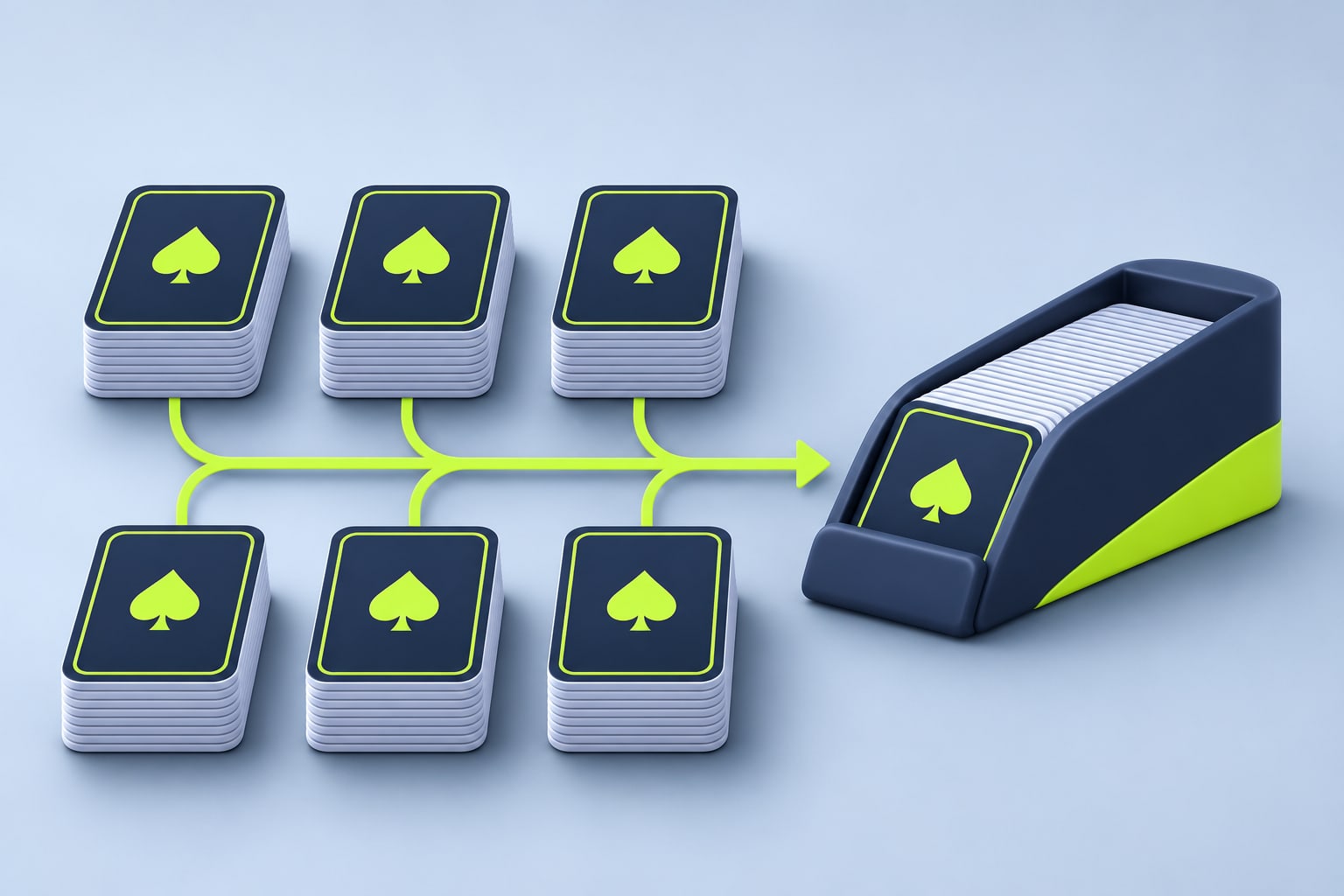
Multiple-deck blackjack uses two or more packs of cards in the game's dealing pool. Deck count affects card composition and probabilities, but it must be assessed alongside payout rules, dealer actions and the way cards are shuffled or replaced.
What is being multiplied
A conventional blackjack deck contains 52 cards, so six standard decks contain 312 and eight contain 416 before any cards are removed from play. The same rank and suit can appear more than once because each pack supplies another copy. Two identical queens of hearts in one round are therefore possible in a multiple-deck game and are not, by themselves, evidence of an error. A modified variant may use a different pack size, however. Spanish 21 commonly removes the four numbered tens from each pack, leaving 48 cards per deck while retaining jacks, queens and kings. Always establish both the number of packs and their composition. The phrase six decks alone does not completely describe a game that uses a nonstandard set of cards.
Deck count is separate from dealing equipment
Multiple decks are often held in a shoe, but the shoe itself does not tell you the exact number of packs or how they are shuffled. An automatic shuffler can prepare a new pack while the current one is being dealt. A continuous shuffling machine can return used cards to the dealing pool during play according to its operating process. These arrangements have different implications for whether past exposed cards describe a steadily shrinking shoe. Digital blackjack can also model several decks while reshuffling virtually at a defined interval. Read the game rules instead of inferring the model from an animation. A picture of a deep shoe, a shuffle sound or a fast dealer does not establish the actual card replacement procedure.
How removing cards changes proportions
Suppose a single ace has been dealt from a fresh standard deck. Three aces remain among 51 cards. If it was dealt from a fresh six-deck shoe, 23 aces remain among 311 cards. Those fractions differ even though both games started with the same ace proportion. The example shows why finite deck count affects conditional probabilities. It does not mean that a particular next card can be predicted. Other exposed cards must also be included when analysing a real round. The effect of one removed card is generally diluted in a larger pool, but exact strategy still depends on the rules and information available. A full mathematical comparison considers all possible starting hands and subsequent decisions, not just one selected rank.
Why fewer decks is not a complete recommendation
Under otherwise comparable conventional blackjack rules and appropriate play, reducing deck count is generally favourable to the player. However, casinos rarely differ in only one feature. A two-deck game paying 6 to 5 for blackjack can be less attractive than a multi-deck game paying 3 to 2, despite its smaller pack count. Dealer soft-17 policy, surrender, doubling restrictions and splitting permissions also matter. Avoid assigning one universal house edge to all six-deck or all double-deck tables. Any published return should identify the complete rules and the assumed strategy. Side bets need their own calculation because duplicate-card opportunities and paytables can change with deck count. The main game's return does not automatically describe the combined cost of optional wagers.
What to record when comparing games
Record the deck count, pack composition, shuffle method, blackjack payout, dealer drawing rule and available player actions. For a live table, distinguish the number of decks loaded from the proportion actually dealt before the next shuffle. For an online game, check whether cards persist between rounds and whether the displayed rules apply to the specific version being opened. If a review cannot establish one of these facts, leave it unknown rather than guessing from the interface. Multiple decks do not make a game inherently unfair, and a smaller pack does not guarantee good results. The practical aim is to understand the model behind the probabilities. Set spending and time limits independently of deck count, since even favourable rules still permit losing hands and losing sessions.