A horn high bet is a five-unit craps combination covering 2, 3, 11 and 12 on the next roll, with two units on one chosen number and one unit on each of the other three.
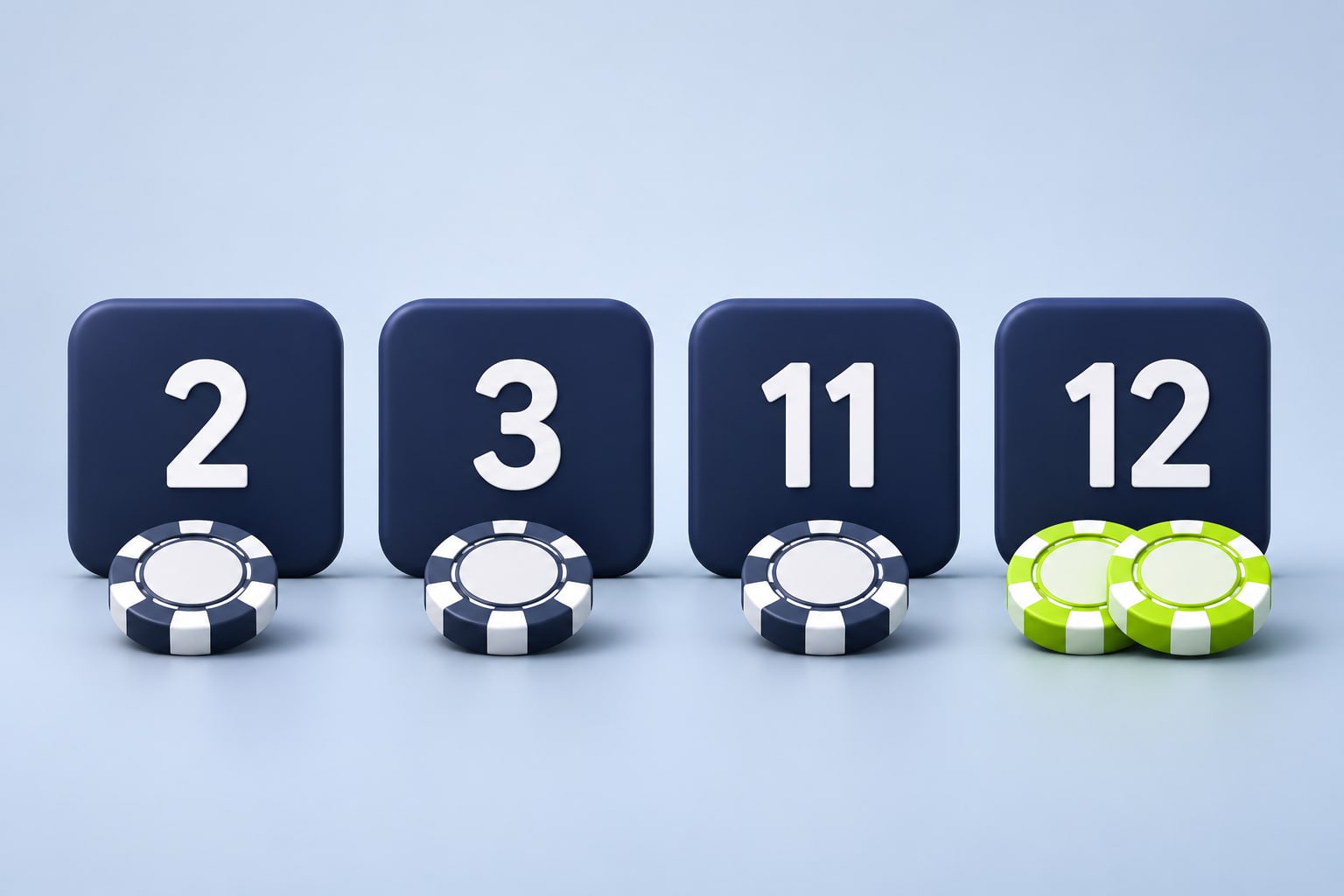
Visual explainer
Horn high twelve: one doubled component
Illustrative 5-unit wager with 30 to 1 profit on 2 and 12, and 15 to 1 profit on 3 and 11.
12 rolls
+57 units net
2 rolls
+26 units net
3 or 11 rolls
+11 units net
Any other total
−5 units net
One roll settles the complete combination. These are net results across all components; confirm the table’s actual payouts. Related: Craps · Paytable.
What high means here
High identifies the horn number receiving the extra unit. It does not mean betting on all large dice totals. A horn high twelve consists of one unit each on two, three and eleven, plus two units on twelve. A horn high three puts the doubled portion on three instead. Five units make the allocation straightforward, although a table's denomination and minimums determine the accepted amount. A $5 example uses $1 units; a $25 example uses $5 units. Both have the same relative distribution. Specify the favored number clearly so the dealer does not have to infer it from the chip amount.
One roll settles the combination
All four components concern the next roll of two dice. If that roll totals two, three, eleven or twelve, its corresponding component wins while the other three components lose. Any other total loses the entire combination. There is no point to establish and no waiting for a seven to end a continuing contract. This makes horn high different from a place bet or a hardways bet that can remain unresolved across several rolls. If you want the same combination on a later roll, that is another wager, whether you place fresh chips or instruct the dealer to keep an amount working.
Calculating a horn high twelve result
Use an illustrative table paying 30:1 profit on two and twelve, and 15:1 profit on three and eleven. With $5 horn high twelve, a twelve wins $60 on the $2 component while the other $3 loses. The net profit across the complete wager is $57. If two rolls, its $1 component wins $30 while the other $4 loses, giving $26 net profit. If three or eleven rolls, the $15 profit on the winning dollar is reduced by the other $4 lost, leaving $11. These are net profits; returned winning stakes are separate when reconciling the dealer's chip payment.
Why the payout is not the whole story
Two fair six-sided dice have 36 equally likely ordered combinations. Two and twelve each have one combination; three and eleven each have two. That produces six winning combinations out of 36 for any horn high allocation, but the amount won depends on which number appears. Doubling the stake on twelve changes the distribution of payouts without making twelve more likely. It is therefore misleading to compare the highest payout with the full stake and ignore the more common losing outcomes. A rare large payment can coexist with an unfavorable long-run average result.
The cost depends on the favored number
Under the illustrative 30:1 and 15:1 schedule, the individual bets on two and twelve each have a 13.89% house edge, while three and eleven each have an 11.11% edge. Weighting the doubled portion gives approximately 12.78% for horn high two or twelve and 12.22% for horn high three or eleven. These figures refer to the total five-unit stake and assume the stated payouts. A different paytable changes the calculation. The favored number therefore matters to both payout distribution and expected cost, even though the chance that some horn component wins remains the same.
Practical placement and checks
At a physical table, these proposition bets are usually handled by the dealer. State the total amount and the high number, then check that the allocation is acknowledged before the dice are released. In an online version, inspect the selected components or the bet confirmation rather than relying only on a combined button label. Remember that repeating a $5 wager for ten rolls produces $50 of turnover, even if winnings fund some of those bets. Treat the combination as entertainment with a known exposure, not as protection for another wager or a way to make a losing session balance itself.
If a table lists payouts as amounts for one rather than to one, convert the figures carefully: a total return includes the stake, while profit odds exclude it.