An edge is a mathematical advantage, expressed through expected results. It may favour the house or, under specific conditions, a player.
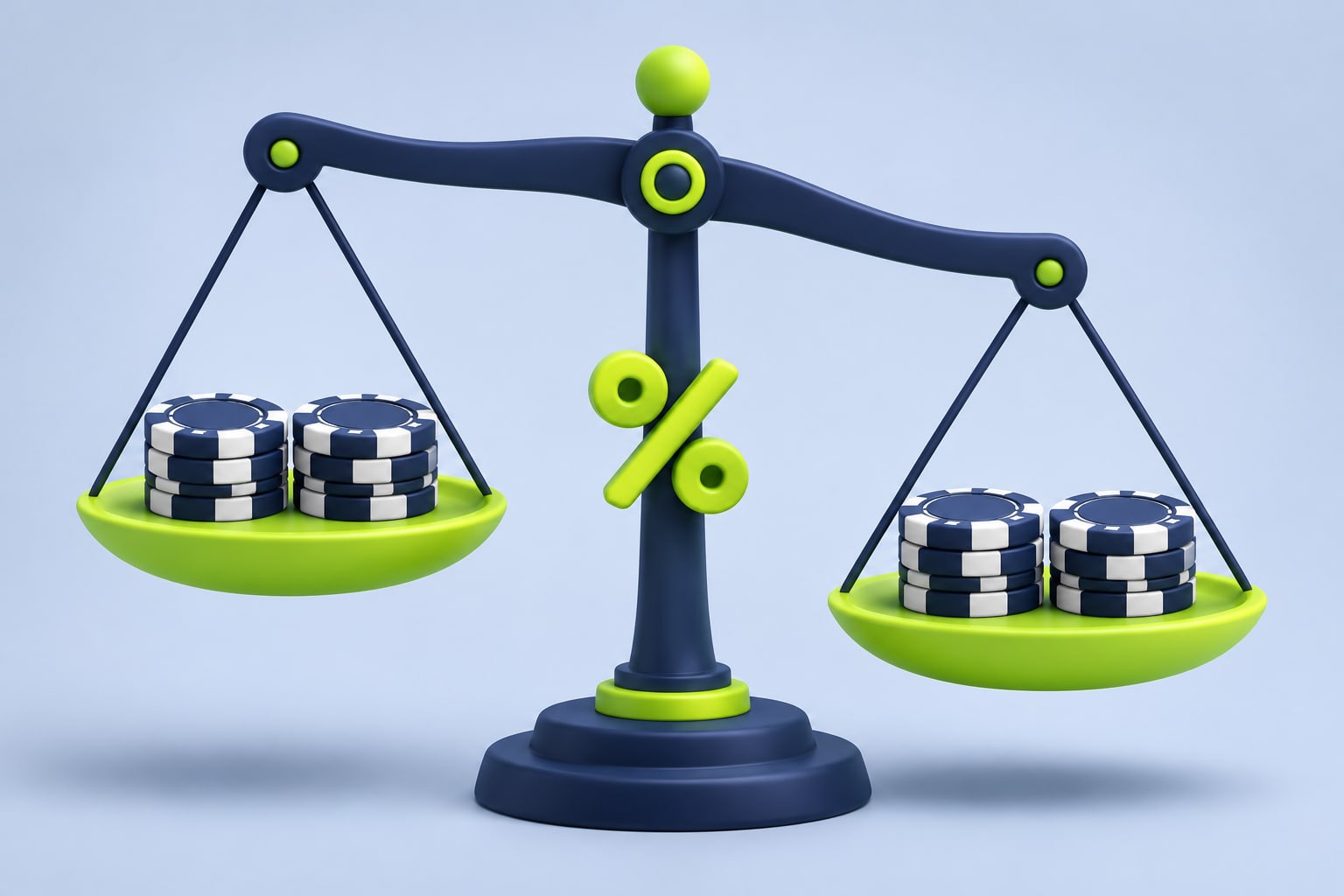
Visual explainer
An edge comes from probabilities and net payouts
Hypothetical one-unit wager: equally likely win and loss, with no additional fees.
Win probability
50%
Winning net profit: +0.90 unit.
Loss probability
50%
Losing net result: −1.00 unit.
Player EV = (0.50 × 0.90) + (0.50 × −1.00) = −0.05 unit per one-unit stake.
Player expectation
House edge
Session results can differ
Winning total return would be 1.90 units: 1 stake returned plus 0.90 profit. Changing this payout changes the edge. Related: Expected Value or EV · House Advantage or House Edge.
The mathematical meaning
An edge is an advantage in the expected result of a wager or game. A house edge favours the casino; a player edge favours the player under the conditions being analysed. The term concerns the average implied by probabilities and payouts, not who is currently winning. A player can be ahead after a short session despite facing a house edge, and can lose while holding a genuine positive expectation. When someone claims an edge, ask what calculation supports it and which rules, costs and decisions it assumes. Without those details, the word may describe confidence rather than a measurable advantage. The size of the stake must also be clear when translating a percentage into an expected monetary amount.
A simple example
Imagine a hypothetical one-unit bet with a 50 percent chance of earning one unit of profit and a 50 percent chance of losing the stake. Its expected profit is zero before any fee. Now suppose the winning profit is reduced to 0.90 units. Half of 0.90 minus half of one equals minus 0.05 units, giving the house a five-percent edge relative to the one-unit stake. The chance of winning remains 50 percent; the reduced payoff creates the disadvantage. This example shows why win frequency alone is not enough to establish whether a game favours the player.
Choosing the correct denominator
A percentage edge needs a defined base. Casino references often express house edge against the initial wager, but some comparisons use total money staked when later betting decisions are possible. Those measures can differ. Do not compare percentages blindly if one calculation includes extra wagers and another does not. Similarly, a five-percent edge on 100 units of cumulative wagers implies an expected loss of five units under the stated assumptions, not an automatic five-unit deduction from a deposit. Money can be wagered repeatedly during a session. The total action, the initial balance and the final result are separate quantities.
Expectation is not a session forecast
Expected results describe a probability-weighted average, while actual outcomes vary. A small edge can coexist with large short-term swings, especially when a game has infrequent large awards. Increasing the number of bets does not guarantee a particular player’s recovery after losses. If the expectation is negative, further wagering adds further expected loss rather than creating a repayment schedule. Even where an advantage is positive, uncertainty and finite funds remain important. The useful distinction is between a supported long-run calculation and the range of results that may occur over the amount of play someone actually undertakes.
Conditions can change the conclusion
Rules, payout schedules, fees and player decisions can all affect an edge calculation. In blackjack, for example, an analysis depends on the rules and strategy assumptions rather than the game name alone. A claimed promotional advantage may also depend on eligibility, withdrawal restrictions and the cost of satisfying terms. Missing one relevant condition can change the result. A historical calculation is not proof that the same opportunity exists in a current game. Verify the inputs before relying on a percentage, and distinguish an independently supported mathematical estimate from a sales claim, a winning anecdote or a pattern noticed in recent results.
What does not create an edge
A lucky streak, a preferred time of day or a plan to raise stakes after losses does not by itself establish favourable probabilities or payouts. Likewise, feeling more familiar with a game is different from demonstrating a mathematical advantage. If a method claims to beat a casino, identify exactly what changes the expectation and whether the evidence matches the current rules. Do not use the word edge as a reason to abandon spending limits. Its value is analytical: it helps explain who benefits from the wager’s structure. It does not make gambling a dependable source of income or remove the possibility of losing the money at risk.