Double Up is an optional video-poker gamble that risks some or all of a settled win for a larger return. Rules vary, including card-comparison or colour choices, tie handling, maximum stakes and repeat limits.
A new risk after a winning hand
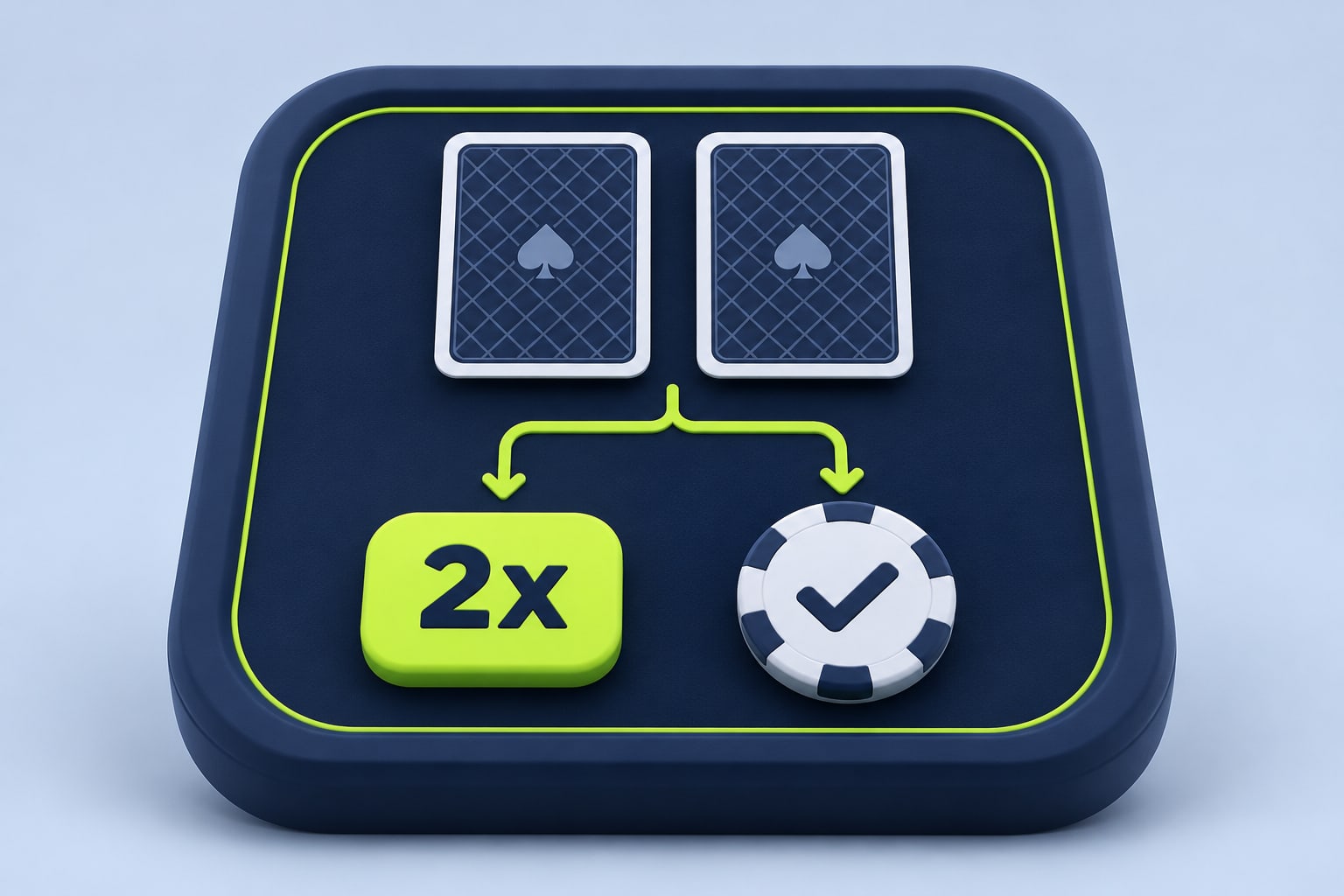
Double Up is an optional feature offered by some video-poker games after a paying result. Instead of collecting the available return, the player risks a stated amount in a separate gamble for a chance to increase it. A common version compares a chosen hidden card with a displayed dealer card, while other versions use colour choices or different mechanics. The name does not establish one universal rule set. Read how much is being risked, what counts as a win and whether the feature can be repeated. The amount offered for collection already has value; risking it is a fresh decision, not a free opportunity.
Separate the original hand from the gamble
The video-poker hand has already reached its payout category before the optional gamble begins. Choosing Double Up does not improve the held cards or change whether the original hand was a pair, flush or royal flush. It changes what happens to the resulting award. Suppose a game offers 20 units for collection and allows all 20 to be gambled for 40. A successful gamble increases that amount by 20; a losing gamble forfeits the 20 at risk. If only part of the win is selected, the unrisked portion may be retained under the rules. Confirm the exact amount rather than assuming the feature always uses the same share.
Read card ranks and tie rules
In a card-comparison version, establish whether aces are high or low, which card is revealed first, how the player's card is selected and what happens on equal ranks. A tie might push, require another selection or be handled differently under the game's specific rules. Some versions offer more than one risk option with different rewards. An attractive multiplier is not enough to determine value without the associated winning probability and treatment of ties. Do not assume every higher-card screen offers a mathematically fair gamble. The complete mechanism must be understood before a return percentage or expected value can be calculated.
A fair gamble still increases uncertainty
Consider a hypothetical option with an exact 50% chance of doubling the amount at risk and a 50% chance of losing it. Its expected return equals the amount staked, so the additional gamble has zero house edge in that simplified model. It nevertheless replaces a certain collectible amount with two uncertain outcomes. Repeating the gamble makes the possible swings larger and increases the chance of losing the entire amount being risked. This example is not a claim about every Double Up implementation. A fair optional gamble also does not erase the expected loss incurred in the underlying video-poker game before the win occurred.
Limits and bonus conditions matter
A game can cap the amount eligible for Double Up, the maximum possible award or the number of consecutive attempts. Promotional balances may be subject to additional restrictions, and an optional gamble may not count toward wagering requirements in the same way as the base game. Check those conditions before using bonus-related winnings. The feature's display should make clear whether the amount shown is the new total return or the extra profit. If a connection interruption occurs, inspect the recorded game history and balance before retrying. An incomplete animation does not necessarily mean that the gamble was cancelled or that the previous award remains available.
Collecting is a complete decision
Declining Double Up preserves the amount offered for collection under the game's rules and is not a failure to finish the hand. The option can be skipped regardless of how recently a previous gamble won or lost. A run of low cards or wrong colours does not make the next result owed to the player. Decide whether any additional risk fits the session budget and your tolerance for losing the collected amount. Avoid treating winnings as less real than deposited funds. Once money or cashable credits can be collected, gambling them again carries the same practical consequence as risking other money you own.