Chameleon strategy is an informal roulette label for copying another player’s wagers, often after noticing that player winning; copying alone does not change the wheel probabilities or create an advantage.
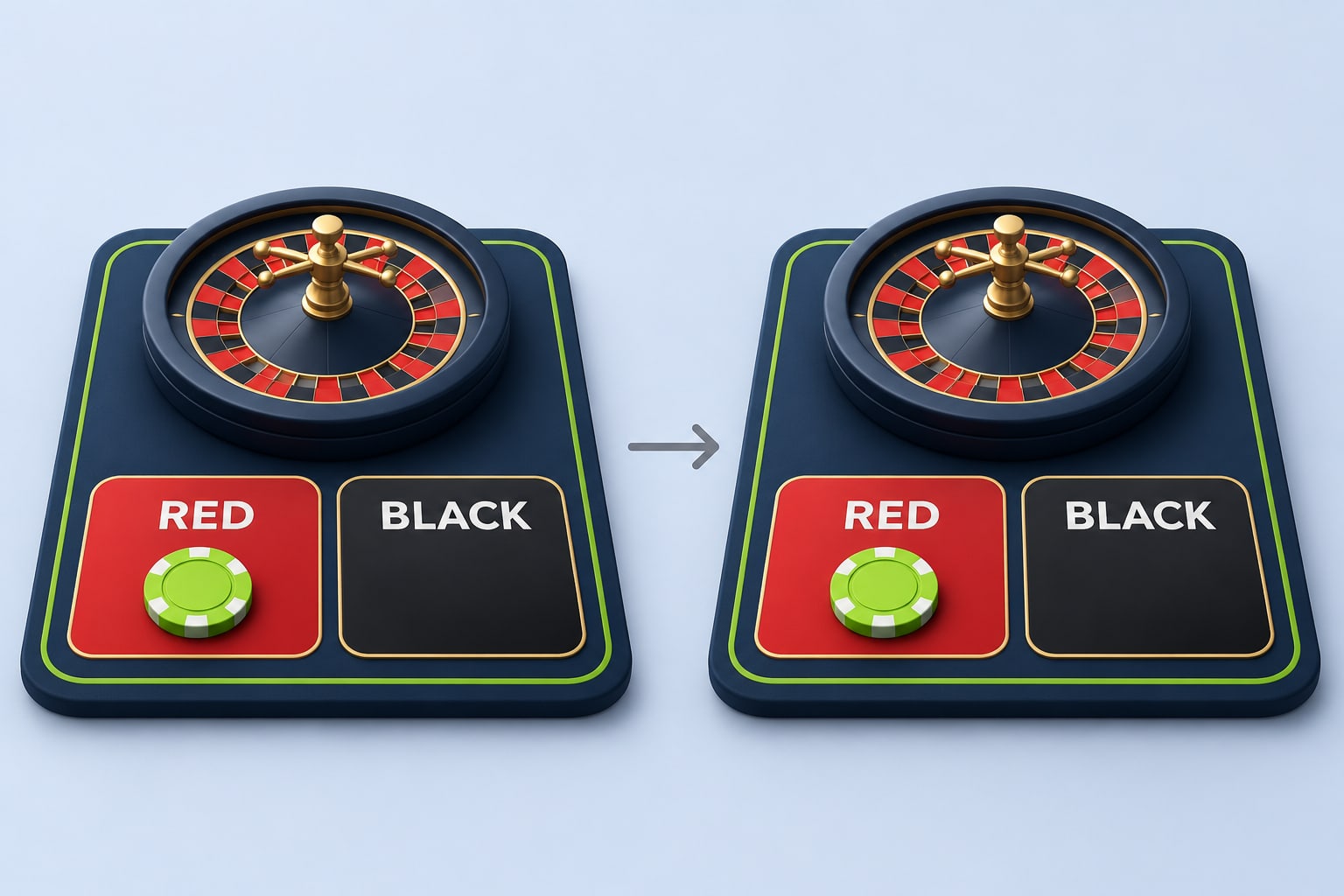
Visual explainer
Copying a winner does not change the wheel
Illustrative single-zero roulette: one 10-unit bet on red, standard 1 to 1 profit, with zero losing.
Choose red yourself
A win earns 10 units profit; any other pocket loses 10.
Copy someone betting red
The same 10-unit win or loss applies.
Expected net result per bet: (18/37 × 10) − (19/37 × 10) = −10/37, about −0.27 unit. Copying the selection leaves this calculation unchanged.
An observed winning streak does not supply evidence that the next independent spin is predictable. Related: European Roulette · House Advantage or House Edge.
What the label describes
A chameleon approach imitates another roulette player's betting choices instead of selecting wagers independently. A person might copy the same colour, numbers or stake pattern after seeing that player collect several payments. Coat-tail betting is a related expression. This is an informal description rather than one standardised system with a universally defined staking sequence. Different accounts may use the name for different kinds of copying. Before analysing it, identify exactly what is being copied: selected pockets, stake amounts, changes after wins or losses, or only occasional bets. Without that detail, a claim about the strategy's results cannot be evaluated meaningfully.
Copying changes choices, not the wheel
On an ordinary fair roulette wheel, another player's previous success does not alter the probability of the next pocket. Copying a red wager still covers the same eighteen red numbers as any other red wager under that game's rules. Copying a straight-up number still covers that one number. The source of the selection does not change the payout schedule or remove the zero pockets. If both players make the same bet on the same spin, their outcomes are linked because they depend on the same result. Sharing a result with another player is different from improving the expected return of the wager itself.
A simple copying example
Suppose one player stakes two units on red and another copies with one unit on red. A red result pays each at the applicable red-bet rate, while a losing result affects each according to their own stake. The second player has chosen a smaller exposure but has not changed the chance of red occurring. If the first player later switches to a number bet and the second follows, the copied wager now has a different hit frequency and payout. That change comes from the wager's coverage, not from the identity of the player being followed. Track the actual contracts and amounts rather than attributing their properties to the copying method.
Why observing winners can mislead
A person noticed after several wins has already been selected because of those favourable results. That observation may omit earlier losses, other losing wagers on the same spins or sessions you did not see. A payment collected from one chip is not necessarily net profit across the player's entire betting layout. Without a complete record of stakes and returns, even the description winning player can be uncertain. More fundamentally, a short run of success does not demonstrate a repeatable advantage on a fair wheel. Evaluate evidence over the relevant full sample rather than treating a memorable streak or confident table manner as proof that future selections will work.
Staking patterns can increase exposure
Following someone else's stake increases can move the copied wager beyond your own intended budget. The other player may have different resources, limits or reasons for playing, and those details may be unknown. A progression that raises bets after losses does not remove the house edge and can require much larger amounts than the initial wager suggests. If the copied pattern spreads chips across many areas, calculate the total cost of the spin rather than looking only at a small individual chip. Multiple bets can also overlap. Understanding the full exposure is necessary even when the original decision was simply to imitate another person's arrangement.
A clear way to assess the idea
Describe the method plainly as copying wagers, then compare the selected bets using their actual probabilities, payouts and total stakes. No special advantage should be claimed merely because the copied player recently won. If someone proposes an additional source of advantage, that separate claim needs its own evidence and conditions; the chameleon label does not establish it. Keep any gambling within limits chosen independently of other players' behaviour, and do not continue to recover a loss or avoid feeling left out of a group. The term can help explain a social betting habit, but it should not be presented as a predictive method or a reliable route to profit.
Related glossary terms
Sources and further reading
- Synonym:
- Coat-tail