Buy-your-pay, also called buy-a-pay, describes a slot structure in which additional credits activate additional paying combinations or awards. It changes qualification, rather than simply multiplying every payout by the same factor.
Visual explainer
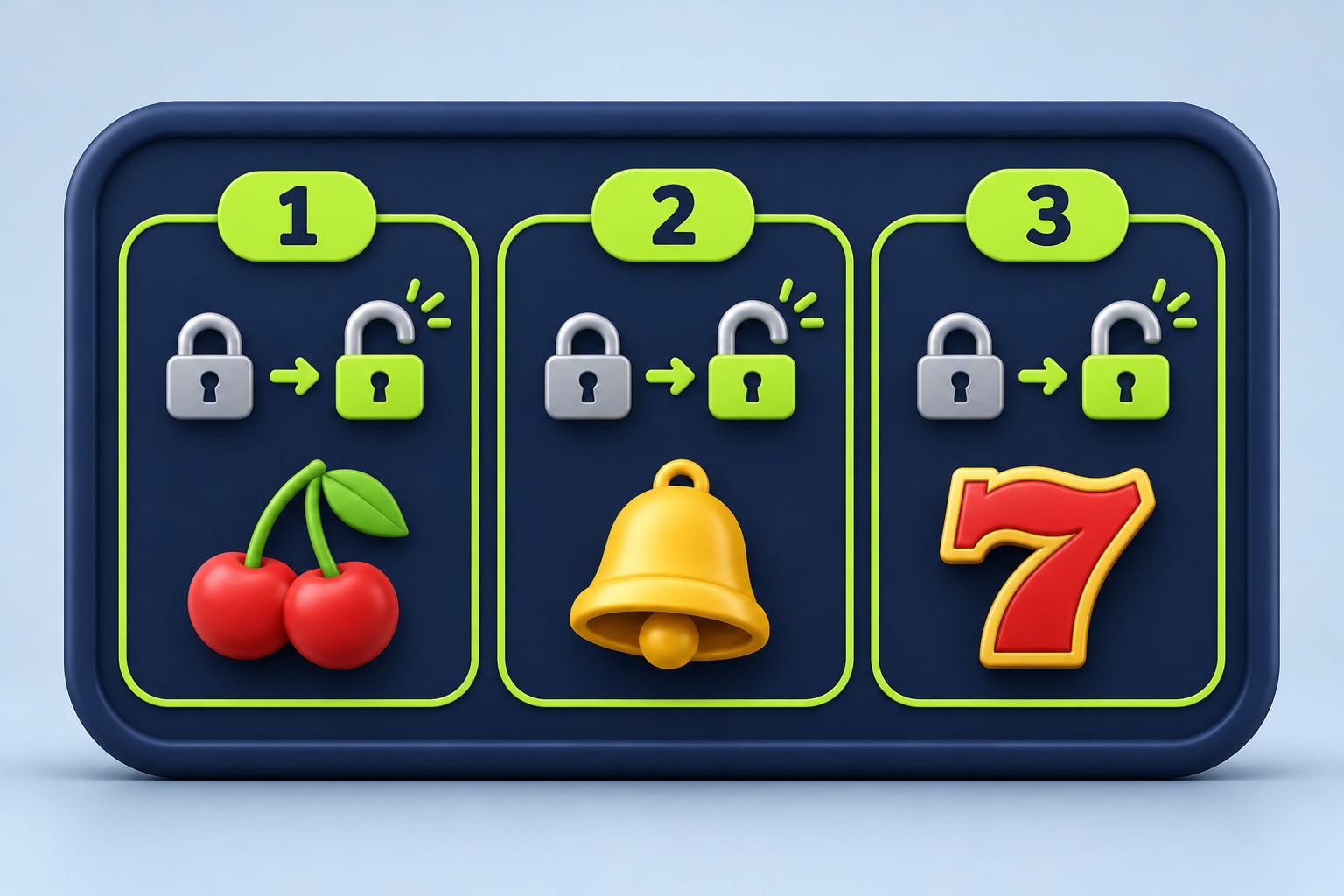
More credits can unlock different awards
Fictional buy-your-pay example. Each credit costs 0.25 units, and each tier retains the qualifying combinations from the tier below.
1 credit
0.25 units
Specified BAR combinations qualify.
2 credits
0.50 units
BAR combinations + an additional bell combination qualify.
3 credits
0.75 units
BAR and bell combinations + a top-symbol combination qualify.
A top-symbol result could be nonpaying at one credit but qualify at three. This is an eligibility change, not merely multiplying every award by three.
These are invented tiers for explanation, not a commercial paytable. More eligible awards alone do not establish better expected value. Buy-your-pay is distinct from purchasing a bonus feature. Related: Paytable · Bonus Buy.
Additional credits can unlock awards
Buy-your-pay is an older slot term also commonly written buy-a-pay. It describes a game in which the number of credits wagered determines which paying combinations or awards are available. Adding credits can therefore change qualification rather than merely increasing every award in proportion to the stake. The exact design is game-specific. A player should read the paytable columns and any explanatory notes to establish what each credit level activates. The term is about the wager structure; it does not mean buying a guaranteed win, purchasing a casino bonus balance or paying a fee after a winning result has already occurred.
A simplified example of the structure
Imagine a hypothetical single-line machine with three credit levels. At one credit, a stated group of bar combinations qualifies for payment. At two credits, an additional bell combination becomes eligible. At three credits, a separate top-symbol combination is also covered. This is an illustration of the concept, not a description of a particular commercial game. A top-symbol result at the one-credit setting could therefore be nonpaying even though it would qualify at three credits. The decisive question is what the actual paytable says for the selected wager, rather than what the same symbols would have paid under a different setting.
Different from a simple multiplier schedule
On a proportional multiplier schedule, increasing the wager may multiply the payout for the same qualifying combination. For example, a ten-credit award at one unit might become twenty credits at two units if the schedule scales directly. A buy-your-pay structure instead adds or changes qualifying awards, although a real game can combine several mechanisms. Do not infer the structure just because the table has several columns. Compare the entries across those columns and identify both the combinations that qualify and the amounts attached to them. A blank or unavailable entry can be as important as a larger number elsewhere in the table.
Total cost and denomination still apply
The credit count must be converted into a currency stake using the denomination and any other wager components. Three credits at 0.25 per credit cost 0.75 on a simple single-line game. If the interface also has multiple lines or an optional feature charge, the complete cost may require additional components. Use the final total displayed by the game. A description such as one more credit can make an increase sound trivial, but repeated over many spins it adds real turnover. Qualification for an extra award should be considered alongside that extra exposure, not as a benefit obtained without additional cost.
Do not confuse it with a bonus buy
A modern bonus-buy feature usually offers direct entry to a specified feature for a separately stated price. That is not automatically the same mechanism as a traditional buy-a-pay credit schedule. Similarly, selecting more paylines changes which routes are active, while a progressive side wager may have its own qualification rules. Several of these controls can appear together, so the terminology should not replace reading the instructions. If a game uses a familiar phrase in an unusual way, its current rules take priority over an old glossary example. Names alone cannot establish the precise relationship between stake, feature access and award eligibility.
Qualification is not a recommendation to raise the bet
A higher credit level may make an additional prize available without making the overall wager appropriate for the player's budget. Eligibility does not reveal the probability of receiving that prize, and a large top award does not describe the complete return distribution. Check any published return information against the exact setting and version rather than assuming every credit level has the same mathematical characteristics. If the required wager is above a planned limit, the useful conclusion is that the game or setting does not fit that limit. Buy-your-pay explains how a schedule works; it is not an instruction to maximise credits or continue until an unlocked prize appears.