A buy-in is the money exchanged for chips or committed to enter a game or tournament. Minimum and maximum buy-ins, entry fees, rebuys and cash-out rules depend on the particular format.
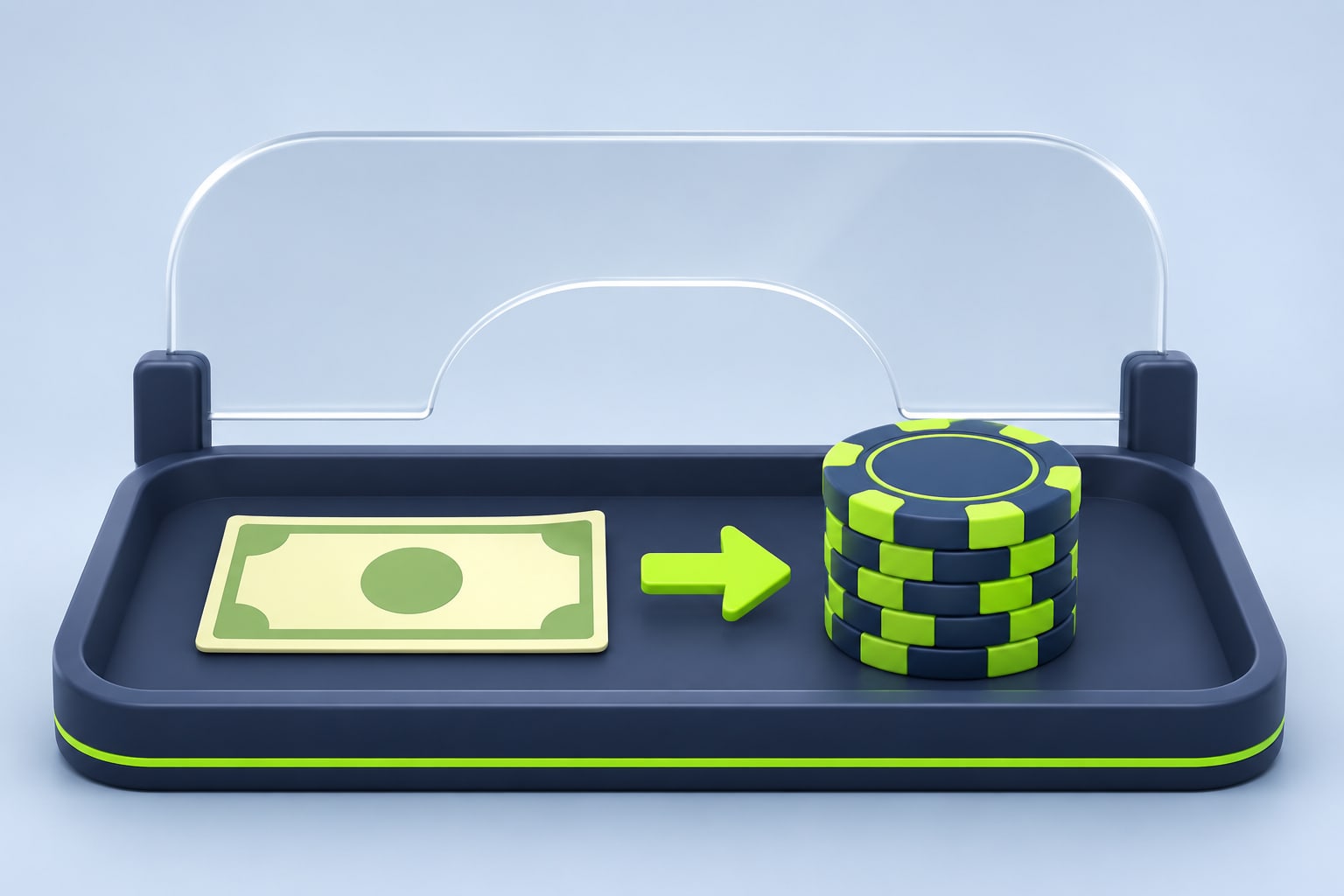
Putting money into the game
Buy-in describes the amount a player brings into a particular game. At a physical casino, it can mean exchanging cash for chips at a table or cashier. In online poker, it commonly means moving part of an account balance into a seat's chip stack. In a tournament, it means paying the stated entry amount. These transactions have different consequences even though the same expression is used. The buy-in is not automatically the amount wagered on the next hand, and it is not evidence that the player has already lost the money. What happens next depends on the game's rules.
Cash games and table limits
A poker cash game may specify a minimum and maximum stack for entering. For example, an illustrative table might permit a buy-in between 40 and 100 big blinds. If the big blind is two currency units, that range would be 80 to 200 units. This is an example, not a universal rule. Other games use fixed entry amounts or different stack restrictions. The table's individual betting limits are a separate issue: they control permissible wagers and raises. Check both the seat-entry requirement and the betting structure before assuming that a small advertised blind makes the whole session inexpensive.
Tournament buy-ins work differently
A tournament usually exchanges the entry payment for a starting stack of tournament chips. Those chips represent progress in the competition and generally cannot be cashed out individually at their displayed face value. Prizes are awarded according to the tournament's finishing or other stated conditions. An entry may be displayed as a contribution to the prize pool plus a separate fee, so read the breakdown rather than treating the headline figure as the entire cost. Re-entry, rebuy and add-on options can create additional spending beyond the initial entry. Availability and deadlines should be stated in the event rules.
An account deposit is a separate step
Depositing money into a casino account does not necessarily buy a seat or enter a tournament. It may simply add funds to an account balance from which several products can be accessed. Conversely, moving existing account funds to a poker table can be a buy-in without any new deposit. This distinction matters when reading promotion terms that refer specifically to deposits, entries or wagers. Do not assume that one action qualifies as another. Also check whether the relevant balance is cash, restricted bonus credit or tournament-only currency, since each can have different withdrawal and wagering conditions.
Track repeated entries and cash-outs
Suppose you buy into a cash game for 100 units, later add another 50 and eventually leave with 120. Your net result is a loss of 30 units, not a gain of 20 based only on the first entry. Keep all top-ups in the calculation. For tournaments, record entry fees and any permitted re-entries alongside the eventual prize. Unused account funds should be separated from money currently committed to play. This simple record makes session spending easier to understand and avoids the common mistake of treating a fresh stack as a fresh budget unrelated to earlier losses.
Questions to settle before entering
Confirm the required amount, what the payment purchases, whether fees are included and whether additional entries are possible. For a cash game, establish the permitted stack range and the process for leaving with remaining chips. For an event, check the starting stack, schedule, prize structure and cancellation terms. A lower buy-in does not by itself mean a safer or better-value game if repeated entries or long sessions increase total spending. Choose an amount within a predetermined entertainment budget, and do not borrow or increase the budget because a previous entry failed to produce the result you wanted.
Ask whether unused tournament chips have any value after elimination; they normally serve as counters rather than redeemable cash balances.